


Struggling with hair extensions losing volume or turning into a tangled mess? Shedding and tangling are two common problems, but they’re not the same. Here’s a quick breakdown:
- Shedding is when hair strands fall out from the weft, leaving extensions thinner and patchy.
- Tangling happens when strands twist together, forming knots that can lead to damage.
Both issues reduce the lifespan and appearance of your extensions, but they have different causes and solutions. Shedding often comes from weak stitching, rough handling, or exposure to harsh products. Choosing high-quality hair, such as Russian or Mongolian extensions, can also impact how well the hair stays attached to the weft. Tangling, on the other hand, is usually caused by dryness, cuticle misalignment, or friction.
To keep your extensions in top shape:
- Use sulphate-free products to prevent shedding.
- Keep extensions hydrated with weekly masks to avoid tangling.
- Brush your extensions gently and avoid sleeping on wet hair.
Want a quick comparison? Check out the table below:
| Issue | Shedding | Tangling |
|---|---|---|
| Cause | Weak wefts, rough handling | Dryness, friction, misaligned cuticles |
| Signs | Hair loss from weft | Knots, frizzy texture |
| Prevention | Sulphate-free shampoo, careful brushing | Hydration, silk pillowcases |
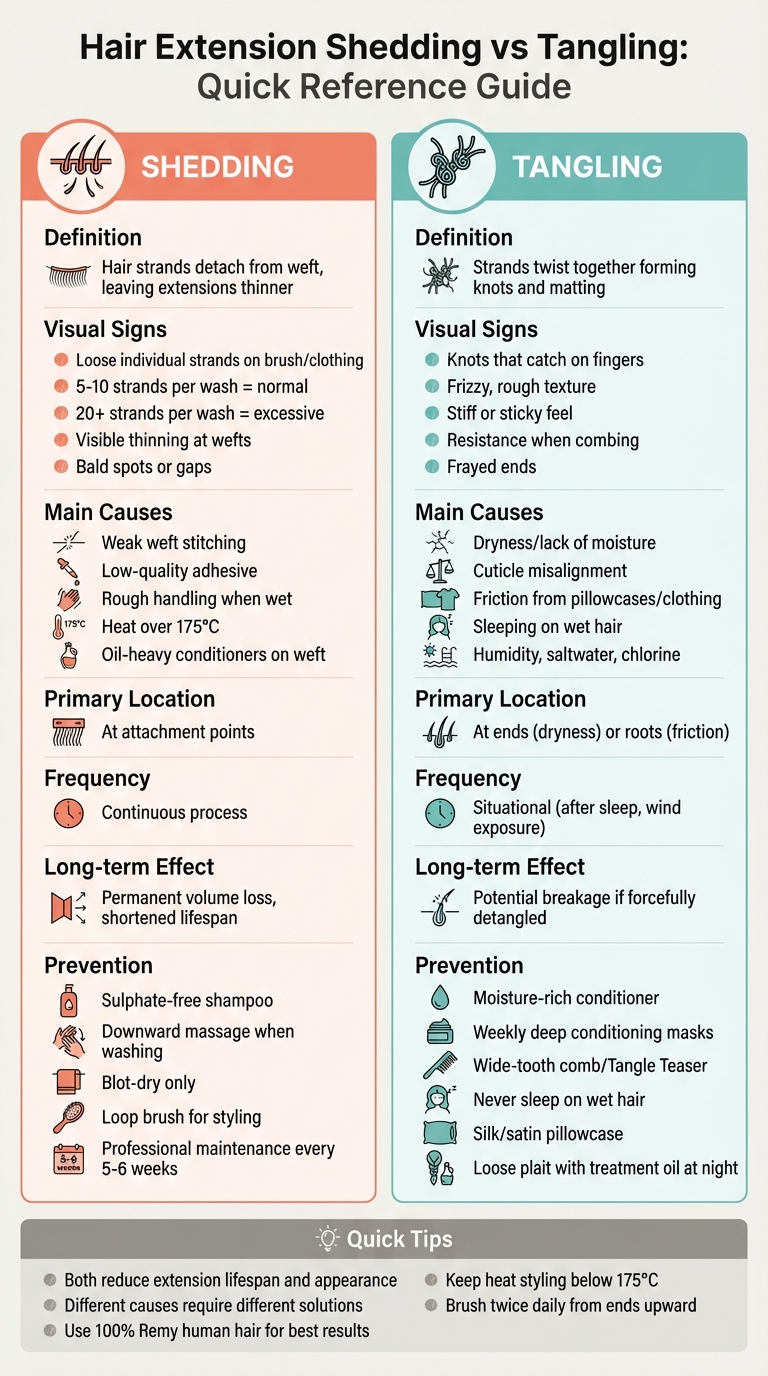
Hair Extension Shedding vs Tangling: Visual Comparison Guide
How to stop your hair extension from shedding
sbb-itb-dcde78e
What is Shedding in Hair Extensions?
Shedding in hair extensions occurs when strands detach from the weft, tape, or bond, leaving the extensions looking thinner and patchy over time. Unlike natural hair shedding - where your body naturally replaces old hair with new growth - this type of shedding happens because of mechanical issues in the extension's construction. When strands come loose, it shortens the lifespan of your extensions and diminishes their appearance and value.
What Causes Shedding
Shedding can stem from several factors, often tied to how the extensions are made or handled. For instance:
- Weak weft stitching or single-weft construction: These may not hold up well under the daily strain of brushing, styling, or general wear.
- Low-quality adhesive in tape-in extensions: This issue worsens when the adhesive is exposed to sulphate or alcohol-based products.
- Rough handling: Wet brushing or aggressive styling can stress the attachment points and cause strands to loosen.
- Heat damage: Using styling tools hotter than 175°C can weaken the weft and degrade the bonds.
- Oil-heavy conditioners: Applying these directly to the weft can make strands slip out.
How to Identify Shedding
Catching shedding early can prevent further damage. Here's what to look for:
- Strand loss during washing: Losing 5–10 strands per wash is normal, but anything over 20 strands signals excessive shedding.
- Loose hair accumulation: Strands on your pillow, clothing, or floor are a red flag.
- Hair caught in brushes or combs: If your styling tools consistently trap excessive hair, it’s worth investigating.
- Drain build-up: Pay attention to how much hair collects in the drain or on your hands while washing your extensions.
- Visible thinning: Check the wefts for bald spots or thinning areas. Following a daily hair extension care routine can help you spot these changes early. If you feel gaps at the attachment points, it might be time to consult a professional stylist.
Next, we’ll dive into tangling - another common issue with its own unique set of challenges and solutions.
What is Tangling in Hair Extensions?
Tangling occurs when strands of hair twist together and form knots, making your extensions hard to manage and less appealing. Unlike shedding - where strands fall away from the weft - tangling involves hair that remains attached but becomes knotted or matted. Hair expert Shakira Dickinson puts it simply:
Tangled extensions look messy and risk damage if knots aren't carefully removed.
When tangling worsens into matting, it creates a dense, compact mass that regular brushing can’t fix, often requiring more effort to resolve.
What Causes Tangling
Tangling is mainly caused by cuticle misalignment and moisture problems. High-quality Remy hair has cuticles that are aligned, allowing strands to glide smoothly. In contrast, lower-quality or synthetic extensions lack this alignment, making them more prone to knotting. Extensions also don’t produce natural oils like your own hair, which makes them more susceptible to dryness and tangling.
External factors can also play a big role. Friction from clothing, cotton pillowcases, or even environmental elements like humidity, saltwater, and chlorine can roughen the cuticle and lead to tangles. Sleeping on wet extensions is another common culprit, as damp strands can twist and knot under the weight and movement of your head during sleep. Improper washing techniques, like rubbing the hair vigorously or using circular motions, can also create snarls at the base.
How to Identify Tangling
Spotting tangling early makes it much easier to manage. Watch for knots that catch on your fingers. You might also notice changes in texture - extensions can feel stiff, dry, or even "sticky" due to product buildup or a lack of moisture. In humid conditions, hair may swell or frizz before knots fully develop. Another red flag is increased friction, especially at the nape of your neck, where tangles often start. If your extensions lose their shine, feel brittle, or the ends appear frayed, tangling is likely underway.
Main Differences Between Shedding and Tangling
How They Look and Feel Different
Shedding and tangling may seem similar at first, but they have distinct characteristics. Shedding appears as loose, individual strands of hair that you’ll find on your brush, clothing, or even the floor. These strands come out smoothly from the base without any resistance, making the process painless and straightforward.
On the other hand, tangling is much more noticeable due to the knots and frizzy texture it creates. When you try to comb through tangled hair, it feels rough, and the brush often catches on clumps of strands. Unlike shedding, the hair doesn’t fall out but instead twists and sticks together, forming stubborn knots.
Where these issues occur also sets them apart. Shedding usually happens at the attachment points, while tangling is more common at the ends - caused by dryness - or near the roots, where friction from pillows or clothing can lead to matting.
How Often They Occur and Their Effects
The frequency and impact of shedding and tangling also differ. Shedding is a continuous process. Losing 5–10 strands during a wash is considered normal, but anything over 20 strands is excessive and could indicate common hair extension problems. Over time, excessive shedding can lead to a noticeable reduction in volume and shorten the lifespan of your extensions.
Tangling, however, is more situational. It often happens after sleeping on wet hair, exposure to wind, or skipping regular brushing. While tangling primarily affects how manageable and presentable your hair looks, severe cases can lead to breakage if you try to forcefully remove the knots , so it is vital to detangle hair extensions without damage.
The table below summarises these differences for a clearer comparison.
Comparison Table
| Feature | Shedding | Tangling |
|---|---|---|
| Visual Appearance | Loose individual strands | Knots; frizzy appearance |
| Tactile Feel | Hair slides out smoothly | Resistance when combing; strands stick together |
| Primary Location | At attachment points | At the ends or near the roots |
| Frequency | Continuous; 5–10 strands normal, 20+ excessive | Situational; after sleep or wind exposure |
| Long-term Effect | Permanent volume loss; shortened lifespan | Potential breakage if not properly detangled |
How to Prevent Shedding and Tangling
Now that you can identify shedding and tangling, let’s dive into how to keep these issues at bay.
How to Prevent Shedding
The first step in preventing shedding is protecting the attachment points. These areas are prone to weakness and stress, so avoid applying conditioners, oils, or heavy serums near bonds or wefts. These products can loosen extensions and cause strands to slip out. When shampooing, focus on the scalp and use a downward massaging motion - scrubbing the bonds can weaken them.
Stick to sulphate-free and alcohol-free products. Sulphates can strip moisture and weaken bonds, while items with protein or keratin may make extensions harder to manage and more likely to shed. After washing, gently blot your hair with a towel instead of rubbing, as friction can pull strands from the weft.
Regular professional maintenance is critical. Schedule touch-ups every 5–6 weeks (or every 4 weeks if you have fine hair). This helps re-section the extensions as your natural hair sheds, ensuring the bonds remain secure and don’t cause damage. For tape extensions, hold off on washing your hair for 48–72 hours after application to allow the adhesive to fully set.
Preventing tangling, on the other hand, requires careful handling and consistent hydration.
How to Prevent Tangling
While protecting bonds addresses shedding, keeping your extensions moisturised is the key to avoiding tangling. Start by detangling your hair with a wide-tooth comb or Tangle Teaser before washing. When your hair is wet, comb gently to avoid breakage. Use a conditioner on the mid-lengths and ends, leaving it on for about 5 minutes. Incorporate a deep treatment mask into your routine once a week to maintain hydration.
"Extensions are 100% Remy European human hair, but they require moisture and care. Avoid products containing: protein, keratin, sulphates, and high alcohol content." - Hair Wonderland
Never sleep on wet hair, as it’s one of the main culprits behind severe matting and tangling. Blow-dry your hair on medium heat (below 175°C), ensuring the roots and bonds are completely dry. Before bed, apply 2–3 pumps of treatment oil and secure your hair in a loose, low plait or ponytail to minimise friction. Sleeping on a silk or satin pillowcase can also reduce tangling by limiting friction overnight.
For a quick overview, check out the comparison table below.
Comparison Table
| Prevention Method | Shedding | Tangling |
|---|---|---|
| Product Choice | Sulphate-free shampoo; alcohol-free formulas | Moisture-rich conditioner; weekly masks |
| Washing Technique | Downward massage at scalp only | Detangle before wetting; gentle combing |
| Drying Method | Blot-dry only | Medium heat; ensure complete dryness |
| Brushing Tool | Loop brush to protect bonds | Wide-tooth comb or Tangle Teaser |
| Night-time Care | Keep oils away from attachment points | Loose plait with treatment oil |
| Professional Care | Re-sectioning every 5–6 weeks | Heat styling below 175°C with protectant |
How to Fix Severe Shedding and Tangling
When preventive measures aren't enough, and you're dealing with significant shedding or tangling, acting quickly can help salvage your extensions - or determine if it's time for a replacement.
Fixing Severe Shedding
If you're experiencing heavy shedding, it's best to consult a professional stylist. They can inspect the attachment points and repair them if needed. This might involve securing loose wefts with stitches or using specialised glue. However, if the wefts remain thin and continue to shed even after repair, it’s likely time to replace them. Persistent shedding often signals that the extensions have reached the end of their useful life.
"Shedding weakens the wefts and shortens the lifespan of your hair extensions, making them less cost-effective in the long run." - Neha Indora
Addressing shedding promptly is crucial, as it directly impacts the longevity of your extensions.
Fixing Severe Tangling
Severe tangling also calls for immediate attention to prevent further damage. Start by applying an alcohol-free detangling spray or leave-in conditioner to the matted areas. Use your fingers to gently work through larger knots, then switch to a wide-tooth comb or loop brush, combing from the ends upward. Always hold the weft securely while detangling to minimise stress on the bonds.
For dense matting that resists these efforts, you might need a professional detangling service. Alternatively, a weekly deep conditioning mask can sometimes help restore manageability before considering replacement. However, if the hair remains sticky, brittle, or frizzy despite these treatments, the cuticles are likely too damaged to recover. In such cases, upgrading to 100% Remy human hair - with its aligned cuticles - can reduce tangling caused by friction, which is common in lower-quality extensions.
Why Premium Double-Drawn Extensions Reduce Both Problems
Benefits of Double-Drawn Extensions
Double-drawn extensions solve the issues of shedding and tangling by focusing on their construction. Unlike single-drawn vs double-drawn hair extensions, where the former contains strands of varying lengths, double-drawn options are crafted to have consistent thickness from root to tip, thanks to the manual removal of shorter hairs. This results in a blunt-cut finish that not only looks better but also lasts longer.
With this structure, shedding is reduced by up to 80% compared to single-drawn options. High-quality double-drawn extensions typically lose only 5–10 strands per wash. Additionally, the reinforced stitching in premium double-drawn wefts undergoes tension testing to ensure they can handle daily brushing and heat styling without losing strands.
Another key feature is the alignment of cuticles in 100% Remy human hair. Proper cuticle alignment ensures all strands face the same direction, significantly lowering friction and preventing tangling. Non-Remy hair, on the other hand, often has reversed cuticles, leading to matting caused by friction. Furthermore, double-drawn hair retains its thickness over time, avoiding the thin, stringy look that can trigger tangling as extensions age. These thoughtful design elements highlight why double-drawn extensions stand out in quality and performance.
Hair Wonderland's Quality Standards
Hair Wonderland takes these principles to the next level with its expertly designed extensions. Developed by Lisa, a professional hairstylist with experience working with thousands of hair types, these extensions are crafted to tackle the common issues of shedding and tangling. The seamless wefts are thinner and more durable than traditional stitched options, reducing stress at attachment points - a common area where shedding begins.
Hair Wonderland also offers a complete care system to maintain the quality of its extensions. The Tangle Tamer Brush ($21.95) and Moisture Magic treatment ($39.95) are specifically formulated to combat friction and dryness, two major causes of tangling. With over 1,000 five-star reviews and the endorsement of professional stylists across Australia, the Seamless Set extensions ($499.00 for 22" length) deliver long-lasting durability and require minimal upkeep. Plus, the free colour-matching service ensures a natural blend, reducing the need for excessive styling and extending the life of the extensions.
Conclusion
Shedding and tangling may seem similar, but they are distinct issues that need different solutions. Shedding happens when hair strands fall out of the weft, reducing both the volume and lifespan of your extensions. Tangling, on the other hand, leads to knots and matting, which can permanently damage the fibres if not managed properly. Knowing the difference is key to adopting the right maintenance strategies.
Incorporating a few simple habits into your routine can make a big difference. Brush your extensions twice a day, starting at the ends and working upwards, and opt for sulphate-free products to keep the hair healthy. Sleeping on a silk pillowcase helps minimise friction, while limiting heat styling to twice a week and keeping tool temperatures under 175°C protects the hair from unnecessary damage. These small changes can go a long way in preserving your extensions.
The quality of your extensions is equally important. Using 100% Remy human hair ensures better resistance to friction and overall durability. As Neha Indora explains:
"Shedding weakens the wefts and shortens the lifespan of your hair extensions, making them less cost-effective in the long run."
For example, Hair Wonderland's Seamless Set extensions ($499.00 for 22" length) showcase the importance of quality. Paired with tools like the Tangle Tamer Brush ($21.95), these extensions are designed to combat both shedding and tangling effectively. By choosing high-quality products and committing to a consistent care routine, you can maintain a stunning look for much longer.
FAQs
How can I tell if my extensions are shedding or just breaking?
Hair loss can occur in two main ways: shedding and breaking. While they might seem similar, they’re actually quite different.
Shedding happens when entire strands of hair detach from their roots, often from attachment points like wefts or tapes, leading to gradual thinning over time. On the other hand, breaking involves strands snapping mid-length, leaving behind shorter, uneven pieces.
Here’s how you can tell the difference: If you notice hair falling out during brushing or washing but the strands are still full-length, that’s shedding. However, if your hair feels brittle, has split ends, or you see shorter pieces breaking away, then you’re dealing with breakage.
To manage both, handle your hair gently and steer clear of excessive heat styling to keep it healthy and strong.
What should I do first if my extensions start matting at the nape?
If your extensions begin to tangle or mat at the nape, use a gentle brush to carefully work through the knots. Avoid tugging or pulling too hard, as this can cause damage. Matting is often the result of improper care, so it's important to stick to a consistent haircare routine. Brush your extensions gently and try to minimise friction caused by clothing or pillowcases. If the matting becomes severe, it's best to seek help from a professional who can safely detangle and fix the extensions without risking harm to your natural hair.
How often should I get my extensions maintained to prevent shedding?
Regular upkeep every 6 to 8 weeks is crucial for keeping shedding in check. Scheduling professional check-ups allows any loose strands or attachment issues to be handled promptly. To reduce shedding even further, stick to proper care habits: brush your extensions gently, choose hair care products suited for extensions, and steer clear of excessive heat or harsh chemical treatments. These practices not only help minimise shedding but also prolong the life of your extensions and keep them looking great.