


Heat styling extensions can elevate your look, but it requires extra care to avoid damage. Extensions lack natural scalp oils, making them more prone to dryness and heat-related issues. Here's what you need to know:
- Temperature Matters: Use 120–150°C for most extensions. Premium Remy hair can handle up to 180°C, but synthetic extensions melt above 120°C.
- Preparation Is Key: Always detangle and dry extensions completely before styling. Use a lightweight, alcohol-free heat protectant to shield against damage.
- Tools to Use: Choose ceramic or tourmaline flat irons, curling wands, and ionic blow dryers for even heat distribution and reduced frizz.
- Styling Techniques: Work in small sections, avoid heat near bonds or clips, and let the hair cool before brushing or blending.
- Maintenance Tips: Limit heat styling to twice a week, use silk pillowcases, and wash extensions with sulphate-free products to extend their lifespan.
With proper care, high-quality extensions can stay in great condition for up to 12 months, giving you polished, long-lasting styles.
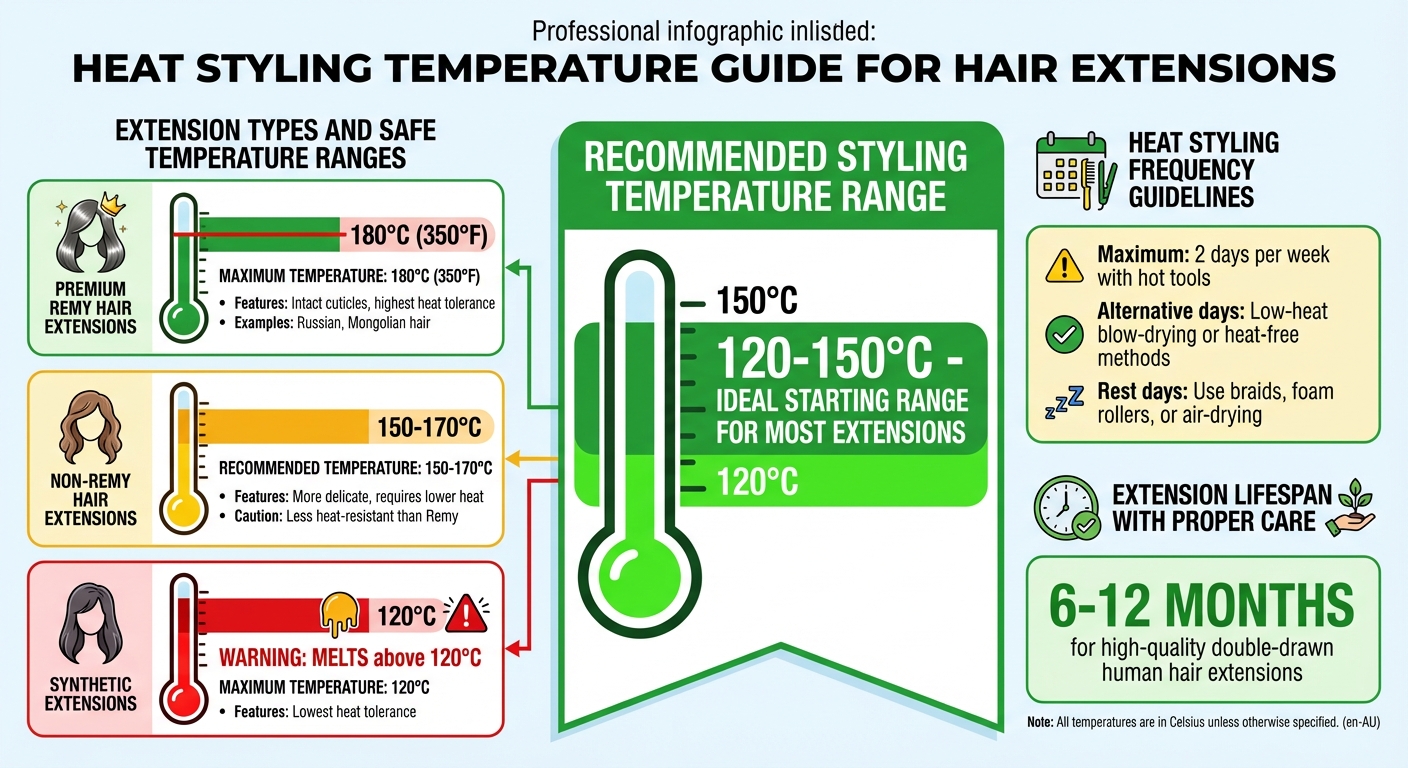
Heat Styling Temperature Guide for Different Hair Extension Types
Do You Let Your Extensions Fully Dry Before Heat Styling?
Preparing Extensions for Heat Styling
Getting your extensions ready for heat styling is key to achieving stunning, damage-free results. Before you grab that curling wand or straightener, it’s essential to understand your extension type, ensure they’re completely dry and tangle-free, and use the right protective products.
Knowing Your Extension Type
The type of extensions you’re working with makes a big difference in how they respond to heat. Premium Remy extensions - like high-quality Russian or Mongolian hair - are better equipped to handle heat compared to non-Remy or synthetic options. Remy hair has intact cuticles, allowing it to withstand temperatures up to 180°C (350°F) without damage. On the other hand, non-Remy hair is more delicate and should be styled at lower temperatures, around 150–170°C, while synthetic extensions can melt if exposed to heat above 120°C.
The way your extensions are attached also matters. Clip-ins, such as Hair Wonderland’s seamless sets, can be removed for easier detangling and styling. Meanwhile, tape-in and weft extensions require extra care to avoid applying heat too close to the bonds or attachment points. Always ensure your extensions are fully dry and detangled before moving on to heat protection.
Detangling and Drying Properly
Heat styling on damp extensions is a big no-no. Moisture trapped inside the hair shaft can turn into steam when exposed to heat, leading to internal damage and breakage. After washing, let your extensions air-dry or use a blow dryer on a cool setting until they’re completely dry.
Once dry, detangle your extensions using a brush designed specifically for extensions. Start at the ends and work your way up in small sections to minimise pulling and breakage. Hair Wonderland offers tools like the Tangle Tamer Brush ($21.95) and The Detangle Brush ($29.95) that are gentle on extensions. If you’re working with clip-ins, remove them before brushing. For tape-ins or wefts, use heat-resistant clips to section the hair and keep everything organised.
Applying Heat Protectant
A lightweight, alcohol-free heat protectant is your best friend when styling extensions. These products create a protective barrier that seals the cuticle, reflects heat, and locks in moisture - essential for extensions, which don’t benefit from natural scalp oils.
Hold the spray about 15–20 centimetres away and apply it evenly, focusing on the mid-lengths and ends where the hair is most prone to damage. Avoid over-saturating the roots, especially near bonds or clips. After applying, comb through the hair to distribute the product evenly and give it a minute or two to absorb before using any heat tools. This simple step can make a huge difference in preserving the look and lifespan of your extensions.
Heat Styling Methods for Extensions
Once your extensions are clean, dry, and prepped with heat protection, it’s time to style them. Whether you’re aiming for sleek straight locks, defined curls, or a voluminous blow-dry, these techniques will help you achieve professional results while keeping your extensions in top condition. Proper preparation and careful heat application are key to maintaining their look and longevity.
How to Straighten Extensions
Straightening extensions requires a gentle approach to avoid damage. Start by setting your flat iron to a temperature between 120–150°C. Always begin at the lower end of the range and increase only if needed. Opt for a flat iron with ceramic or tourmaline plates for even heat distribution, and work on small sections, about 2–5 cm wide, for better control.
Use heat-resistant clips to section your hair, and keep the iron at least 2–3 cm away from bonds, clips, or wefts to avoid exposing these areas to excessive heat. Glide the flat iron smoothly from mid-length to the ends in one continuous motion, holding it for about 8–10 seconds per section. For clip-in extensions, remove them and style each piece on a heat-resistant surface. For permanent extensions, such as tape-ins or hand-tied wefts, keep the iron moving downward and away from the attachment points.
Once straightened, let the hair cool before combing or blending it with your natural hair. To create a seamless look, try the "sandwich" method - straighten your extensions and natural hair together in thin layers.
How to Curl Extensions
Curling extensions is all about precision and consistency. Set your curling iron, wand, or straightener to 120–150°C, and maintain a 2–3 cm distance from attachment points throughout the process. If you’re working with clip-in extensions, remove them and curl each weft individually. For permanent extensions, section off your natural hair and curl only the extension hair.
Take small sections of hair (around 2–3 cm) and wrap them around the curling barrel or use a straightener with a twisting motion. Hold each curl for about 8–10 seconds. Curling irons with clamps create more defined curls, while clampless wands offer softer, more natural waves. For a polished finish, curl the hair away from your face and alternate the direction of the curls as you move upward through the layers.
Allow the curls to cool by holding them briefly or pinning them in place. Once cooled, set the style with a cool shot from your blow dryer or a light mist of hairspray to lock in the curls.
How to Blow-Dry Extensions
Blow-drying extensions requires low heat and constant movement to prevent damage. Make sure your extensions are at least 80–100% dry before styling. Apply a heat protectant, then use a blow dryer fitted with a concentrator nozzle, set to low or medium heat (around 120–150°C). Hold the dryer about 15–20 cm away from your hair and work in sections, directing the airflow downward to smooth the cuticles and minimise frizz.
Use a brush designed for extensions to gently guide the hair while drying. Avoid holding the dryer directly over bonds, clips, or wefts - maintain a 2–3 cm gap from these areas. Once the hair is fully dry, finish with a cool shot to seal the cuticle and boost shine. For extra volume, use a diffuser attachment and lightly scrunch the hair as you dry.
Premium extensions - like Hair Wonderland's double-drawn Russian and Mongolian human hair - are crafted to handle heat up to 180°C when properly prepped. This makes them a great choice for a variety of heat styling techniques while maintaining their natural look and feel.
sbb-itb-dcde78e
Preventing Heat Damage to Extensions
Even with the right techniques, repeated heat exposure can gradually weaken your extensions. The best way to protect them is to stick to safe temperature limits and spot early signs of damage before it's too late. Following strict temperature and usage guidelines is essential for keeping your extensions in good condition.
Temperature and Frequency Guidelines
Start your styling session at a lower temperature - somewhere between 120°C and 150°C - and only increase it if absolutely necessary. For Remy extensions, keep the heat under 180°C, while non-Remy extensions should stay below 170°C. Always aim to use the lowest temperature that gets the job done. To reduce overall heat exposure, limit yourself to one or two smooth passes with your tool per section, instead of repeatedly going over the same area.
Try to keep hot tool use to a maximum of two days a week. For instance, you might fully style your hair with heat twice a week, use low-heat blow-drying on another day or two, and rely on heat-free methods like braids, foam rollers, or air-drying for the rest of the week. On heat-free days, focus on nourishing your extensions with leave-in conditioners or lightweight oils to maintain their strength and elasticity.
Protecting Bonds and Attachment Points
Heat can wreak havoc on clips, tape, keratin bonds, and sewn-in wefts by softening adhesives and distorting keratin, which can cause slippage or premature wear. To avoid this, direct heat toward the mid-lengths and ends of your extensions, steering clear of the bonds. When blow-drying near these sensitive areas, use a cool or low setting and keep the nozzle moving to avoid concentrated heat.
For clip-in extensions, never clamp a flat iron over the metal clips, and be gentle when blow-drying around these areas. If you’re using tape or keratin bonds, apply heat protectant to the lengths of your hair but avoid heavy products on the actual bonds. Heat-resistant clips can also be helpful for sectioning your hair while shielding bonds from direct heat. These steps work hand-in-hand with the heat styling techniques mentioned earlier.
Recognising Heat Damage Early
Signs of heat damage often show up as dryness, a crispy texture, and a loss of shine, particularly along the mid-lengths and ends. Damaged extensions may tangle more easily and lose their curl definition. Unlike product build-up, which can be washed out, heat damage is permanent and tends to worsen with continued styling.
If you notice these warning signs, it’s time to cut back or completely stop heat styling for a while. Switch to heat-free methods while your extensions recover. Add deep conditioning treatments to your routine once or twice a week, use sulphate-free shampoos followed by hydrating conditioners, and apply a leave-in conditioner or lightweight oil to damp hair to restore moisture. If the ends are severely frayed, consider a small trim by a stylist experienced with extensions to prevent further splitting and bring back a smoother appearance.
Maintaining Heat-Styled Extensions
Keeping your heat-styled extensions in top condition requires consistent care. With the right maintenance, you can extend their lifespan and keep your look fresh for longer.
Overnight Care for Styled Extensions
Before heading to bed, gently brush your extensions starting from the ends and working upward using a soft detangling brush. To minimise stress on the bonds and prevent kinks, loosely braid your hair or tie it in a ponytail using a fabric scrunchie - steer clear of tight elastics. Sleeping on a silk or satin pillowcase is a game-changer; it reduces friction, helps maintain curls, and prevents frizz far better than cotton. If you're wearing clip-in extensions, always remove them before sleeping to avoid unnecessary pulling and tangling. And one golden rule: never sleep with wet or damp extensions, as this can lead to matting and strain the attachment points.
Washing and Conditioning Routines
Stick to washing your extensions just once or twice a week to retain essential moisture. Opt for sulphate-free and alcohol-free shampoos, along with lightweight conditioners designed for extensions or colour-treated hair. Before you wash, detangle your hair thoroughly, then cleanse gently in a downward motion - no rough scrubbing! When conditioning, focus only on the mid-lengths and ends to avoid loosening the bonds. Rinse with cool water for a smooth finish, and let your hair air-dry in a loose braid. Between washes, a lightweight serum can refresh your style, and instead of restyling your entire head, re-curl just the face-framing sections for a polished look.
Proper storage after cleaning and conditioning is equally important to keep your extensions looking their best.
Storing Extensions and Maintaining Tools
After using your extensions, brush out any tangles and let them cool completely before storing - this helps set the style and reduces frizz. Store them in their original box, a dedicated hanger, or a breathable bag (like those from Hair Wonderland accessories) to protect them from heat, moisture, and sunlight, which can cause colour fading and dryness. For your styling tools, wipe them down after each use with a soft cloth to remove any product build-up or heat protectant residue. Clean tools with smooth heating surfaces will prevent snags and ensure even styling.
With consistent care, high-quality double-drawn human hair extensions can last anywhere from 6 to 12 months or even longer, depending on how often you wear them and your installation method.
Conclusion
Taking care of your extensions during heat styling is all about thoughtful preparation and mindful techniques. By following a few essential steps, you can keep your extensions looking flawless and extend their lifespan. Start by detangling thoroughly, ensuring they’re completely dry, and applying a heat protectant to create a shield against damage.
Keep your styling temperature between 120–150°C for the best results. Work in small sections, make controlled passes with your styling tools, and avoid placing heat too close to bonds or attachment points. Investing in high-quality tools, such as those with ceramic or tourmaline plates, ensures even heat distribution and minimises the risk of damage.
Since extensions don’t benefit from your scalp’s natural oils, they need extra care. Limit heat styling sessions when possible, and give your extensions a break by incorporating air-drying into your routine. Premium double-drawn human hair extensions, like those from Hair Wonderland, are designed for regular styling when handled gently, but they’ll still last longer with careful treatment.
To keep your extensions in top shape, consider additional care routines like using silk pillowcases overnight, washing with sulphate-free products, and storing them properly when not in use. With these practices, premium double-drawn extensions can stay beautiful for 9–12 months, giving you versatile, salon-quality results that blend seamlessly with your natural hair.
FAQs
What’s the best way to protect my extensions from heat damage during styling?
To protect your extensions while heat styling, start by applying a heat protectant spray - this step is non-negotiable. Keep your styling tools set to a low or medium temperature, ideally no higher than 180°C, to minimise potential damage. Be mindful of how long you expose your extensions to heat and avoid over-styling. When you can, let your extensions have a break from heat altogether to help preserve their natural appearance and extend their lifespan.
What tools should I use to heat style human hair extensions?
For achieving great styles while keeping your extensions in top condition, opt for high-quality ceramic or tourmaline flat irons and curling wands. These tools provide even heat distribution, which helps minimise damage and leaves your hair looking smooth and polished.
Before applying any heat, always use a heat protectant spray. This essential step acts as a barrier against heat damage, preserving the vibrancy of your extensions and extending their lifespan.
How often can I use heat styling tools on my hair extensions without damaging them?
To keep your extensions in top condition, try to limit heat styling to once or twice a week. Excessive use of hot tools can weaken the hair strands and shorten the lifespan of your extensions.
When you do reach for the curling iron or straightener, make sure to apply a heat protectant spray first. Set your tools to a lower temperature - below 180°C is ideal - to reduce the risk of damage while still getting the look you want. A little care and moderation go a long way in preserving the quality and durability of your extensions.