


Hair extensions can transform your look, but maintaining them is a mix of professional salon visits and daily home care. Without proper upkeep, even high-quality extensions can become damaged. Here's what you need to know:
- Salon Care: Stylists ensure extensions are properly adjusted to accommodate hair growth, preventing damage. Costs range from $160 to $850 per visit, with appointments needed every 4–12 weeks depending on your hair extension maintenance planner. Professional care includes repositioning, deep cleaning, and trimming for a polished look.
- Home Care: Daily routines focus on hydration and preventing tangles. Brush extensions gently, wash 2–3 times weekly with sulfate-free products, and apply treatment oils to keep them soft. Avoid heat near bonds and use silk pillowcases to protect hair while sleeping.
- Lifespan: With proper care, human hair extensions can last 9–12 months, while synthetic ones last about a month.
Both methods are essential for keeping extensions looking great and protecting your natural hair. Combining salon expertise with consistent at-home care ensures long-lasting results.
Professional Salon Care: Benefits and Methods
Benefits of Salon Care
When you opt for professional salon care, you're not just paying for a service; you're investing in the health and longevity of your hair extensions. Skilled stylists know how to distribute the weight of extensions evenly across your scalp, which helps prevent follicle tension and breakage. This is especially important when you're spending anywhere between $1,500 and $6,500 on high-quality extensions.
Salons also use top-tier products, including 100% Remy human hair and specialised adhesives designed to minimise irritation. During maintenance appointments, stylists carefully comb through the naturally shed 45 to 98 strands of hair you lose daily. This step is vital to avoid matting and tangling at the roots, which can compromise the look and feel of your extensions.
"A professional extension specialist has the training, experience, and knowledge necessary to apply extensions safely and correctly." - Shakira Dickinson, HairCandy Extensions
Expert stylists also excel at blending extensions seamlessly with your natural hair through precise cutting and layering techniques. Additionally, they can perform deep cleansing treatments to remove product buildup and oils from areas around the attachment points that are tough to clean on your own.
Standard Salon Maintenance Procedures
The type of hair extensions you have determines how often you’ll need to visit the salon. For example:
- Tape-ins: Require repositioning every 4–8 weeks.
- Keratin bonds: Typically need reapplication every 10–12 weeks.
- Weft or hidden bead extensions: Should be reinstalled every 8–12 weeks.
If you have fine hair, you might need to schedule appointments as frequently as every 4 weeks.
During these visits, stylists perform what’s known as "move-ups", where extensions are removed and reapplied closer to the scalp to accommodate hair growth. This process ensures bonds don’t become visible or place undue weight on your natural hair. They also check for common hair extension problems like slippage or damaged beads, which can lead to hair loss if not addressed. To maintain a natural look, ends are trimmed as needed. While professional care offers undeniable advantages, it's worth noting that the associated costs and time commitments should be factored into your decision.
sbb-itb-dcde78e
Professional Salon Care: Drawbacks and Costs
Salon Visit Costs
Maintaining hair extensions through a salon can be a pricey commitment. The initial cost for a full head of extensions ranges from $160 to $3,500, and regular upkeep adds another $160–$850 per session. For fusion extensions, reapplication is required every three to four months, costing between $400 and $800 per session, which could total $2,400–$3,000 annually. Tape-ins, on the other hand, need repositioning every six to eight weeks, costing $150–$400, while micro-bead adjustments can run anywhere from $150 to $800 per session.
"This service [reapplication] costs more than the initial extension procedure, as it takes time to remove, re-bond, and reapply the extensions." - Kate Soloshenko, Hair Expert, I Love Slavic Hair
Beyond appointments, you’ll also need to factor in other costs. Salon-grade products can set you back $100–$200, repairs for damage might cost between $200 and $500, and removal services can range from $50 to $210. Some salons even require you to purchase specific products to maintain warranty coverage. Prices also vary by region, with total costs typically falling between $250 and $2,000, depending on where you’re located.
And it’s not just your wallet that takes a hit - salon care can also demand a lot of your time.
Time and Appointment Constraints
Getting extensions installed is no quick task. Installations typically take 2–5 hours, and maintenance appointments are needed every 4–8 weeks. After each appointment, you might also face a waiting period of up to 48 hours before you can style your hair as usual.
"Most salon methods take 2–5 hours to install, plus regular maintenance appointments every 6–8 weeks. If you're time-poor or want something low-maintenance, this isn't ideal." - Love the Style Hair Extensions
Scheduling appointments around a busy lifestyle can be tricky, especially when juggling work or family commitments. Missing a session isn’t just inconvenient - it can lead to issues like matting, breakage, or even traction alopecia as your natural hair grows out. This makes sticking to a regular schedule essential for keeping your extensions in good shape.
HOW TO: WASH, STYLE, MAINTAIN HAIR EXTENSIONS
Home Hair Extension Care: Benefits and Methods
Salons can work wonders in restoring the structure of hair extensions, but maintaining their look and feel day-to-day? That’s where your at-home care routine comes in. By sticking to a solid routine, you can protect your investment and avoid issues like matting or damage, which can occur in just a couple of months without proper care.
Looking after your extensions at home can also save you money. For instance, clip-in extensions don’t require regular salon visits and, with good care, can last anywhere from one to three years. Even permanent extensions, which do need salon repositioning every few weeks, rely heavily on your daily habits to keep them soft and shiny for their 9–12 month lifespan . Plus, a little effort at home can cut down on your morning prep time, making life that much easier.
Daily Care Routines
Your daily habits play a big role in how long your extensions last. Start each morning by brushing your hair thoroughly with a brush made specifically for extensions. These brushes are gentle on the bonds, reducing the risk of damage. Hold your hair at the roots while brushing and work up from the ends to minimise tension and tangling .
When it comes to washing, less is more - two to three times a week is ideal. Use only sulfate-free and paraben-free shampoos, focusing the shampoo on your scalp and keeping conditioner strictly on the mid-lengths and ends to avoid loosening the bonds . Since extensions don’t benefit from your scalp’s natural oils, it’s a good idea to apply a small amount (1–2 pumps) of treatment oil, like argan oil, to the ends daily to keep them hydrated . If you’re using heat styling tools, always apply a heat protectant spray first, and keep the temperature between 150–175°C to avoid unnecessary damage .
Protective Habits for Longer-Lasting Extensions
It’s not just about what you do during the day - your nighttime routine matters, too. Never go to bed with wet hair. Instead, gently brush it and secure it loosely with a silk or satin scrunchie. Pair that with a silk pillowcase to cut down on friction and prevent tangling while you sleep .
Other tips? Avoid applying heavy hair masks or oils directly to the bonds, as this can weaken the adhesive. Keep heat tools away from the attachment points to prevent melting . If you’re planning to swim, coat your extensions with a leave-in cream beforehand to protect against chlorine or salt water. After swimming, rinse thoroughly and shampoo twice to remove any residue.
Home Hair Extension Care: Common Mistakes
Even with the best intentions, small missteps in your home care routine can drastically cut down the lifespan of your extensions. The upside? Most of these mistakes are easy to avoid once you're aware of them. Let’s dive into some common detangling and product-related errors that could be sabotaging your efforts.
Poor Detangling Mistakes
One of the most common mistakes is brushing your hair from top to bottom. This method puts unnecessary stress on the bonds and can weaken them over time. Instead, always start detangling from the ends and work your way up. Hair expert Kate Soloshenko emphasises:
"Improper combing techniques (from top to bottom instead of from bottom to top) can create excessive tension and weaken keratin bonds".
Another issue is using the wrong type of brush. Regular ball-tip brushes can snag on the extension bonds, causing damage. Swap them out for a brush designed specifically for extensions, like Hair Wonderland's Tangle Tamer Brush ($21.95) .
Sleeping with wet or loose hair is another habit to break. This can lead to tangling and matting around the bonds due to friction. To prevent this, always dry your hair thoroughly before bed and secure it in a loose plait or low ponytail.
Product Misuse Errors
Incorrect product use is another major factor that can shorten the life of your extensions. Applying conditioners or masks directly onto the bonds weakens the adhesive, potentially leading to premature loss. To avoid this, focus conditioning treatments on the mid-lengths and ends only.
Additionally, steer clear of products containing sulfates, protein, keratin, or high levels of alcohol. These ingredients can strip moisture from your extensions, leaving them dry and brittle. Always check product labels and stick to sulfate-free, protein-free options recommended by your stylist.
Heat styling poses another risk. Applying heat directly to the bonds can melt the adhesive and compromise the extensions. Always use a heat protectant spray and keep hot tools away from the attachment points.
Salon vs Home Care: Side-by-Side Comparison
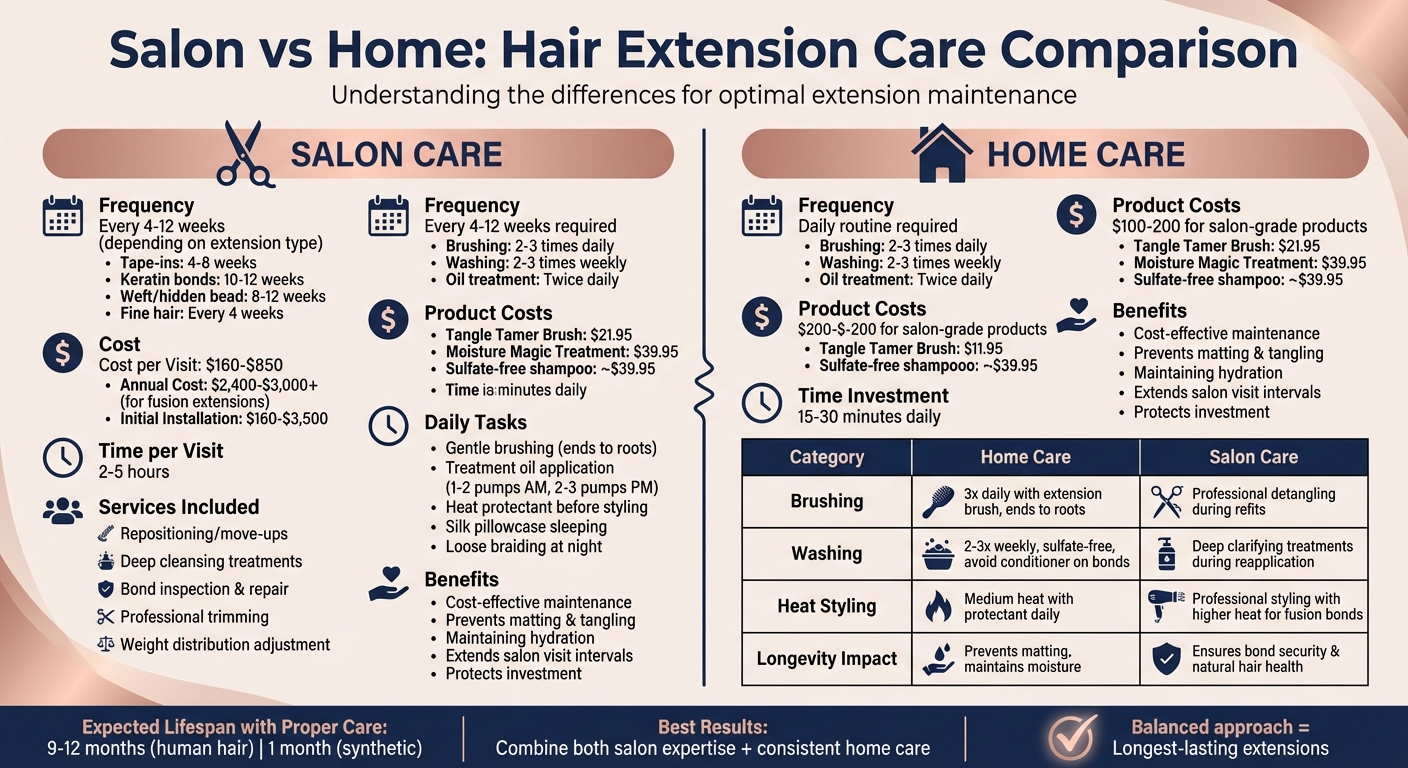
Salon vs Home Hair Extension Care: Complete Comparison Guide
After exploring salon and home care methods in detail, this comparison breaks down their key differences. Salon visits focus on maintaining bond strength and overall hair health, while at-home care routines prioritise hydration and the appearance of your extensions.
Understanding the pros and cons of each method helps you tailor a care routine that suits your lifestyle and budget. Below is a comparison table that outlines the main distinctions between the two approaches.
Comparison Table: Key Care Categories
| Care Category | At‐Home Care | Professional Salon Care |
|---|---|---|
| Brushing | Follow an ultimate guide to brushing hair extensions at least three times daily, starting from the ends and moving up to the roots. | Professionals handle detangling during refits. |
| Washing | Wash two to three times a week, focusing shampoo on the scalp and avoiding conditioner near the bonds. | Includes deep clarifying treatments and thorough scalp cleansing during reapplication sessions. |
| Heat Styling | Use a heat protectant daily and safely heat style hair extensions by keeping heat settings at medium. | Professional styling often involves higher heat settings for fusion bonds. |
| Maintenance Frequency | Requires consistent daily routines, both morning and evening. | Tape-ins need refitting every 4–6 weeks, while keratin bonds last 3–4 months. |
| Cost | More budget-friendly, with products like specialised shampoos ($39.95) and brushes ($21.95). | Costs are higher due to service fees for refitting and professional styling. |
| Longevity Impact | Prevents matting and keeps extensions moisturised between salon visits. | Ensures natural hair health and bond security for extended wear. |
How to Combine Salon and Home Care
Balanced Care Approach
To keep your extensions looking their best, a mix of professional salon visits and consistent at-home care is key. Regular salon appointments, scheduled every 8–12 weeks, address the structural needs of your extensions. During these visits, stylists re-section the extensions to accommodate natural hair growth and shedding, which helps prevent damage caused by over-weighted attachment points. This approach also helps avoid common issues like tangling and improper product use, ensuring your extensions stay secure and your natural hair remains healthy.
In between salon visits, a solid daily routine is just as important. Start by keeping your extensions hydrated - apply a treatment oil twice a day, using 1–2 pumps in the morning and 2–3 pumps at night, focusing on the mid-lengths and ends. Brush your hair at least twice daily with a specialised detangling brush, working from the ends up to the roots to minimise stress on the bonds.
Your salon schedule will depend on the type of extensions you have and your hair's density. Tape-in extensions usually need maintenance every 5–8 weeks, while keratin bonds can last 10–12 weeks. If you have fine hair, you might need to visit the salon more often - about every 4 weeks - to avoid tension-related damage.
At night, protect your hair by securing it in a loose, low plait and using a silk or satin pillowcase to reduce friction. Wash your extensions 2–3 times a week with sulfate-free products, and always blow-dry the bonds or tapes on a medium heat setting to prevent slippage.
Recommended Tools and Products
The right tools and products can make all the difference in maintaining your extensions. Hair Wonderland offers a selection of items tailored for extension care. The Tangle Tamer Brush (AU$21.95) is a must-have, featuring soft bristles that glide through knots without tugging on attachment points. To keep your extensions hydrated, the Moisture Magic Treatment (AU$39.95) is perfect for delivering the moisture that extensions can't naturally retain.
For those using clip-in extensions, the Seamless Set 22" (AU$499.00) is a standout option. Made from 100% Remy European Human Hair with Invisi® weft technology, these extensions blend seamlessly with your natural hair. With proper care and regular maintenance, they can last 9–12 months. To keep them in top condition when not in use, store them in the Clip In Storage Bag (AU$54.00).
Conclusion
Keeping your extensions looking flawless and lasting longer comes down to balancing professional salon care with a consistent at-home routine. Visiting your stylist every 5–6 weeks ensures your extensions are properly maintained and adjusted as your natural hair grows. Meanwhile, daily care - like gentle brushing, applying treatment oils twice a day, and sticking to sulfate-free products - keeps them soft, shiny, and free of tangles.
Because extensions don't benefit from your scalp's natural oils, they depend entirely on the hydration and protection you provide. As Hair Wonderland explains, "Extensions are 100% Remy European human hair, but they require moisture and care".
When cared for properly, quality human hair extensions can last between 9–12 months. Without this balance of professional upkeep and daily attention, you risk issues like matting, dryness, and even damage to your natural hair.
To help you maintain your extensions, Hair Wonderland offers a range of products tailored to your needs, including the Tangle Tamer Brush (AU$21.95) and Moisture Magic Treatment (AU$39.95). For those looking to elevate their look, premium options like the Seamless Set 22" (AU$499.00) are also available. Treat your extensions with the same care and attention as your natural hair, combining expert salon visits with a thoughtful daily routine to keep your style polished and professional.
FAQs
How can I tell if my extensions need a move-up?
When your extensions start to grow out and no longer sit properly with your natural hair, it’s probably time for a move-up - typically needed every 5–6 weeks. One clear sign is when they feel loose or slack. Ignoring this can lead to damage, so regular maintenance is key to keeping both your extensions secure and your natural hair in good condition.
What products should I avoid to prevent bond slippage?
To keep your extensions secure and avoid bond slippage, stay away from products containing proteins, keratin, sulfates, or high levels of alcohol. These ingredients can break down the bonds, causing them to loosen. Make it a habit to read product labels carefully and choose options that are safe for extensions.
What’s the best sleep routine to prevent matting?
To keep your extensions tangle-free, gently detangle them before bed, secure your hair in a loose braid or ponytail, and use a silk or satin pillowcase. These simple steps help reduce friction and keep tangling to a minimum while you sleep.