


Want natural-looking extensions? The secret lies in matching their texture to your hair. When textures align, your extensions blend invisibly, move naturally, and are easier to maintain. Mismatched textures, on the other hand, can reveal the extensions and lead to styling headaches.
Here’s what you need to know:
- Hair Type vs. Texture: Hair type refers to curl patterns (straight, wavy, curly, coily), while texture is about strand thickness (fine, medium, coarse).
- Why Texture Matching Matters: Extensions that mimic your hair's texture ensure a polished look and reduce heat styling needs.
- Choosing Extensions: Russian vs Mongolian hair extensions suit different needs; straight hair often pairs well with lightweight clip-ins, wavy hair needs textured extensions, and curly hair benefits from pattern-specific options like sew-ins.
- Blending Tips: Style natural hair and extensions together, layer extensions for a smooth transition, and match density for natural movement.
- Care Essentials: Use sulphate-free products, detangle gently, and store properly to extend extension life.
Key takeaway: Matching extensions to your hair's texture is the difference between obvious installs and an undetectable finish. Proper care and strategic styling seal the deal.
How To Texture Match Your Hair Extensions
Learning how to blend extensions with natural hair is the first step toward a flawless look.
sbb-itb-dcde78e
How to Identify Your Natural Hair Texture
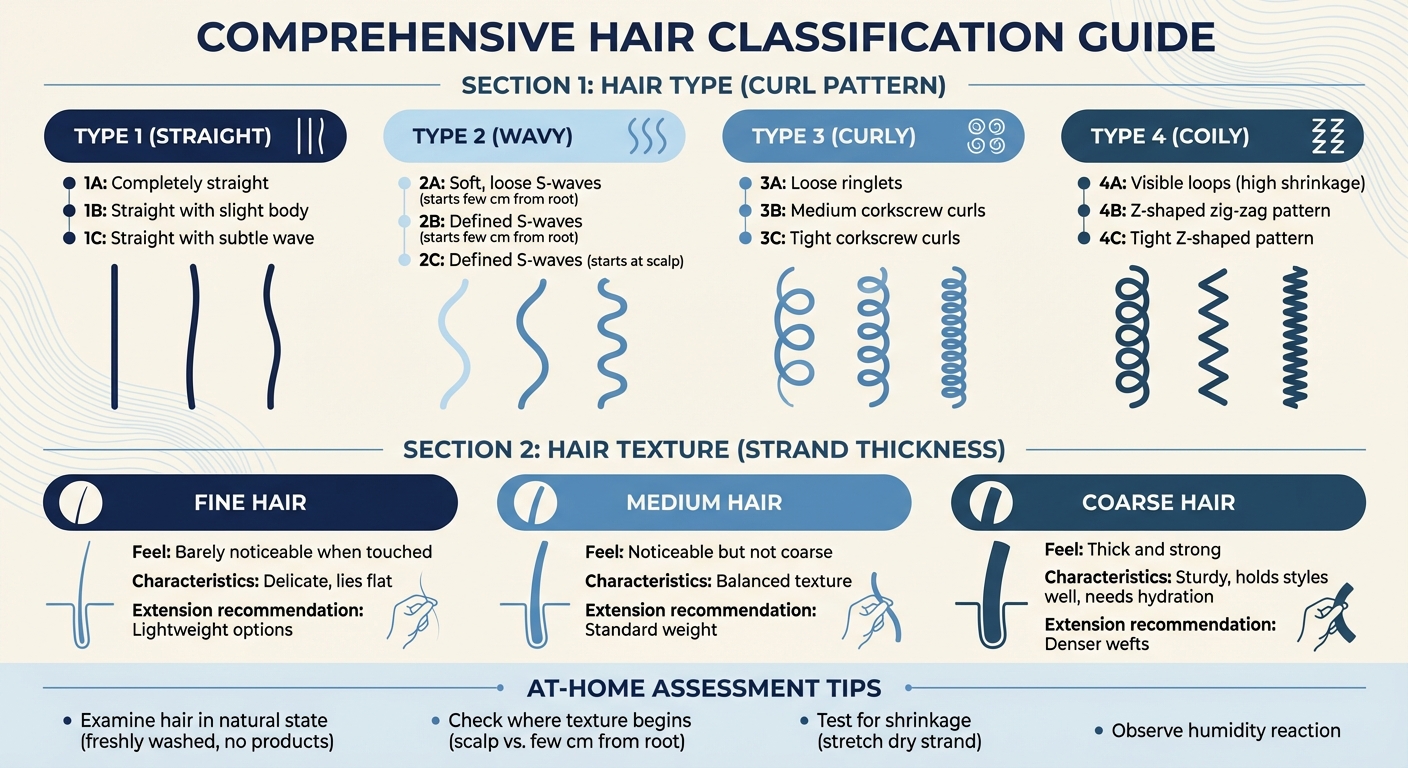
Hair Type and Texture Classification Guide for Extensions Matching
Getting to know your hair starts with distinguishing between hair type and hair texture. As Olaplex puts it, "Hair type refers to the natural curl pattern of your hair, while hair texture refers to the thickness of each individual hair strand". Your hair type is typically categorised into four main groups: Type 1 (Straight), Type 2 (Wavy), Type 3 (Curly), and Type 4 (Coily). Each of these is further broken down into subtypes A, B, and C, which reflect how loose or tight the pattern is - A being the loosest and C being the tightest.
The numbering system helps make things easier to pinpoint. For instance:
- Type 1 ranges from completely straight (1a) to straight hair with a subtle wave or body (1c).
- Type 2 showcases "S"-shaped waves, ranging from soft, loose waves (2a) to more defined ones starting closer to the scalp (2c).
- Type 3 is all about curls, from loose ringlets (3a) to tighter corkscrew curls (3c).
- Type 4 features the tightest patterns, with textures ranging from visible loops (4a) to zig-zag "Z"-shaped strands seen in 4b and 4c.
When it comes to hair texture, this refers to how thick or thin each strand feels. A quick way to figure this out is the strand test: take a dry strand of hair and run your fingers along it.
- If you can barely feel it, your hair is fine.
- If it feels noticeable but not coarse, it’s medium.
- If it feels thick and strong, it’s coarse.
Each texture comes with its own characteristics. Fine hair is delicate and tends to lie flat, while coarse hair is sturdier, holds styles better, but often needs extra hydration.
Tips for Assessing Hair Texture at Home
Understanding your natural hair type and texture can help you achieve a seamless look when blending single or double-drawn extensions or choosing styling products. Here’s how to get started:
- Examine your hair in its natural state: Make sure your hair is freshly washed and free of any styling products. Look at how it forms naturally - wavy hair tends to create an "S" shape, curly hair forms "O" or corkscrew patterns, and coily hair often displays a zig-zag or "Z" shape.
- Pay attention to where the texture begins: For example, Type 2a and 2b waves usually start a few centimetres from the root, while textures like 2c, 3, and 4 often begin right at the scalp.
- Check for shrinkage: Stretch a strand of dry hair and compare its length to when it’s unstretched. If there’s a noticeable difference, you might have Type 4 hair, which is known for its shrinkage.
- Observe how your hair reacts to humidity: Noticing how your hair behaves in different weather conditions can give clues about its natural texture and how well it might match with extensions in various climates.
Choosing the Right Extensions for Different Hair Textures
Once you've identified your hair type, the next step is finding extensions that blend seamlessly with your natural hair. As one expert explains, "The key to natural-looking hair extensions is choosing a texture that closely matches your own".
It’s not just about matching the curl pattern. You’ll also need to think about the density and thickness of the strands. For fine hair, lightweight extensions are best - they won’t add unnecessary bulk or strain fragile strands. On the other hand, coarser hair can support thicker, denser wefts. It’s crucial to ensure the weight of the extensions and the attachment method suit your hair type to avoid damage or discomfort.
Weather also matters. If your hair reacts to humidity or changes texture with the seasons, pick extensions that behave similarly. This will ensure your overall look stays consistent, no matter the conditions. Below, we’ll explore the best extension options for straight, wavy, and curly hair.
Matching Extensions to Straight Hair
Straight hair, known for its sleekness, requires carefully chosen extensions to maintain that polished look. Naturally straight hair (Type 1) is typically shiny, with strands that lie flat from root to tip. Clip-ins and tape-ins are excellent choices for this hair type, as they require minimal styling.
For those with fine or thin straight hair, lightweight extensions are a must. Hair Wonderland’s premium double-drawn Russian/Mongolian hair extensions, featuring Invisi® weft technology, offer an ultra-thin, seamless bond. These 22-inch seamless extensions weigh 200 grams, providing volume without overwhelming fine strands. Tape-in extensions are another great option for fine hair, as their flat, lightweight bonds minimise stress on natural hair. They usually last 4 to 8 weeks before needing adjustment.
Matching Extensions to Wavy and Curly Hair
When it comes to wavy or curly hair, the right extensions should enhance your natural texture. Wavy hair (Type 2) typically forms an "S" shape, while curly hair (Type 3) features defined loops or spirals. The challenge lies in finding extensions that match your unique wave or curl pattern for a seamless blend. Extensions with a touch of texture work particularly well for wavy hair, allowing them to move naturally with your own.
For curly hair, it’s essential to match the specific curl pattern - whether it’s loose ringlets (3a) or tight corkscrew curls (3c). Sew-in extensions are often recommended for tighter curls because they can handle the weight of braids and wefts. These should be adjusted by a professional every 6 to 8 weeks. Additionally, since curly hair tends to have more volume, it’s important to choose extensions with a similar density to avoid a mismatched or overly bulky appearance.
Techniques for Blending Extensions with Natural Hair
Blending hair extensions with your natural hair can feel tricky, but with the right approach, you can create a seamless look that’s virtually undetectable. Here are some expert tips to help you achieve that flawless finish.
Layering and styling together is key to merging the textures of your natural hair and extensions. Once the extensions are installed, style your entire hair - natural and extensions - together. This avoids the common "installed" look where natural roots puff up while extension ends stay sleek. If you have a blunt haircut, ask your stylist to layer the extensions to match your natural cut. This eliminates the "shelf" effect and creates a smoother transition between your natural hair and the extensions.
Colour matching and customisation also play a big role. Natural hair often has subtle variations in tone. Choosing extensions with a mix of shades or blending tones or using a hair extension shade finder can mimic this multi-dimensional effect. This creates a more natural and convincing appearance compared to a single, flat colour.
If your hair is short or blunt, placement becomes even more critical. Attach extensions to the lower layers of your hair rather than the top sections. This helps disguise the blunt ends and creates a gradual transition. You may also need more wefts to achieve the right volume and coverage for a seamless look.
Another important factor is weight matching. Extensions should match the density of your natural hair for a natural movement and feel. For fine hair, lightweight extensions are ideal to avoid strain and maintain a balanced look. Thicker hair can handle denser wefts, but the extensions should still blend well with your natural texture.
Layering and Styling for a Natural Look
Layering is a game-changer when it comes to blending extensions. When extensions are cut to match your haircut, they sit naturally and move with your hair. This is especially important if you have layers, a fringe, or a graduated cut. A professional stylist can trim the extensions to ensure they mirror the shape and volume of your natural hair.
It’s also essential to style your extensions and natural hair together. For example, if you’re curling your hair, don’t curl your natural hair first and then add the extensions - this creates two distinct textures. Instead, clip in the extensions and style everything at the same time. Whether you’re creating waves or straightening, treating your hair and extensions as one ensures they move and look cohesive.
For wavy or curly hair, this technique is especially important. Make sure the extensions match your natural curl pattern. If your curls are tight, use a curling tool to replicate that texture in the extensions. This approach ensures the blend is smooth and almost invisible.
Strategic Clipping and Placement
The way you position and clip your extensions significantly affects the final look. Avoid attaching clips or bonds too close to your hairline or natural part, as these areas are more visible, and the attachment points can show through. Instead, place them slightly further back for a more discreet finish.
If you have a blunt or short haircut, focus on the underlayers of your hair. Position most of the wefts beneath the top sections, allowing your natural hair to drape over and conceal the extensions. The top layer of your hair acts like a veil, hiding where the extensions begin.
Spacing is another important factor. Don’t cluster all your wefts in one area. Distribute them evenly across your head to create balanced volume. If your hair is short, you might need additional wefts to ensure full coverage and avoid any gaps or thin spots where the extensions could show.
Maintaining and Styling Premium Extensions
Premium extensions, like Hair Wonderland's Seamless Set 22", can last anywhere from 12 to 24 months if you take care of them properly. Since they don't benefit from the natural oils your scalp produces, they require extra moisture and gentle handling to keep them in top condition.
Start by brushing your extensions daily with a specialised brush. Always begin at the ends and work your way up to avoid unnecessary pulling. For premium Russian or Mongolian hair, detangle 2–3 times a week when the extensions are dry.
When it comes to washing, aim for every 7–10 wears. Use lukewarm water (under 35°C) and a sulphate-free shampoo to gently cleanse your extensions. Apply conditioner only to the mid-lengths and ends, avoiding the roots. After washing, gently squeeze out excess water with a microfibre towel - no rubbing! Allow the extensions to air dry on a mannequin head to prevent matting and maintain their shape.
For storage, keep your extensions in a cool, dry, shaded area. Use the original silk pouch or a breathable storage bag, and loosely braid or secure them in a low ponytail with a silk scrunchie to preserve up to 95% of their shine. At night, avoid leaving them loose. Instead, secure them in a loose braid or a pineapple updo and wear a silk bonnet to minimise tangling. These steps ensure your extensions stay looking their best.
Tools You Need for Maintenance
The right tools make all the difference when caring for extensions. A specialised brush, like Hair Wonderland's Tangle Tamer Brush, is perfect for detangling without damaging the cuticle. A wide-tooth comb helps smooth out waves or curls while reducing breakage.
Other must-haves include a sulphate-free shampoo brush for gentle scalp cleaning, microfibre towels to minimise frizz, and silk scrunchies to avoid creasing during storage. These tools work together to keep your extensions in great shape while reducing wear and tear.
Best Practices for Longevity
To get the most out of your extensions, follow these styling and care tips. Always apply a heat protectant before using hot tools, and keep the temperature between 150–180°C. A 25mm curling wand is ideal for creating natural waves, and a light mist of argan oil adds shine. When styling, section your extensions to ensure even heat distribution.
Be mindful of activities that can damage your extensions. For example, swimming in chlorinated pools can cause colour fading after just one or two exposures. If you swim, rinse your extensions with fresh water immediately afterward and apply a leave-in conditioner.
Avoid using cotton towels, as they can cause frizz. Stick with microfibre towels instead. At night, lightly detangle your extensions and secure them in a loose braid or pineapple style with a silk bonnet to protect the clips and minimise tangling.
For daily care, limit heat styling and always use a heat protectant. Apply treatment oil to keep your extensions hydrated - 1–2 pumps in the morning and 2–3 pumps in the evening should do the trick. These simple habits will help your extensions blend seamlessly with your natural hair and stay looking flawless for longer.
Conclusion
Matching extensions to your natural hair texture is key to achieving a flawless and natural look. As Couture Hair Co. explains, "Texture matching is the difference between good extensions and great ones." By understanding your natural texture and choosing extensions that mimic the way your hair moves and reacts, you can avoid the tell-tale signs of an install.
It’s not just about matching curl patterns. Take into account your daily styling habits, as well as your hair's density and porosity. For example, if you frequently straighten curly hair, selecting a Natural or Wavy texture can save styling time and minimise heat damage. These factors are crucial for creating an undetectable blend.
High-quality human hair extensions, such as Hair Wonderland's double-drawn Russian and Mongolian options, are crafted to behave like natural hair. They adapt well to washing and styling, making them an excellent choice for a seamless finish.
Proper care is just as important. Since extensions lack your scalp’s natural oils, using treatment oils and sulphate-free products is a must to maintain their appearance and longevity.
When you combine texture matching, premium extensions, and consistent care, the result is a transformation that feels and looks like your own hair. With the right approach, you can enjoy natural-looking extensions every day.
FAQs
How do I choose extensions if my hair is between two textures?
If your hair features mixed textures, it's best to choose extensions that match the most dominant or visible texture for a seamless look. For instance, if your roots are straighter while your ends have a wavy pattern, go for extensions that complement the waves. Another option is to pick extensions that closely resemble your overall texture and use styling tools or techniques to smooth out the transition.
What extension type is safest for fine hair?
Fine hair needs extra care when it comes to extensions, and lightweight options are the way to go. They help prevent unnecessary strain and reduce the risk of damage. Tape-ins, halo extensions, and micro rings are excellent choices - they boost volume without being harsh on your delicate strands.
How can I stop extensions frizzing in humidity?
To keep frizz at bay in humid conditions, store your extensions in breathable bags and choose a cool, dry spot for storage. Avoid brushing them while they're wet, as this can lead to damage and frizz. Accessories like silk scarves or hats can help minimise friction, while protective hairstyles - think braids or buns - offer added defence. Make sure your extensions are thoroughly dried, and use styling products designed to maintain smoothness and control frizz.