


Matching hair extensions to your natural colour is crucial for a natural look. Here's how to get it right:
- Start with your base colour: Focus on the mid-lengths and ends, not the roots. Use natural daylight for accuracy.
- Identify undertones: Warm tones (gold, caramel), cool tones (ashy, beige), or neutral. Extensions should align with these tones.
- Consider highlights and lowlights: Multi-tonal extensions blend better than single-tone ones.
- Use tools like swatches or colour rings: Compare shades in natural light to avoid mismatches.
- Test with samples: Before committing, try small extensions to check the blend.
- Blend after installation: Use heat styling and professional trimming for a polished finish.
Avoid common mistakes like matching roots instead of mid-lengths, using artificial lighting, or ignoring undertones. Tools like colour rings and professional advice can make the process easier. Properly matched extensions will look natural in any light and last longer with care.
How to Color Match Hair Extensions Like a Pro
Understanding Your Natural Hair Colour
Your natural hair colour is made up of three key elements: your base colour, undertone, and natural highlights or lowlights. The base colour is the main shade you see along the mid-lengths and ends of your hair - think shades like dark blonde, medium brown, rich copper, or soft black. Then there’s the undertone, which gives your base its unique character: warm undertones might show hints of gold, copper, or caramel, while cool undertones lean towards ashy, beige, or smoky hues. Finally, the naturally varied strands in your hair - your highlights and lowlights - add depth and dimension. To ensure hair extensions blend well, they should reflect all three elements. Let’s dive into each one to help you find your perfect match.
Identifying Your Base Shade
To pinpoint your base colour, focus on the mid-lengths and ends of your hair rather than the roots, as roots are often darker due to regrowth or past colouring. For the most accurate result, examine your hair in natural daylight - preferably soft, indirect light, as the harsh midday sun can distort colours. For example:
- Wheat to beige tones suggest blonde shades.
- Chocolate or espresso hues indicate brunettes.
- Copper hints at red tones.
- Soft black represents deeper, darker shades.
In Australia, hair colour is often categorised into levels, with numbers like 6–7 for blonde or light brown and 3–4 for darker brown shades. Taking photos of your hair in natural daylight from the side and back can also be helpful when comparing shades on a chart or consulting a professional for colour matching.
Recognising Undertones and Highlights
Once you’ve identified your base shade, the next step is to determine your undertone. Look at your hair under different lighting conditions. If you see golden, copper, or honey tones, your undertone is warm. If your hair appears ashy, silvery, or slightly matte, you’re likely on the cool side. If neither warm nor cool tones dominate, your undertone may be neutral. This is an important detail because extensions with the wrong undertone can stand out in an unnatural way.
Next, look for natural highlights and lowlights. Examine your hair in varied lighting to spot these subtle variations. Many Australians naturally have strands that are sun-lightened, especially in the mid-lengths and ends, even if their base colour is darker or cooler. These highlights and lowlights create a multi-dimensional appearance. To maintain this natural look, choose extensions that mimic the blend of tones in your hair, ideally staying within 1–3 levels of your base colour. This helps avoid a flat, uniform appearance and ensures your extensions blend beautifully.
Tools You Need for Colour Matching
When it comes to colour matching, nothing beats using physical hair samples like professional colour rings or individual swatches. These tools allow you to compare your mid-lengths and ends in natural light, steering clear of the distortions caused by digital images or artificial lighting. For the best results, work in natural, indirect daylight against a neutral background. This simple yet essential step sets you up for accurate matching and makes it easier to seek professional advice or make informed purchases.
Using Hair Wonderland Colour Matching Assistance

Once you’ve identified your base shade and undertones, Hair Wonderland's team takes it a step further. They specialise in matching their premium double-drawn Russian and Mongolian hair extensions to your unique hair colour. During their consultations, experts consider your base colour, undertones, and even multi-tonal variations to suggest blends that look completely natural. Often, they’ll mix two or three shades to replicate highlights and lowlights, mimicking the dimensional look achieved in salons. By combining their expertise with tools like colour rings and swatches, you’ll achieve a seamless match that feels effortless.
Benefits of Colour Rings and Swatches
Colour rings and swatches offer a hands-on, accurate way to match your hair - something digital images simply can’t provide. By holding a swatch up to your mid-lengths, you can quickly check if the undertones align, giving your extensions depth and avoiding a one-dimensional, flat appearance. Priced between AUD $60–$150, these tools are a worthwhile investment for anyone looking to achieve natural, polished results with their hair extensions.
sbb-itb-dcde78e
Step-by-Step Guide to Matching Hair Extensions
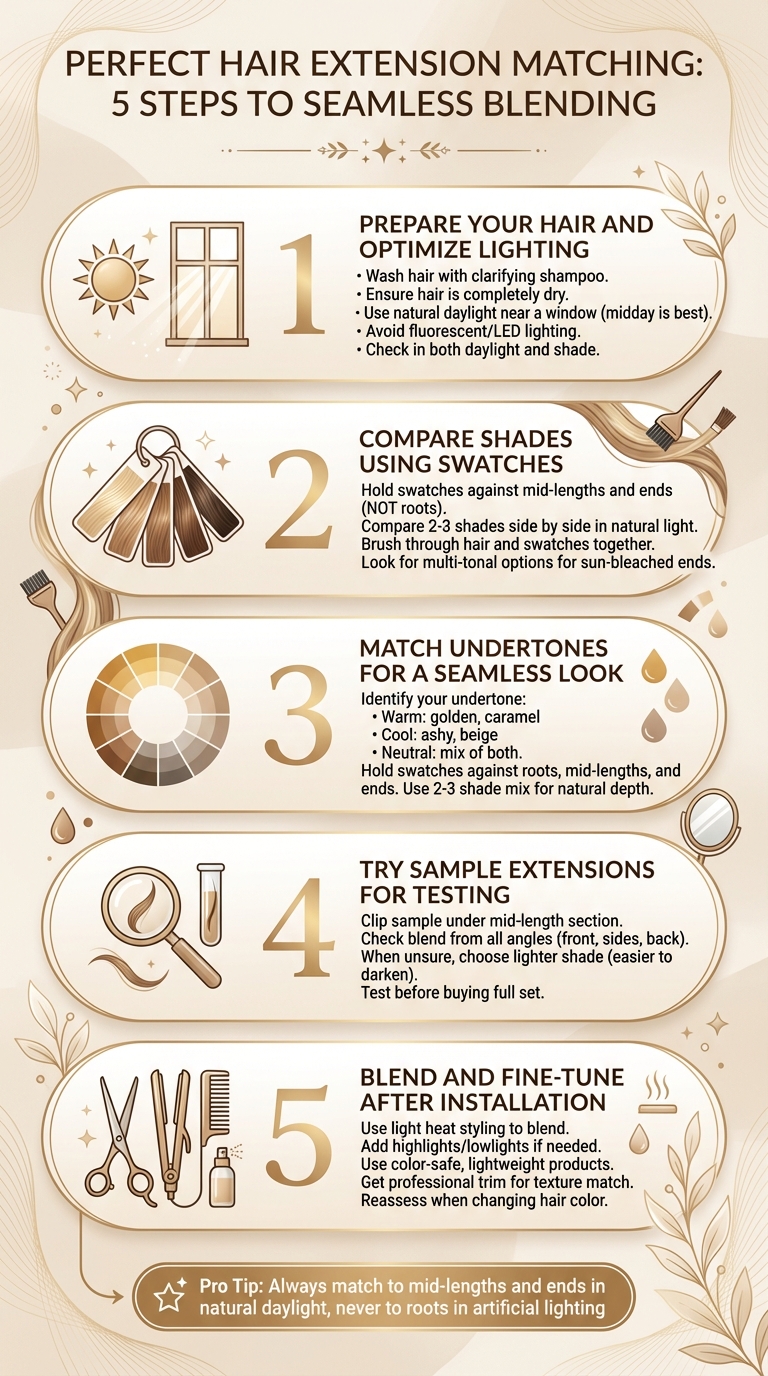
5-Step Guide to Matching Hair Extensions to Your Natural Hair Color
Now that you’ve got everything you need, let’s dive into the process of matching hair extensions. By following these steps, you’ll be able to create a flawless blend that looks natural in any light.
Step 1: Prepare Your Hair and Optimise Lighting
Start by giving your hair a good wash using a clarifying shampoo to remove any product buildup. Once your hair is clean, make sure it’s completely dry - dry hair shows its true colour and tone. Use a wide-tooth comb or a detangling brush (like those from Hair Wonderland) to gently remove any knots or tangles.
Lighting plays a crucial role here. Position yourself near a window to take advantage of natural daylight, ideally around midday when the light is most neutral. Avoid using fluorescent or LED lighting, as these can distort your hair’s colour, and steer clear of harsh sunlight, which can wash out subtle tones. If possible, check your hair and swatches in both daylight and shade to ensure consistency. With your hair ready and lighting sorted, you can now start comparing swatches to your hair’s base colour.
Step 2: Compare Shades Using Swatches
Take your colour ring or individual swatches and hold them against the mid-lengths and ends of your hair. Avoid matching to your roots, as they’re usually darker and not representative of where the extensions will blend. Compare two to three shades side by side in natural daylight to find the closest base match. Keep in mind that Australian hair often has sun-bleached ends, so multi-tonal swatches usually work best.
To get a better idea of how the colours will blend, brush through both your hair and the swatches. This reveals how well they merge, rather than just seeing them as separate pieces. If you’re shopping online, Hair Wonderland provides colour rings, swatches, and online matching assistance to guide you through selecting the perfect shade from their premium double-drawn Russian/Mongolian extensions.
Step 3: Match Undertones for a Seamless Look
Once you’ve identified your base shade, focus on your hair’s undertones. These can be golden or caramel for warm tones, ashy or beige for cool tones, or a mix for neutral tones. Choosing extensions with undertones that match your natural hair will ensure a more seamless blend.
If your hair features highlights or balayage, hold swatches against your roots, mid-lengths, and ends to observe how the tones shift. A multi-tonal mix of two or three shades can recreate the natural depth and dimension you’d expect from professionally styled hair. Once you’ve matched the undertones, test the blend with sample extensions to see how it looks in action.
Step 4: Try Sample Extensions for Testing
Before committing to a full set, use a tester piece or small sample extension to check the blend. Clip or position the sample under a section of your natural hair at the mid-lengths to see how the colours merge. Look at the blend from all angles - front, sides, and back - to ensure the shades align with your highlights and lowlights.
If you’re unsure between two shades, it’s usually better to go for the lighter option. Lighter human-hair extensions can be toned or darkened by a stylist, and they generally blend more naturally than extensions that are too dark. Many Australian suppliers, including Hair Wonderland, offer sample packs or individual wefts, allowing you to test the match before committing to a full set.
Step 5: Blend and Fine-Tune After Installation
Once your extensions are in place, use light heat styling to help blend your natural hair with the extensions. Focus on small sections where the two meet to create a more cohesive look. If there are slight mismatches, a stylist can add highlights or lowlights to enhance the overall dimension.
To maintain your extensions, use lightweight, colour-safe products like leave-in conditioners. This helps protect against brassiness caused by UV exposure, which is especially important in Australia’s sunny conditions. For the final touch, have a professional trim the ends to match your hair’s natural texture and sun-lightened finish. Hair Wonderland’s premium double-drawn extensions are designed to handle heat styling and custom blending, making it easier to achieve that effortless, natural look.
Keep in mind that whenever you change your hair colour or let it grow significantly, you may need to reassess your extensions for a better match or adjust their placement.
Common Colour Matching Mistakes and How to Avoid Them
Matching hair extensions to your natural hair might seem straightforward, but it's surprisingly easy to get wrong. Missteps can lead to extensions that look awkward, mismatched, or just plain unnatural. To help you avoid these frustrations, let’s explore some common mistakes and how to steer clear of them.
Recognising Common Mistakes
One frequent issue is matching extensions to your darker roots instead of focusing on the mid-lengths and ends. As your hair grows, this can lead to a stark contrast, especially if your hair has highlights or multi-tonal colouring. The result? Extensions that look patchy or out of place.
Another common problem is relying on artificial lighting when choosing shades. Indoor lighting can skew colour perception, making extensions that seem perfect under a lamp look completely off in natural daylight. Always compare swatches in natural light - preferably near a window around midday, when the light is most even and neutral.
If your hair has natural dimension - think highlights, lowlights, or subtle gradients - using single-tone extensions can create a flat, unnatural appearance. Multi-tonal blends are a much better option, as they mimic the depth and variation of natural hair, making the extensions less noticeable.
Here’s a quick reference to help you avoid these pitfalls:
| Mistake | Consequence | Prevention Tip |
|---|---|---|
| Matching to roots instead of mid-lengths/ends | Extensions look stark and unnatural as roots regrow | Match to mid-lengths/ends in natural light |
| Ignoring undertones (warm/cool) | Extensions clash with your natural hair tone | Use colour rings and swatches to assess undertones in daylight |
| Using artificial lighting | Leads to mismatches that are obvious in natural light | Always compare shades in natural daylight |
| Using a single shade on multi-tonal hair | Creates a flat, blocky look | Opt for multi-tonal blends or combine shades |
| Skipping a blending test | Noticeable seams and poor integration | Test swatches on small sections and brush through your hair |
Hair Wonderland’s colour rings and swatches are excellent tools to help you navigate these challenges. By avoiding these common mistakes, your extensions will blend effortlessly, just as outlined in our step-by-step guide.
Conclusion
Finding the perfect colour match for your hair extensions doesn’t have to be complicated. By focusing on your base shade, identifying undertones, and using swatch comparisons, you can achieve a seamless, natural blend. Avoid common mistakes like matching only at the roots, ignoring undertones, or choosing a flat, single colour when your hair has multi-tonal dimensions.
The right tools and careful testing can make all the difference. Colour rings and swatches allow you to compare shades accurately in daylight, while test samples help ensure a flawless transition. If you’re dealing with tricky balayage or ombré styles, or if you’re stuck between two shades, professional advice from colourists or brand-specific matching services can guide you to the perfect choice.
Hair Wonderland offers premium double-drawn Russian/Mongolian human hair extensions that are crafted to blend beautifully and stand the test of time when cared for properly. Their clip-in extensions, paired with expert colour-matching services and extension-safe accessories like detangling brushes and specialised care products, make the matching process smooth and reliable.
Taking the time to find the right match will pay off in the long run. Extensions that blend naturally under Australian daylight - whether in bright outdoor sunshine or indoor lighting - deliver better results and value over time. High-quality human hair extensions can be re-styled and reused for 9–12 months with proper care, making them a more practical and stylish option compared to cheaper alternatives that don’t blend well.
Ready to find your perfect match? Start by taking a photo of your hair in natural light, browse Hair Wonderland’s carefully curated range of shades, and take advantage of their colour-matching services. Finish your routine with their care products and accessories to maintain that flawless blend for months, ensuring your extensions stay natural-looking and resilient.
FAQs
How can I find the right undertone to match my hair extensions?
To figure out your hair's undertone, start by examining your skin. If your skin has yellow, golden, or peachy tones, your hair likely carries a warm undertone. On the other hand, if your skin has pink, red, or bluish tones, your hair probably has a cool undertone.
One quick trick is to hold a plain white cloth or piece of paper next to your face while standing in natural light. If your skin looks more golden, you have warm undertones. If it looks pink or slightly bluish, you have cool undertones. Understanding this can make it much easier to pick extensions that blend seamlessly with your natural hair for a polished, natural look.
What can I do if my hair extensions don’t blend naturally after installation?
If your hair extensions aren’t blending well with your natural hair, try teasing the roots of your own hair gently to add some extra volume. Another trick is to trim or layer the extensions so they align better with your haircut. For a more precise match, you might want to consult a professional for help with colour matching or styling adjustments.
To keep everything looking seamless, use a wide-tooth comb to detangle and blend the extensions smoothly. Adding lightweight styling products can also help give your hair a polished, natural finish. With regular care and proper styling, you can achieve a flawless, cohesive look.
Why should hair extensions match the mid-lengths and ends of your hair instead of the roots?
Matching hair extensions to the mid-lengths and ends of your hair is key to achieving a natural, seamless blend. Since roots often vary in colour due to natural regrowth or highlights, focusing on the mid-lengths and ends helps create a consistent and harmonious look throughout your hairstyle.
This method also prevents any obvious mismatches at the scalp, allowing the extensions to blend effortlessly with your natural hair for a smooth and polished finish.