


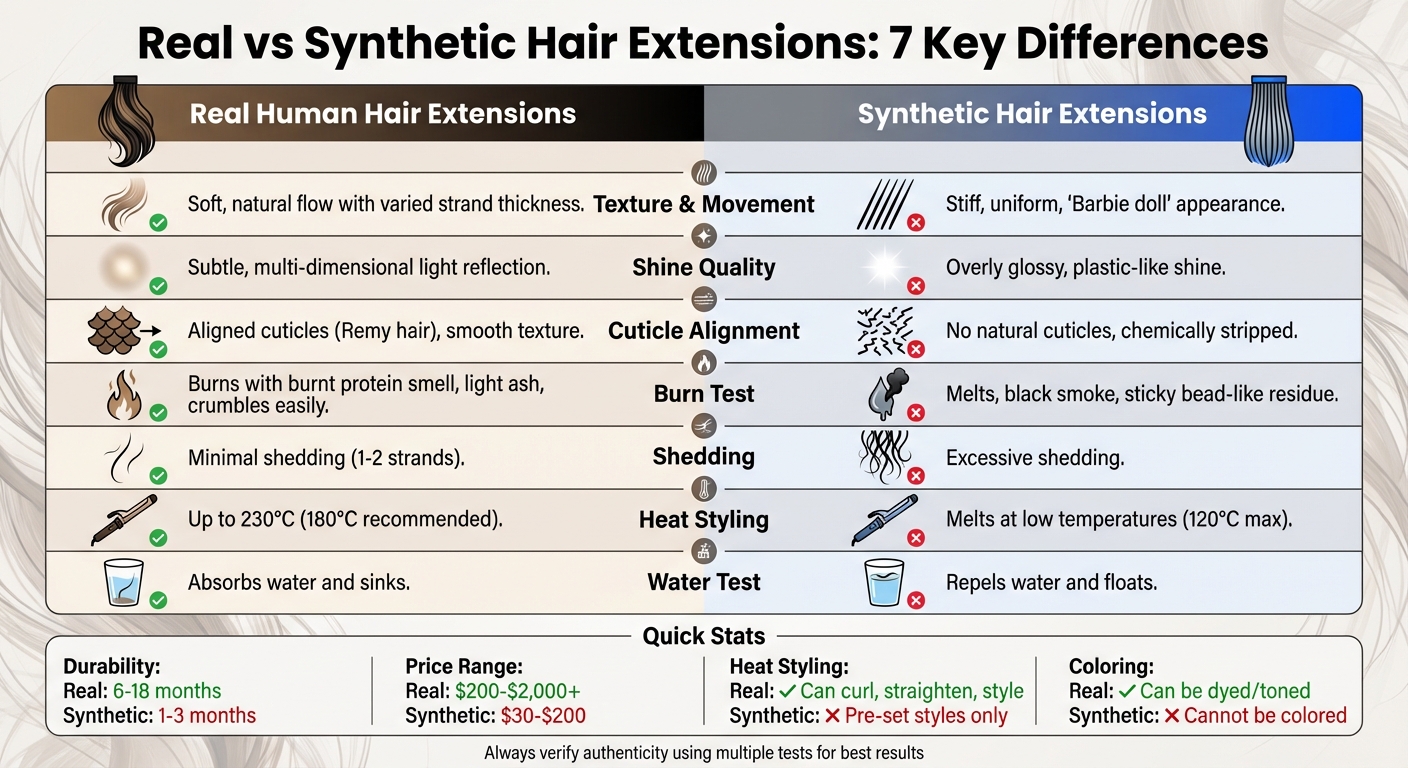
Real human hair extensions can be hard to differentiate from synthetic ones, especially in an unregulated market. Spotting the differences ensures you avoid wasting money on poor-quality products. Here are the seven key signs to identify real human hair extensions:
- Natural Texture and Movement: Flows naturally with soft, varied strand thickness, unlike the stiff, uniform appearance of synthetic hair.
- Subtle Shine: Genuine hair reflects light softly and multi-dimensionally, while synthetic hair often looks overly glossy or plastic-like.
- Cuticle Alignment: Properly aligned cuticles (Remy hair) ensure smoothness and durability. Misaligned or stripped cuticles result in tangling and brittleness.
- Burn Test Response: Real hair burns with a burnt protein smell and light ash, while synthetic hair melts, emits black smoke, and leaves sticky residue.
- Minimal Shedding: High-quality extensions shed very little due to intact cuticles and reinforced wefts.
- Heat Styling Compatibility: Can handle up to 230°C without damage, unlike synthetic hair, which often melts at lower temperatures.
- Water Absorption: Real hair absorbs water and sinks when submerged, while synthetic hair floats and repels water.
These factors help ensure you're investing in quality extensions that blend seamlessly with your natural hair and last longer. Always check for these signs to avoid synthetic blends mislabelled as human hair.
Real vs Synthetic Hair Extensions: Complete Comparison Guide
How to test HAIR SAMPLES From your VENDOR | Burn test, filler test, wash test and more!
sbb-itb-dcde78e
1. Natural Texture and Movement
The way hair moves and feels can reveal whether extensions are made from real human hair. Genuine human hair flows naturally, blending effortlessly with your own hair. It sways and bounces with a fluidity that synthetic fibres just can't replicate. Synthetic hair often looks stiff and wiry, missing the soft, organic flow that makes real hair so appealing.
When you touch high-quality extensions, they should feel consistently soft and smooth. As Sarah McKenna from Vixen & Blush explains:
"Human hair should feel soft and smooth and have a natural movement and texture to it"
On the other hand, synthetic options can feel more like plastic. Carla Lawson highlights this issue:
"Silicone is an artificial product that may give the illusion of shine however it weighs the hair down, creating limp, lifeless hair"
Another giveaway is the thickness of the strands. Real human hair has natural variations in strand thickness, just like biological hair, while synthetic strands often appear too uniform - giving them a "Barbie doll" look.
If you're unsure about authenticity, try the scrunch and grip tests. Hold the hair at the top, push the ends upward toward the roots, and then slide your fingers along the strands. Real hair allows your fingers to glide smoothly, while snagging or thinning suggests lower quality. Also, pay attention to the natural, subtle shine that only authentic human hair extensions can offer.
2. Subtle Natural Shine
One of the standout features of real hair extensions is their soft, natural shine. This comes from the cuticle, which reflects light in a way that's both subtle and multi-dimensional, changing with movement. On the other hand, synthetic extensions, often made from materials like acrylic or nylon, tend to have a uniform, overly shiny finish that can appear artificial.
Under bright lighting, genuine hair showcases a gentle, varied glow, while synthetic fibres often emit a flat, plastic-like glare. As Daniel Kim explains:
"Low-quality synthetic blends are often silicone-coated, giving them an overly glossy look that real hair doesn't have"
The silicone coating on synthetic extensions may create an initial shine, but it usually wears off after a couple of washes. Once this happens, the fibres lose their gloss and take on a dull, rough texture.
Moisture plays a big role in keeping real hair extensions looking their best. When properly hydrated, real hair maintains its natural shine. However, if moisture levels drop below 10%, the hair can become dry and brittle, resembling straw. This is why maintaining hydration is critical for keeping premium extensions looking vibrant and authentic.
To spot the difference, look for extensions that reflect light naturally without appearing too polished. Real hair extensions blend effortlessly with your own hair because they share the same protein-based structure and light-reflective qualities - something synthetic fibres simply can't match.
3. Cuticle Alignment
Cuticle alignment plays a key role in identifying authentic human hair, going beyond just texture and shine.
The cuticle, the outermost layer of a hair strand, is made up of overlapping cells that resemble roof shingles. In genuine human hair extensions, all cuticles should align in the same direction - from root to tip. This alignment, often referred to as "Remy" hair, is widely regarded as a hallmark of quality.
When cuticles are properly aligned, the scales lie flat, allowing hair strands to slide smoothly past one another without tangling. Carla Lawson, founder of Carla Lawson Hair Extensions, explains:
"Tangling occurs when inverted cuticle edges catch and create friction instead of laying flat."
On the other hand, non-Remy hair - often sourced from salon floors or comb waste - has cuticles facing in different directions. To prevent immediate tangling, manufacturers chemically strip these cuticles and apply a silicone coating. However, this coating wears off after a few washes, leaving the hair rough, brittle, and prone to common hair extension problems like matting.
A simple strand test can help you check cuticle alignment at home. Run your fingers upward along a strand, against its natural growth direction. If you feel slight resistance, the cuticles are intact and healthy. Properly aligned, high-quality extensions can last 6–18 months, while poorly aligned hair often deteriorates within weeks [12, 16]. Cuticle alignment not only ensures durability but also enhances the overall authenticity of human hair extensions.
4. Burn Test Response
After assessing texture, shine, and cuticle alignment, the burn test offers another practical way to check if hair is genuine.
Human hair contains keratin, which causes it to catch fire and burn upwards when exposed to a flame. As it burns, it gives off a distinct burnt protein smell, much like singed hair. The smoke is light, and the ash left behind is fine and crumbles easily.
In contrast, synthetic hair - made from plastic or polymer fibres - reacts very differently. It melts, shrivels, or drips almost immediately. You’ll notice thick black smoke, a sharp chemical odour like burning plastic, and a sticky residue that hardens into bead-like lumps. Hair stylist Renee Wesonga explains:
"Human hair will immediately catch fire, burn nearly instantly curling into a little ball, and smell like burning hair. Human hair burns, synthetic melts."
To conduct the burn test safely, cut a small, discreet section of hair and hold it with tweezers over a heat-resistant surface, such as a ceramic plate. Ensure you’re in a well-ventilated area, away from anything flammable. Observe how the hair reacts to the flame - pay attention to the smoke, smell, and residue, as these details reveal whether the hair is real or synthetic.
It’s worth noting that real hair can safely handle heat up to 230°C, while synthetic fibres typically withstand only 120°C. This difference in heat tolerance explains the starkly different results during the burn test. Together with other simple checks, the burn test is a handy tool for verifying the quality of hair extensions.
5. Minimal Shedding
High-quality human hair extensions shed very little. If you’re constantly picking up loose strands from your clothes or brush, it’s a sign of poor quality. Genuine Remy hair extensions are designed to shed minimally because their cuticles stay intact and aligned from root to tip - just like natural hair. This alignment ensures that the tiny scales on the hair shaft lie flat, reducing friction and preventing tangling or breakage during brushing. Following a daily care checklist can further minimize these issues.
The way the extensions are constructed plays a huge role too. Premium options feature double-stitched or reinforced wefts, which securely hold each strand in place. This prevents them from loosening over time. As Daniel Kim from Barely Xtensions explains:
"Real human hair extensions that are well-made will have intact cuticles and proper wefts, so they shouldn't shed much or tangle immediately."
Cheaper extensions, on the other hand, often lack this level of care. Non-Remy hair, for instance, has cuticles that are either misaligned or chemically stripped, leading to increased friction and excessive shedding.
Want to check the shedding for yourself? Run your fingers through the extensions or give them a gentle shake. Losing one or two strands is normal, but if you notice more, it’s a red flag. Also, take a close look at the wefts - tight, even stitching without gaps signals solid craftsmanship that can handle regular use and styling.
6. Heat Styling Compatibility
One standout feature of genuine human hair extensions is their ability to handle heat styling, thanks to their natural keratin fibres - just like your own hair. This means you can confidently use tools like straighteners, curling wands, and blow dryers to blend extensions with natural hair seamlessly. In contrast, most synthetic extensions will melt under heat unless specifically labelled as "heat-friendly."
For the best results, style your extensions at temperatures between 120°C and 150°C. High-quality human hair can even handle up to 180°C without damage. However, going beyond this range can dry out the hair and shorten its lifespan. As Sam Conan, CEO of Canada Hair, advises:
"For human hair extensions, stay below 350°F (180°C) to prevent damage".
Always use a heat protectant to lock in moisture. Since extensions don’t benefit from the natural oils produced by your scalp, they’re more prone to heat damage. Stick to professional-grade tools, like ceramic or tourmaline ones, and avoid applying heat near attachment points to prevent adhesives or clips from melting.
And remember - never apply heat to damp extensions. Following proper brushing and care routines will also help maintain their integrity. Doing so can cause immediate fibre damage, leaving your extensions looking less than their best.
7. Water Absorption
Here’s a simple way to check: drop a few strands of hair into a glass of water and see what happens. Real human hair is naturally porous, meaning it absorbs water, becomes heavier, and gradually sinks to the bottom. Synthetic fibres, on the other hand, are non-porous, so they repel water and float instead. This straightforward test, along with how the hair dries and feels, can help confirm if it’s genuine.
Drying behaviour is another tell-tale sign of quality. Genuine human hair - especially Remy hair - tends to dry soft and manageable after washing, often with a gentle natural wave. In contrast, synthetic or low-quality hair often dries frizzy, stiff, or tangled, particularly after any silicone coating wears off.
There’s also the cuticle test. When wet, authentic hair with intact cuticles will feel slightly rough if you run your fingers upward from the tips to the roots. Synthetic hair, lacking a natural cuticle layer, feels unnaturally smooth in both directions. For extensions to keep that healthy look, they need to retain at least 10% moisture - anything less, and they’ll become brittle and straw-like.
Before trying any of these tests, make sure your extensions are clean and free of heavy styling products. Residue can create a waterproof barrier, potentially skewing your results.
Real vs Synthetic Hair Extensions Comparison
Here's a quick breakdown of how real human hair extensions stack up against synthetic ones. This comparison builds on earlier tests, summarising the key differences between the two types.
| Feature | Human Hair Extensions | Synthetic Hair Extensions |
|---|---|---|
| Material | Made from 100% natural human hair | Crafted from synthetic fibres like nylon or polyester |
| Texture | Soft, natural movement that varies by donor | Stiff and uniform with thicker strands |
| Shine | Natural, light-reflecting lustre | Often plastic-like and overly shiny |
| Heat Styling | Can be curled or straightened like your own hair | Most will melt; limited to pre-set styles |
| Colouring | Can be dyed or toned | Not suitable for colour treatments |
| Durability | Lasts 6–12+ months with proper care | Typically lasts 1–3 months |
| Water Response | Absorbs water, requiring restyling afterward | Retains its original style, even when wet |
| Price Range | $200 to $2,000+ | $30 to $200 |
Real human hair extensions clearly outperform synthetic ones in most areas. They can last 6–12 months - or even up to 18 months for premium Russian hair extensions - while synthetic extensions only hold up for 1–3 months. This means synthetic options might need replacing four to twelve times more often, which could end up costing more over time despite their lower initial price.
One standout feature of synthetic hair is its "style memory." This means the curl or wave pattern is permanently set into the fibres. As HairExtensions.com explains:
"Synthetic Extensions have 'memory', meaning the style is pre-set and will not fall in the rain or humidity as 100% Human Hair does".
This makes synthetic hair a practical choice for humid climates or outdoor events, though it comes at the cost of flexibility - you can't restyle it.
When it comes to heat styling, real hair can handle temperatures of 120°C–175°C, while most synthetic fibres will melt on contact. Some "heat-friendly" synthetic options can tolerate up to 180°C, but they still have a shorter lifespan, typically lasting only 2–3 months.
Conclusion
When it comes to authentic hair extensions, there are seven key signs to look out for: natural texture and movement, a subtle, non-glossy shine, aligned cuticles, a clear burn test result, minimal shedding, heat styling compatibility up to 230°C, and natural water absorption. These qualities help distinguish genuine human hair from synthetic alternatives that can damage your natural hair and wear out quickly.
Choosing real hair extensions isn’t just about appearance - it’s about longevity and versatility. Authentic human hair extensions can withstand professional colouring, perming, and daily heat styling. Synthetic options simply can’t offer that same level of flexibility or durability.
"The ability to differentiate between fake and real hair extensions is not just about preserving the aesthetic appeal, but also about ensuring value for money and safeguarding the health of your natural hair".
For those prioritising premium quality, Hair Wonderland stands out with its double-drawn vs single-drawn Russian and Mongolian human hair extensions. Trusted by professional salons across Australia, the brand uses only the highest-grade hair. With proper care, these extensions can stay in excellent condition for 9–12 months, providing a natural look and the durability highlighted by the seven key signs.
Recognising these features ensures you can invest in extensions that not only enhance your natural hair but also offer long-lasting quality and versatility.
FAQs
How can I tell if my hair extensions are real human hair?
To figure out if your hair extensions are made from real human hair, you can try a few easy tests at home.
Start with the strand test. Run your fingers along the hair - real human hair feels smooth and natural, with all the cuticles aligned in the same direction. Next, there’s the burn test. Carefully burn a small strand (in a safe, controlled environment). Human hair burns slowly and gives off the distinct smell of burnt hair, while synthetic hair melts quickly and emits a chemical-like odour.
You can also try the water test. Drop a strand into water. Real human hair tends to absorb water and may darken slightly, whereas synthetic hair often floats and repels water. These simple methods can help you determine if your extensions are genuinely made from human hair.
What makes real human hair extensions better than synthetic ones?
Real human hair extensions are a fantastic choice if you’re after a natural look and feel. They blend effortlessly with your own hair, making them nearly impossible to spot. Plus, you can treat them just like your own - curl, straighten, or even dye them without worrying about damage. Unlike synthetic extensions, which can look fake and don’t handle heat well, human hair extensions are durable and versatile, perfect for daily use or special events. For an extra boost in volume and consistency, you might want to go for double-drawn extensions - they offer a thicker, more polished finish.
What’s the best way to care for real human hair extensions to make them last longer?
To keep your real human hair extensions in top condition and extend their lifespan, following the right care routine is key. Start by scheduling in-salon maintenance every 4–6 weeks. This helps prevent damage and ensures both your extensions and natural hair remain healthy - especially if your hair is on the finer side.
When it comes to at-home care, choose products carefully. Stick to hair care items that are free from sulfates, keratin, protein, and high alcohol content, as these ingredients can weaken your extensions over time.
For your daily routine, handle your extensions gently. Use a detangling or extension brush to avoid tugging, always apply a heat protectant before using styling tools, and steer clear of excessive heat or harsh products. With consistent care and attention, your extensions will remain comfortable, durable, and naturally stunning for longer.