


When it comes to high-quality hair extensions, the process is everything. From sourcing virgin hair to precise colour matching, manufacturers follow over 50 quality control steps to ensure extensions look natural, last long, and resist tangling or shedding. Here's what you need to know:
- Sourcing: Hair is ethically collected from donors, temples, or salons, ensuring it remains untreated (virgin) with intact cuticles.
- Inspection: Strands are graded for colour, texture, and health, with damaged or misaligned hair removed.
- Cleaning: Hair is washed and tested for cuticle alignment to prevent tangling.
- Production Testing: Thickness, colour, and length are checked with tools like micrometers, ensuring uniformity.
- Durability Checks: Stress tests, such as wet tangle and tensile tests, confirm the extensions' strength and longevity.
- Final Packaging: Hair is treated to retain moisture, packaged securely, and inspected before shipment.
These steps ensure premium extensions that blend seamlessly, hold their colour, and stay soft over time.
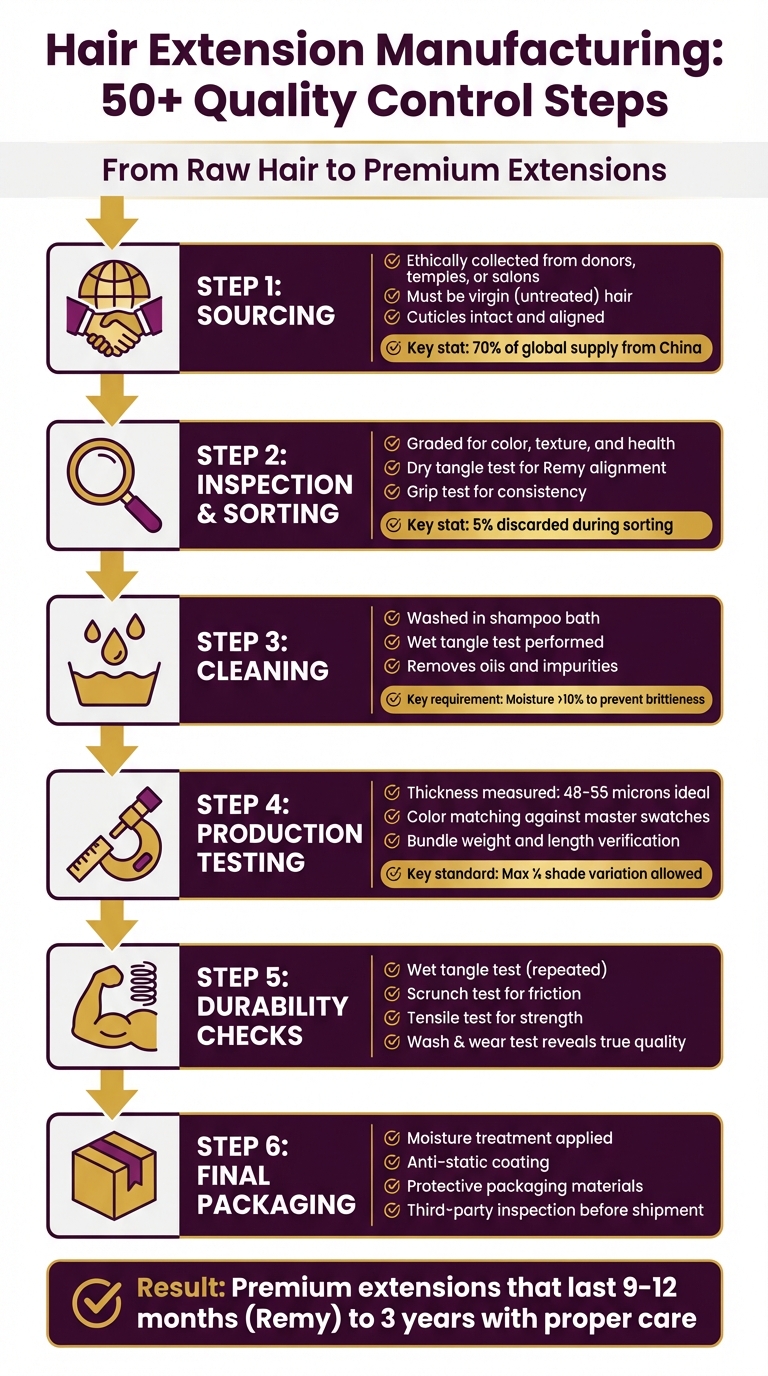
Hair Extension Manufacturing Quality Control Process: 6 Essential Steps
How We Check for the Highest Quality Indian Remy Hair Extensions
Raw Hair Collection and First Inspection
Turning raw hair into premium extensions starts with meticulous sourcing and inspection. High-quality hair is often sourced from rural areas in China, India, and Eastern Europe (including Russia and Ukraine). Factories collect this hair through three primary methods: voluntary sales by donors, offerings at religious temples (especially in India, where hair is often donated as part of religious traditions), and occasionally from salons. To ensure durability and quality, the hair must remain virgin - meaning it has never been chemically treated, dyed, or permed. These early steps are critical for maintaining the cuticle integrity that defines premium extensions.
Hair Sourcing and Grading
Ethical practices are central to the hair collection process. Factories adhere to strict standards, such as ensuring donors are at least 13 years old, that sales are voluntary, and that donors receive fair compensation. One manufacturer, Showpony, emphasises this commitment:
"We believe no one should be coerced into selling their hair; ethical practices drive our entire supply chain." – Showpony
To achieve Remy quality - where the cuticles are intact and aligned in the same direction - dealers focus on collecting 'ponytail hair'. Hair is graded meticulously based on its natural colour, texture, density, and length. To preserve the root-to-tip alignment, coloured threads or fasteners are used to secure the top and bottom of each bundle. Initial inspections also screen for grey hairs, lice, or signs of chemical treatment, ensuring only virgin hair is selected for premium lines.
For hair intended to be bleached to light blonde shades, factories use micrometers to measure strand thickness. The ideal range for this process is between 48–55 microns, measured about 25 centimetres from the roots. Hair outside this range - too fine or too coarse - cannot endure the bleaching process without compromising the cuticle.
Sorting and Removing Damaged Strands
Once the hair is ethically sourced and graded, it undergoes a thorough physical inspection to eliminate any inconsistencies. Inspectors evaluate the strands for coarseness, smoothness, consistent colour, and healthy ends. A key quality check is the Dry Tangle Test. During this test, rubbing the strands reveals the cuticle scales: they should 'catch' when moving toward the root and feel smooth toward the tip, confirming proper Remy alignment.
Another method, the grip test, helps identify quality issues. Inspectors hold the bundle at the top and slide their hand downward, gripping at various points. If significant thinning is detected midway or near the ends, it indicates the presence of short filler strands rather than full-length hair. Strands with split ends, frizz, or brittleness are removed. Specialised tools, like drawing cards or hackles, are used to comb through the hair and remove shorter or uneven strands. This process typically results in about 5% of the material being discarded, ensuring consistent density throughout the bundle.
| Inspection Parameter | Requirement for High-Grade Hair |
|---|---|
| Cuticle Status | Intact and aligned in one direction (Remy) |
| Chemical History | Virgin (never coloured, bleached, or permed) |
| Fibre Thickness | 48–55 microns (for light blonde processing) |
| Physical Health | No lice, minimal split ends, no frizz |
| Donor Age | Typically 13+ for ethical compliance |
| Collection Method | Cut in ponytail form to preserve alignment |
Hair Cleaning and Preparation
After sorting and inspecting the hair, the next step focuses on cleansing it without disrupting its natural alignment. Once the raw hair has passed the initial checks, it moves into the cleaning phase. This stage helps remove impurities while assessing how the hair holds up under conditions similar to everyday use. It’s a crucial step that sets the stage for further testing and final preparation.
Washing and Decontamination
Hair bundles are washed in a shampoo water bath designed to replicate the conditions of a typical shower. As Hair & Compounds, Inc. explains:
"Using a bath of shampoo water, we mimic what happens to the hair when washed in the shower or shampoo bowl."
This process eliminates dirt, oils, and any residual anti-static treatments applied during earlier handling. A deep cleanse ensures the removal of these treatments, allowing the team to properly evaluate the cuticle direction, hair strength, softness, and how well the colour will hold over time.
Hygiene is a top priority throughout this phase. All production equipment and work areas are cleaned and sanitised daily. Strands showing excessive split ends, frizz, or weathering are separated, ensuring only healthy hair moves forward in the process.
Once decontaminated, the hair undergoes a critical wet tangle test to check for alignment issues.
Wet Tangle Testing and Drying
The wet tangle test is performed while the hair is still wet. Technicians hold the hair bundles firmly at the roots, swishing them in the shampoo bath and rinsing in the same motion. This method is more reliable than dry testing. If cuticles have been inverted during handling, the strands will tangle and form knots near the roots that can’t be brushed out. High-quality manufacturers repeat this test at every step to catch any alignment problems early.
After passing the wet tangle test, the hair is dried using medium heat and gentle blotting to prevent damage. Proper moisture levels are critical - if the moisture content drops below 10%, the extensions can become brittle and straw-like. Once dried, the hair must be free of snagging, breakage, and frizz before being weighed and sorted into final bundles.
Quality Testing During Production
Once the bundles are cleaned and dried, they go through a series of detailed checks to assess thickness, colour, and volume. These tests build on earlier inspections and are designed to ensure consistent quality across every bundle. Using advanced tools and strictly controlled conditions, manufacturers identify and address any inconsistencies before the hair progresses to the final stages. The aim is to meet the rigorous quality standards established during earlier production phases.
Denier Measurement and Strand Thickness
Technicians measure the thickness of hair strands at 25 cm from the roots, using microns as the unit of measurement. This ensures uniformity across each bundle. Hair & Compounds outlines the process:
"A micrometer is used to measure the denier of the hair strands to make sure it falls into the acceptable measurements of 48-55 microns at the point of 10" from roots."
Strands that fall outside the 48–55 micron range are removed, as they are more prone to cuticle damage and uneven colouring. By separating these strands, manufacturers ensure that only the strongest and most uniform hair is used, particularly for premium extensions, like those in lighter blonde shades.
Colour Matching and Consistency
To maintain alignment during the colouring process, temporary threads are used to secure the bundles. Each production batch is then compared to master swatches, which serve as control samples for the brand’s standard shades. These swatches are replaced every 30 days to prevent fading and ensure accurate matching. Hair & Compounds describes their method:
"We have found indirect sunlight to be the best light for comparing production swatches against the blended bundles. We check vertically and horizontally to account for light reflection."
Colour checks are performed at the roots, mid-lengths, and ends under various lighting conditions, including indirect sunlight, lowlights, highlights, and natural light. This ensures a consistent shade throughout the bundle. Some manufacturers maintain strict standards, allowing for a maximum variation of only ¼ of a shade between the bundle and the master swatch. This level of precision ensures the extensions blend seamlessly and retain their colour even after washing.
Bundle Weight and Length Verification
Each finished bundle is weighed with precision to match the order specifications. As Alpha Hair Extension explains:
"We weigh every finished bundle precisely to match the order specifications. This strict control ensures customers receive full-volume products without shortfall."
Adjustments are made to account for colour differences - for example, blonde bundles require slightly more volume to meet weight requirements. Length is checked strand by strand, and any discrepancies lead to rejection. For hair classified as 70% drawn, the final length is measured and multiplied by 0.7 to ensure no strands are shorter than required. For curly hair, measurements are taken while the hair is stretched, and it must extend at least 2.5 cm beyond the specified length to account for the curl pattern.
A final grip test ensures uniformity, providing an additional layer of assurance. Third-party auditors also verify the accuracy of length and weight before the bundles are shipped.
sbb-itb-dcde78e
Final Quality Checks and Packaging
After verifying weight, length, and colour, hair bundles go through a final round of hands-on inspections. These tests build on earlier evaluations, simulating real-world conditions to ensure everyday reliability. Only bundles that pass all durability and alignment checks move forward to packaging and shipment.
Shedding and Durability Tests
Technicians perform several stress tests to check the hair's resilience. The wet tangle test mimics washing by swishing the bundle in shampooed water while holding it by the roots. If the cuticles are inverted or misaligned, the strands will "climb" and form knots near the roots, making them impossible to brush out.
The scrunch test involves rubbing the ends of the bundle up to the roots to create friction. High-quality hair allows fingers to slide through effortlessly, while lower-quality hair snags or feels rough. Next is the grip test, which checks for consistent thickness. Double-drawn hair should feel uniformly full from root to tip; thinning at the ends signals lower quality.
Tensile testing measures the hair's strength and elasticity under stress, ensuring it can handle repeated styling without breaking. Alpha Hair Extension explains their process:
"To prevent breakage, we source hair from young, healthy donors and use cold bleaching methods that preserve cuticle integrity. During final inspection, any strands with excessive breakage or damage are removed."
A wash and wear test is also conducted, involving a deep clean to strip away any anti-static or silicone coatings applied during production. This reveals the hair's natural state, allowing inspectors to assess colourfastness, cuticle quality, and overall durability. Additionally, bond strength, tape adhesion, and stitching are verified to ensure the hair remains secure and resists shedding during use.
| Test Name | Purpose | Failure Indicator |
|---|---|---|
| Wet Tangle Test | Detects non-Remy/inverted cuticles | Hair "climbs" to the root or forms unfixable knots |
| Scrunch Test | Checks for surface friction/snagging | Snagging or rough texture |
| Grip Test | Verifies volume and thickness consistency | Thinning at the ends |
| Tensile Test | Measures strength and elasticity | Breakage or excessive stretching |
| Wash & Wear | Reveals true hair quality | Tangling, loss of softness, or colour bleeding |
Once durability is confirmed, the focus shifts to cuticle alignment and overall finish.
Cuticle Alignment Verification
Maintaining aligned cuticles is critical for both appearance and longevity. Technicians conduct a dry tangle test, rubbing the strands between their fingers. Misaligned cuticles catch on the skin and cause the strands to "climb" toward the roots due to friction. This test quickly identifies non-Remy hair or bundles with inverted cuticles.
Carla Lawson, Founder of Carla Lawson, highlights the importance of this step:
"Stripping the cuticle from the hair creates brittleness, dryness, shorter longevity and reduced UV protection."
Aligned cuticles ensure that Remy hair can last 9–12 months with proper care. To further enhance durability, some manufacturers apply a moisture treatment to the hair cortex during this stage. This helps prevent drying after shipment and keeps the hair elastic and resistant to styling stress. Hair with moisture levels below 10% becomes brittle and prone to breakage, so maintaining hydration is key before sealing the bundles.
Protective Packaging for Shipment
After passing final inspections, hair bundles are carefully packaged to avoid damage during transport. An anti-static moisture treatment is often applied before sealing to maintain softness and prevent frizz or drying out during shipment. Advanced drying methods are used to lock in shine and prevent damage.
Packaging materials include sturdy options like 16pt to 24pt SBS (Solid Bleached Sulfate) paperboard for standard folding cartons, or 36pt to 120pt condensed paperboard for luxury rigid boxes. Custom inserts securely hold bundles in place, preventing friction, tangling, or matting during transit.
To protect against moisture and scuffing, exterior finishes such as soft-touch matte lamination, spot UV, and aqueous coatings are applied. Some manufacturers also use FSC-certified paper and soy-based inks to create eco-friendly packaging. Alpha Hair Extension notes:
"Our packaging is also optimised to reduce waste and minimise shipping impact."
After these rigorous tests and packaging steps, third-party quality control teams perform a final inspection before the bundles are shipped to warehouses. This ensures every package reaches its destination in pristine condition, ready for salon use or retail sale.
Ethical and Environmental Practices in Manufacturing
Manufacturers are increasingly focusing on ethical sourcing and environmental responsibility across the production process. The global hair extensions market, valued at around $7.5 billion, is under growing scrutiny regarding how raw materials are sourced and processed. With China accounting for about 70% of the global hair supply, maintaining transparency and accountability is crucial - not just to protect donors but also to minimise environmental harm. These efforts work hand-in-hand with the rigorous quality checks already in place, ensuring high standards from start to finish.
Environmental Compliance and Safety Standards
Factories now follow Supplier Codes of Conduct that address risks related to environmental, social, and governance issues. These codes help ensure safe chemical use, effective waste management, and strong protections for workers. Many manufacturers use dyes certified by the China Dyestuff Association's Green Leaf Certificate, which confirms that the dyeing processes meet environmental safety standards. Additionally, water recycling systems are employed to purify and reuse water from washing and bleaching processes, significantly reducing chemical runoff. To further lower environmental impact, companies are switching to recyclable packaging and soy-based inks.
Workers operate in safe conditions, performing eight-hour shifts with mandatory protective equipment in well-ventilated spaces. Regular inspections by independent auditors like SGS-CSTC Standards Technical Services ensure compliance with both ethical and quality benchmarks. Some brands have even set ambitious goals, such as achieving net zero emissions by 2050.
Ethical Sourcing and Fair Trade
Ethical sourcing has become a key focus, going beyond technical quality checks to raise overall manufacturing standards. Factories are required to obtain clear consent from donors and provide fair compensation. Derrick Porter, CEO of Beauty Industry Group, highlighted the industry's shift toward greater accountability:
"We have found that hair collectors and factories have desired to rise up and improve not only transparency, but also traceability. The onus comes on the brands to say here's the standard, here's how to get there."
In 2021, Beauty Industry Group conducted an 11-month audit of 32 factories before selecting a supplier in Qingdao, China. They introduced quarterly vendor scorecards and mandated adherence to the United Nations Global Compact to ensure fair pricing and social responsibility. Some companies even pay vendors a 10–20% premium above standard rates to encourage ethical behaviour and discourage shortcuts. Traceability systems, including VAT invoicing and digital records, track every step of the process - from hair collection to final packaging - helping to reduce the risk of corruption in cash-heavy economies.
These ethical and environmentally conscious practices not only enhance the durability and natural look of hair extensions but also uphold the values of fairness and sustainability. At Hair Wonderland, we work exclusively with suppliers who meet these rigorous standards, ensuring each extension is crafted with care for both people and the planet.
Conclusion
Maintaining high-quality standards - like preserving the cuticle and avoiding harsh acid treatments - helps extensions retain their natural moisture, strength, and durability, lasting up to three years. Proper Remy alignment ensures tangle-free wear, while precise colour matching guarantees extensions blend naturally in all lighting conditions.
These strict quality measures bring clear benefits. They prevent surprise tangling after the first wash, ensure consistent thickness from root to tip, and maintain softness and colour vibrancy over time. Factories use micrometer-level precision to ensure strands withstand bleaching without damage, while slow colouring methods protect the fibres, resulting in longer-lasting vibrancy.
At Hair Wonderland, we partner with suppliers who meet these demanding standards. Our premium double-drawn Russian and Mongolian extensions undergo thorough checks - from grading to cuticle verification - so you receive extensions that offer durability, natural movement, and long-term satisfaction. Plus, our ethical sourcing practices prioritise respect for both people and the planet, blending performance with responsibility.
FAQs
How is virgin hair sourced ethically for extensions?
Virgin hair is sourced responsibly by ensuring donors give full consent and are treated with fairness throughout the process. Trustworthy manufacturers collaborate directly with individuals who grow their hair specifically to sell it, guaranteeing they receive fair payment and are not taken advantage of.
Responsible sourcing also means upholding safe working conditions, encouraging transparency, and reducing environmental impact during production. This ensures the hair is collected in a way that avoids unethical practices, such as taking hair without permission or exploiting vulnerable groups.
How is the quality of hair extensions tested to ensure they are durable and tangle-free?
To make sure hair extensions are long-lasting and resistant to tangling, manufacturers put them through a variety of thorough tests. One key test is the grip test, which assesses the hair's strength and smoothness when subjected to friction. Another is the wet tangle test, designed to measure how well the hair resists knotting when exposed to moisture. These processes are crucial for delivering extensions that are durable and simple to care for.
How is consistent colour achieved in human hair extensions during manufacturing?
Maintaining consistent colour in human hair extensions requires meticulous attention to detail throughout the quality control process. First, raw hair is sorted and inspected to ensure it aligns with strict colour and quality benchmarks. This step involves removing any grey hairs or pre-dyed strands that could compromise the final product's uniformity.
In production, advanced dyeing methods are employed, with colour specialists carefully overseeing each stage to achieve the perfect shade. The hair is often washed multiple times to create a natural look and ensure the colour remains long-lasting. Throughout the process, experts ensure that bleaching and dyeing are done in a way that protects the hair cuticle, resulting in vibrant, consistent colours that stand the test of time.