


When buying hair extensions, you want to know they’re ethically sourced and of high quality. Traceability ensures the hair's journey - from donor to final product - is transparent, protecting against unethical practices like forced hair collection or mislabeled products.
Here’s what you need to know:
- Why It Matters: Traceability ensures hair is sourced ethically, donors are fairly paid, and products meet quality standards.
- Industry Challenges: Many brands lack transparency, making it hard to verify origins. The absence of regulations allows unethical practices to persist.
- How It Works: Using batch codes, audits, and technologies like blockchain, brands can track hair through every stage of the supply chain.
- What You Can Do: Look for batch codes, certifications, and brands that openly share sourcing details.
Traceability is a growing priority in the $7.5 billion global hair extension market. Brands like Hair Wonderland are leading the way by ensuring ethical sourcing, offering detailed documentation, and prioritising customer trust.
What Is Traceability and Why It Matters
Traceability in the Hair Industry Defined
Traceability in the hair industry involves tracking hair extensions from the donor all the way to distribution. This process creates documented records that confirm the origin and handling of the hair in an industry expected to reach $3.9 billion in revenue by 2024. By verifying each step - collection from donors, processing, and distribution - traceability helps prevent unethical practices like sourcing fallen strands, mixing in animal hair, or obtaining hair from exploitative environments.
When proper tracking is absent, intermediaries can create a false sense of transparency, failing to connect the hair to its true origin. Starting January 2025, brands like Prolonged Hair are taking a direct approach by working exclusively with donors. Their hair bundles are authenticated by Dubai's Chamber of Commerce and further validated through independent third-party research. This not only guarantees quality but also ensures ethical sourcing practices are upheld.
Ethical Sourcing Through Traceability
Traceability plays a vital role in protecting vulnerable donors while confirming product quality, such as when comparing Russian and Mongolian hair. In rural areas of countries like Cambodia and Vietnam, some women are pressured to sell their hair for as little as $10, even though the final products are sold for hundreds or even thousands of dollars.
Dr. Sarah Daniels, a social ethics expert from Georgetown University, highlights the deeper impact:
These donors often lose an asset with cultural significance for a fraction of its true value.
A transparent supply chain ensures that hair is collected with proper consent and under fair conditions, guaranteeing that donors are paid fairly for their contributions.
Building Customer Trust and Quality Control
Traceability doesn't just prevent exploitation - it also strengthens consumer trust by offering concrete proof of ethical practices. For buyers, traceable extensions mean they can verify both the quality and the ethical sourcing of their products. Instead of relying on vague claims, traceability provides specific documentation, such as batch codes, third-party lab validations, and detailed supply chain records. This level of transparency removes any uncertainty for consumers and salon professionals, giving them confidence in the products they choose.
sbb-itb-dcde78e
Challenges in Achieving Traceability
Lack of Transparency in Sourcing
The hair extension industry operates through intricate supply chains that often involve numerous intermediaries, making it nearly impossible to trace the origins of the hair or verify the conditions under which it was sourced. This lack of clarity allows unethical practices to go unnoticed. As Superior Hair Global points out, "Hair is generally sourced from impoverished areas, where women are offered small payments for their hair". Without direct connections between brands and suppliers, ensuring that donors were willing participants or received fair compensation becomes a significant challenge.
The demand for virgin hair - untreated and undyed hair - further complicates matters. This type of hair commands premium prices, creating opportunities for deceptive practices. Industry insiders refer to this as the "dark side" of the trade, where the origins of hair are deliberately obscured to maximise profits. These murky practices make it even harder to regulate the industry effectively.
Missing Industry Regulations
Unlike industries such as food or pharmaceuticals, the hair extension market lacks universal standards or enforcement mechanisms. There’s no global authority requiring brands to document their supply chains or prove ethical sourcing. As a result, brands can make vague claims about quality without offering any proof. Superior Hair Global acknowledges this gap, stating, "With global standards adapting and the unethical sourcing of hair put under the microscope, we get closer to seeing a change for the better across the industry". However, progress in establishing global standards has been slow, leaving companies to rely on their own initiatives to ensure transparency.
This lack of regulation means that ethical sourcing often depends on a brand’s voluntary efforts rather than legal obligations, making it harder for consumers to trust claims of ethical practices.
Verifying Hair Extension Origins
Even beyond the absence of regulations, verifying the origins of hair presents its own set of challenges. Reports of unethical practices, such as forced hair collection, highlight the complexity of ensuring ethical sourcing. Superior Hair Global has taken a firm stance against these practices, stating, "We do not condone the use of underage workers, underpaid workers, or unethically sourced hair that has become prevalent in the industry".
Verification typically hinges on building direct relationships with suppliers and ensuring that workers are paid fair wages. However, in the absence of formal documentation, these efforts can only serve as indirect indicators of ethical practices. For consumers and salon professionals, distinguishing between genuinely ethical sourcing and marketing spin becomes an uphill battle without concrete evidence to back up claims.
Raw Indian Hair Extensions: Ethical Sourcing Secrets #shorts
How Traceability Works in the Supply Chain
How Hair Extension Traceability Works: From Donor to Consumer
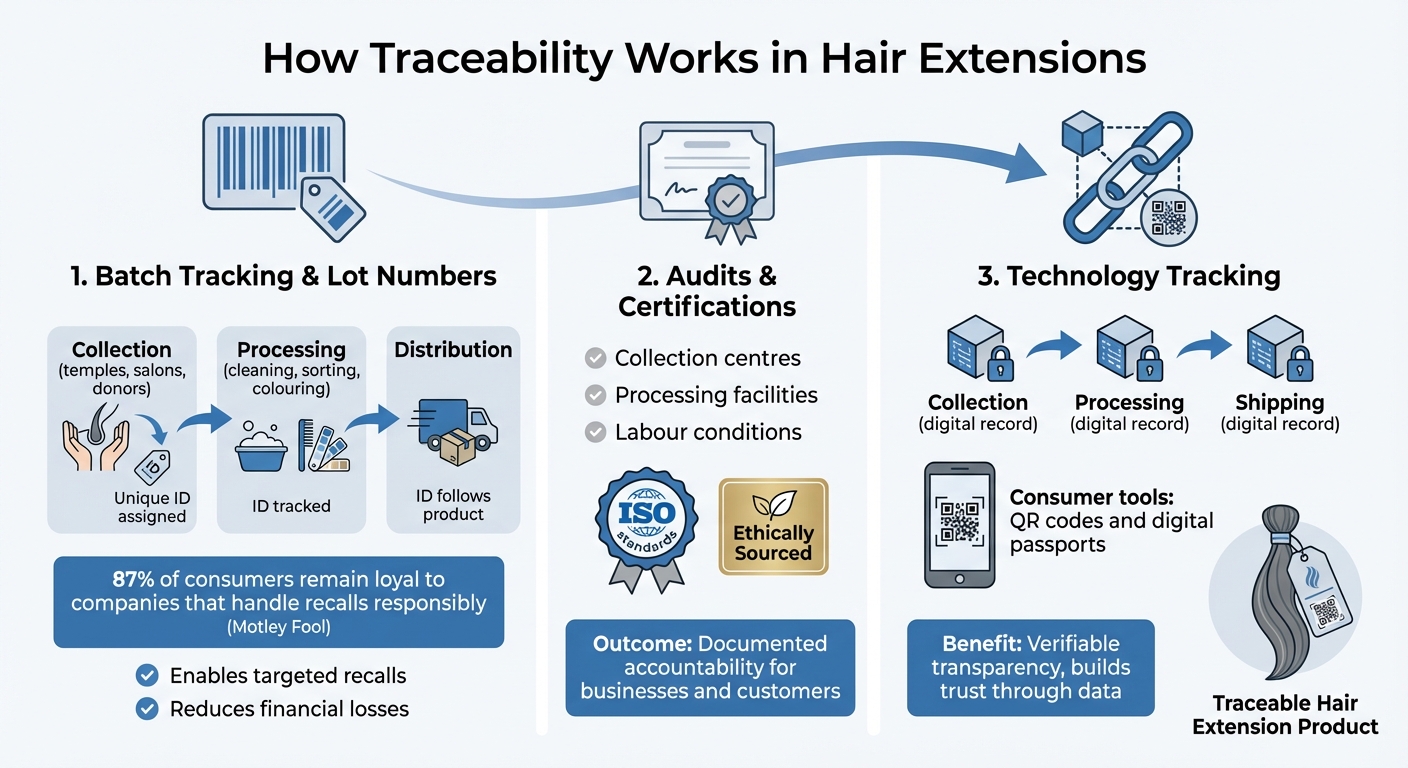
Even with the complexities involved, effective traceability methods are the backbone of accountability and quality control in supply chains. Here's a closer look at how these systems ensure every step is accounted for.
Batch Tracking and Lot Numbers
Batch tracking assigns a unique ID to every group of hair extensions produced together, allowing brands to monitor products through their entire lifecycle. Each bundle is tagged with a lot number at the point of collection - whether from temples, salons, or individual donors - and this number follows the product through cleaning, sorting, and colouring. This system ensures visibility at every stage, making it easier to trace any product back to its origin if issues arise.
Interestingly, a study by Motley Fool found that 87% of consumers would remain loyal to a company that handles product recalls responsibly and ethically. Batch tracking plays a key role here, as it allows brands to isolate and recall only the affected products, reducing financial losses and safeguarding their reputation.
Audits and Certifications
Traceability goes beyond coding systems, with independent audits playing a critical role in ensuring transparency. These audits check everything from collection centres and processing facilities to labour conditions. Certifications, such as ISO standards, act as proof of compliance, offering consumers a clear sign of a brand's commitment to ethical sourcing. Labels like "Ethically Sourced" provide an additional layer of trust.
Regular audits and strict compliance requirements ensure that standards are maintained, with the risk of certification revocation if lapses occur. This documented accountability reassures both businesses and customers that the supply chain meets rigorous ethical and operational benchmarks.
Technology for Supply Chain Tracking
Technology takes traceability to the next level. Blockchain, for example, creates unchangeable digital records for each stage of the process. Each "block" represents a specific step - like collection, processing, or shipping - and once logged, the information can't be altered.
On the consumer side, QR codes and digital passports make it possible to verify a product's journey firsthand. These tools turn traceability into something tangible, giving buyers the ability to see the full story of a product before they make a purchase. This level of transparency bridges the gap between brands and consumers, building trust through verifiable data.
How Hair Wonderland Ensures Traceability
Transparent Sourcing Practices
Hair Wonderland's commitment to traceability starts at the very top with its founder, Lisa, a seasoned hairstylist and salon owner. In 2020, Lisa decided to take full control of the sourcing process, dedicating four years to perfecting her approach before officially launching Hair Wonderland in 2024. Her focus? Delivering premium-quality, double-drawn hair extensions that meet the highest professional standards.
"Lisa quickly realised that finding the perfect balance of quality and durability was not easy... she decided to take matters into her own hands – embarking on a mission to source only the best premium double-drawn Russian hair extensions and Hair Wonderland was born."
This hands-on approach ensures direct accountability at every stage of the supply chain. Lisa’s experience in her Gold Coast salon played a key role in shaping Hair Wonderland’s products, ensuring they deliver both quality and durability.
Quality Control and Customer Confidence
Hair Wonderland takes quality control seriously. Each kit comes with a free hair sample, allowing customers to immediately check the quality, colour match, and authenticity of their extensions.
The results speak for themselves: the brand has received over 1,000 five-star reviews since its launch. Its flagship Seamless Set 22" extensions have a flawless 5.00 out of 5-star rating. Designed to last 12 to 16 months with proper care, these extensions reflect the brand's dedication to durability. To further reassure customers, Hair Wonderland offers a 60-day money-back guarantee.
Products That Support Ethical Practices
Hair Wonderland’s focus on ethical sourcing is mirrored in its product range. The Seamless Set 22" clip-in extensions, priced at $499.00 AUD, feature 200 grams of double-drawn hair enhanced with Invisi-Weft technology, ensuring a natural and undetectable look. To help maintain these extensions, the brand offers complementary products like the Tangle Tamer Brush ($21.95 AUD) and Moisture Magic leave-in treatment ($39.95 AUD).
How to Verify Traceability as a Consumer
Ensuring traceability as a consumer involves taking proactive steps to confirm the origin and authenticity of products. Here's how you can do it effectively:
Ask for Batch Codes and Documentation
Before buying hair extensions, request the batch or lot number from the brand. This unique code tracks the product's journey from raw materials to final distribution. For instance, a batch code like 'A1-23-W42' might include details such as the manufacturing facility, year, and production week. These codes are usually printed near the barcode or on the back of the packaging. Reliable brands should also provide documentation that verifies the product's production and sourcing details. If you’re unsure, reach out to the brand's customer service team with the batch code for clarification. Many modern systems use blockchain or digital portals to offer tamper-proof records, cutting verification time by as much as 83%.
Check for Certifications and Audits
Look for brands that provide certifications proving the origin and quality of their products. Ethical suppliers often include warranties, quality assurances, and maintenance guidelines to back up their claims. Prioritise brands that adhere to these standards and make their certifications easily accessible.
Buy from Transparent Brands
Opt for brands that openly share traceability information. Transparent companies often highlight their commitment to quality through verified customer reviews and detailed product care guides. For example, Hair Wonderland has consistently received five-star reviews from satisfied customers. The company specifies that their extensions are made from 100% Remy European human hair and offers clear maintenance instructions. They also educate consumers on what to avoid - like products containing protein, keratin, sulphates, or high alcohol content - to help maximise the lifespan of their extensions.
Conclusion
Traceability reshapes the way hair extensions are sourced, controlled for quality, and trusted by consumers. By tracking hair from the donor to the final product, brands can ensure ethical sourcing, maintain high standards, and build customer trust.
This approach confirms single-donor origins and prevents the mixing of different hair qualities. Technologies like blockchain and RFID allow real-time tracking, while independent audits further validate ethical practices.
Take Hair Wonderland as an example. Known for its premium double-drawn Russian and Mongolian human hair extensions, the brand sets a high standard for transparency. Since 2020, founder Lisa has worked tirelessly to refine sourcing methods. Hair Wonderland’s dedication to offering 100% Remy European human hair, tailored aftercare tips, and a 6-week warranty highlights how traceability can strengthen customer confidence. With over 1,000 five-star reviews, the brand’s transparency has clearly resonated with salons and consumers across Australia.
When shopping for hair extensions, look for batch codes, ask for documentation, and choose brands that openly share their sourcing practices. Supporting these transparent brands not only promotes ethical standards but also ensures you're getting high-quality, traceable extensions.
FAQs
What proof of traceability should a brand provide?
When it comes to sourcing hair products, a brand must offer clear proof of traceability. This means showing exactly where the hair comes from and how it has been processed.
Key information should include:
- Details about ethical sourcing practices, ensuring the hair is obtained responsibly.
- Insights into quality control measures, confirming the product meets high standards.
- Full supply chain transparency, so consumers know every step of the hair’s journey.
Brands can back up these claims with documentation, certifications, or even advanced tools like blockchain-based tracking systems. These methods provide a reliable way to verify the product's history.
By being transparent, brands can assure customers of their ethical practices and commitment to quality. This not only builds trust but also helps meet industry standards.
How do I check a batch code on hair extension packaging?
To find a batch code, look for it on the underside or back of the packaging. It’s usually a mix of letters and numbers, like '9AL' or '0324AB'. Once you have it, you can input the code into a batch code verification tool. This will provide details like the manufacturing date, expiry date, and whether the product is genuine. It's a simple way to ensure traceability and feel secure about the quality of your hair extensions.
Does traceable hair mean better quality and longer wear?
Traceable hair doesn't inherently promise superior quality or extended durability. What it does provide is clarity about where the hair comes from and how it has been processed. This level of openness often aligns with more ethical practices. While this transparency can sometimes be linked to better quality and consistency, it isn't an absolute guarantee.