


When buying hair extensions, it's important to know where the hair comes from and how it’s collected. Ethical hair sourcing ensures that hair is obtained with consent, fair payment, and respect for the donor. However, the industry faces challenges like exploitation, lack of regulation, and misleading claims about sourcing.
Here’s what you need to know:
- Fair Compensation: Ethical suppliers pay donors directly, with some earning up to A$350 per 100 g of hair, compared to as little as A$10 in unregulated markets.
- Voluntary Consent: Hair is collected through methods like temple donations or direct purchases, ensuring donors willingly contribute.
- Traceability: Ethical brands track hair from donor to product, often using audits or blockchain technology to verify sourcing.
- Better Quality: Ethically sourced hair, such as cuticle-intact Remy hair, lasts longer, tangles less, and looks more natural.
- Community Support: Proceeds from temple hair sales often help fund schools, healthcare, and food programs.
Brands like Hair Wonderland prioritise ethical practices by sourcing high-quality Russian and Mongolian hair, ensuring fair treatment of donors and producing salon-tested extensions. Always check for clear sourcing policies and avoid suspiciously cheap extensions to make informed choices.
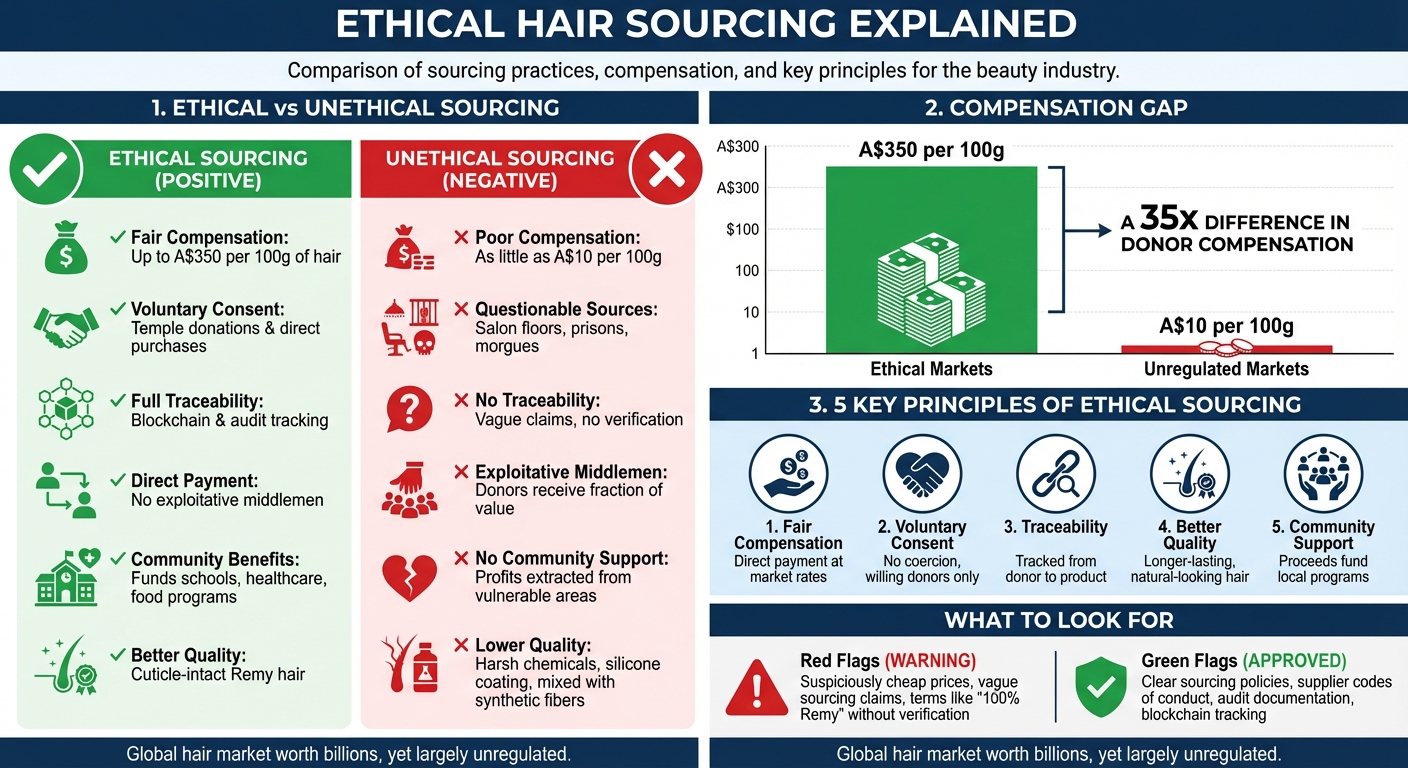
Ethical vs Unethical Hair Sourcing: Key Differences and Fair Compensation Rates
Can the human hair trade ever be ethical?
sbb-itb-dcde78e
What Is Ethical Hair Sourcing?
Ethical hair sourcing revolves around transparency, fairness, and respect for the donor. It ensures that every strand of hair comes from a willing donor who is treated with respect and compensated fairly. Unfortunately, the hair industry operates largely without regulation, leaving room for exploitative practices. Brands that prioritise ethical sourcing not only uphold strong moral principles but also produce higher-quality products. Let’s dive into the key principles and challenges faced by this industry.
Core Principles of Ethical Hair Sourcing
At its heart, ethical sourcing ensures that donors willingly provide their hair, free from coercion, and are paid fairly at market rates. Ethical brands cut out exploitative middlemen by paying donors directly. For instance, in Southeast Asia, women working with ethical suppliers can earn up to A$350 for every 100 g of hair, compared to as little as A$10 in unregulated markets.
Another vital aspect is traceability. Ethical suppliers maintain a transparent chain of custody, tracking the hair from the donor or community to the final product. This accountability ensures that every step of the process aligns with fair practices. Additionally, strict labour standards are essential. These include enforcing age limits, ensuring safe working conditions, and banning child or forced labour.
Environmental responsibility also plays a role. Ethical sourcing incorporates eco-friendly practices, such as using non-toxic dyes, adopting low-impact processing methods, and implementing water recycling systems to minimise chemical runoff. By adhering to these principles, brands not only protect donor rights but also produce double-drawn or single-drawn hair extensions that last longer and look more natural.
Common Problems in the Hair Industry
Despite the high standards set by ethical sourcing, the global hair market faces significant challenges. The lack of regulation allows unethical practices to thrive. One major issue is misleading marketing. Terms like "100% Remy", "Virgin", or "Ethically Sourced" are often thrown around without proof or independent verification.
Unethical collection methods are another widespread problem. Some suppliers gather hair from questionable sources, such as salon floors, hairbrushes, prisons, or even morgues. This hair is often mixed with animal hair or synthetic fibres. To make it appear high-quality, the hair is subjected to harsh chemical treatments and coated in silicone for a temporary shine that fades after a few washes.
The most alarming issue is the lack of donor protection. In the absence of proper oversight, vulnerable individuals - particularly women in rural areas - are often exploited. They may be pressured to sell their hair for a fraction of its real value. While hair extensions can retail for hundreds or even thousands of dollars, donors typically receive only a small portion of that amount. Some are even forced to donate their hair without genuine consent. This exploitation highlights why ethical sourcing is so crucial in maintaining dignity and fairness within the beauty industry.
How Is Donor Hair Collected Ethically?
The ethical collection of donor hair ensures fairness, transparency, and respect for donor rights. By focusing on voluntary consent and fair compensation, these practices stand in stark contrast to exploitative methods. Ethical suppliers often work directly with donors or through established cultural and religious channels. Common methods include temple donations, direct purchases, and community-driven initiatives that reinvest profits locally.
Voluntary Donations and Religious Practices
In Southern India, many individuals donate their hair at Hindu temples as part of the tonsuring ritual. This practice involves shaving one’s head as a spiritual act of humility, gratitude, or devotion, rather than for financial gain. Because the hair is given voluntarily as a religious offering, it is entirely consensual and untreated with chemicals.
"In Southern India, it's a common spiritual tradition for women, men, and children to donate their hair at Hindu temples as an act of humility, gratitude, or devotion. This isn't about vanity - it's a sacred offering." - Indian Princess Hair
Temples often sell this donated hair through fair-trade agreements. For example, one temple in India raised £22 million from hair sales in 2015. These funds were used to support initiatives like feeding 30,000 people daily and constructing schools and hospitals. Beyond these religious avenues, ethical suppliers also engage directly with donors to ensure transparency.
Direct Purchase from Donors
In addition to temple donations, ethical suppliers often purchase hair directly from individuals. This approach is common in rural areas of Southeast Asia and in mountainous regions of China, where suppliers meet donors face-to-face. By cutting out exploitative middlemen, this method ensures fair payment directly to the donor. Dan Angus, CEO of Remy Cabello, highlighted this approach in December 2025, reporting payments of £150 to £200 per donation - far above the exploitative rates of $15 to $20.
"If you're not there, you don't actually know where that hair has come from." - Dan Angus, CEO of Remy Cabello
To uphold ethical standards, suppliers document each transaction with signed consent forms and receipts. Some companies also enforce strict guidelines, such as requiring donors to be over 19 years old and ensuring hair is cut in a way that maintains the donor’s natural appearance (following professional hair extension care tips), like leaving a bob cut. This careful cutting also makes it easier to blend extensions with natural hair for a flawless finish. This process not only confirms consent but also helps establish trust within donor communities.
Community Benefits and Long-Term Support
Ethical hair sourcing creates lasting economic opportunities for donor communities. For instance, women in Southeast Asia can earn up to A$350 per 100 g of hair through ethical channels, providing a meaningful source of income in economically disadvantaged areas. Additionally, proceeds from temple hair sales often fund essential community services, including food programmes, housing, education, and healthcare.
"When you choose ethically sourced hair extensions, you're casting a vote for fair wages, genuine donor consent, and community reinvestment." - Priyanka Swamy, Founder and CEO, Perfect Locks
Ensuring Traceability and Verification
Transparency is what sets ethical hair suppliers apart from those making unverified claims. Proper tracking ensures donor consent, fair compensation, and safe processing practices. With China supplying 70% of the global hair market and India's human hair industry generating over $250 million annually, the supply chain involves a tangled network of collectors, processors, and distributors. This complexity makes rigorous audits and advanced tracking systems a necessity.
Supplier Audits and Certifications
Since no universal certification exists for ethically sourced hair extensions, brands are left to develop their own verification processes. For example, in 2021, Beauty Industry Group, under CEO Derrick Porter, conducted an 11-month audit of factories before selecting a supplier in Qingdao, China, ensuring strict compliance with social and traceability standards. Similarly, Australian brand Showpony enforces a detailed Supplier Code of Conduct and uses dyes certified by the China Dyestuff Association's Green Leaf Certificate, which confirms the use of non-toxic chemicals and adherence to environmental standards.
On-site inspections remain the gold standard for verification. By October 2025, Loxys, a New Zealand-based company, reported that its founders personally visited manufacturing facilities to inspect working conditions and confirm that hair was collected with full consent and processed without harsh chemical treatments. Meanwhile, Seventh Heaven undertook hands-on evaluations of over 30 factories before selecting partners that met their ethical and quality benchmarks.
Tracking Hair from Donor to Product
Traceability is clearest with single-donor sourcing, where hair comes from one individual rather than mixed batches. This approach makes it much easier to confirm that donors were fairly compensated. Some brands go a step further by sourcing hair directly from communities in Yunnan, Guizhou, and Sichuan, eliminating middlemen and paying donors directly.
Financial documentation and blockchain technology are key to creating an auditable supply chain. Showpony, for instance, uses official VAT invoicing and digital records for every bundle purchased, even in rural cash-based economies. Coronet Blockchain offers a specialised solution, tracking hair extensions from their origin to the consumer to prevent counterfeiting and exploitation.
"We have found that hair collectors and factories have desired to rise up and improve not only transparency, but also traceability." – Derrick Porter, CEO, Beauty Industry Group
Vague claims like "sourced from somewhere in Asia" or suspiciously low prices often indicate poor tracking and possible exploitation.
Labour Standards and Environmental Compliance
Traceability works hand-in-hand with audits that ensure fair labour practices and environmental standards. Ethical verification extends beyond the collection stage to include processing facilities. Brands conduct independent social compliance audits and provide human rights training for their suppliers. These measures ensure workers are paid fairly and operate in safe, ventilated environments. Some companies even incentivise suppliers with a surcharge to maintain ethical practices.
Environmental compliance is another critical factor. Monitoring includes water purification systems, proper chemical waste disposal, and the use of Safety Data Sheets (SDS) for all processing substances. Showpony performs annual inspections and quality tests to ensure cuticle integrity and chemical safety. Quarterly vendor scorecards assess supplier performance, timeliness, and ethical adherence, helping brands quickly identify and address any gaps in the supply chain. These measures uphold ethical principles at every step, from the donor to the final product.
| Verification Method | Primary Function | Key Benefit |
|---|---|---|
| Blockchain Technology | Tracks every transaction digitally | Provides unchangeable proof of origin |
| Social Compliance Audits | Independent site inspections | Confirms labour and safety standards |
| Vendor Scorecards | Quarterly evaluations | Highlights gaps in the supply chain |
| Single-Donor Records | Links hair to one individual | Ensures fair compensation and consent |
Hair Wonderland's Ethical Sourcing Practices
Hair Wonderland takes its commitment to transparency and fairness seriously, ensuring that every step of its sourcing process aligns with ethical standards. Founder Lisa dedicated four years to sourcing top-tier double-drawn Russian hair before introducing Hair Wonderland in 2024. This dedication ensures that every product reflects both exceptional quality and ethical responsibility.
Premium Russian and Mongolian Hair Extensions
Hair Wonderland specialises in extensions made from Russian and Mongolian hair, celebrated for its consistent thickness from root to tip. Often untouched by chemical treatments or colouring, this hair is valued for its naturally thick, soft, and silky texture. To maintain its quality, hair is collected in ponytails, preserving cuticle alignment to reduce tangling and enhance durability. These extensions are rigorously tested to meet the high standards of professional salons.
Quality Standards for Australian Salons
Each extension in the Hair Wonderland range underwent thorough testing in Lisa's salon to ensure it could withstand real-world salon conditions. The result? Products that deliver professional-grade results without added complexity. With over 1,000 five-star reviews, Hair Wonderland has become a trusted name among hairstylists across Australia. The brand also supports its customers with a free colour-matching service, available seven days a week, provided by a team of experienced hair experts.
Natural-Looking Clip-In Extensions
Hair Wonderland's clip-in extensions are designed to provide effortless volume and a seamless finish. The Seamless Set 22" 6 Clip In Hair Extensions, priced at $499.00 AUD, utilise Invisi® weft technology for lightweight comfort and natural blending with your own hair. These extensions offer a salon-quality look while allowing clients to give their natural hair a break from tape-ins, all without compromising on professional results.
Conclusion
Ethical hair sourcing is about protecting human rights, ensuring fair pay for donors and workers, and delivering high-quality products. With the human hair market growing into a multi-billion-dollar industry that lacks proper regulation, transparency and traceability have become crucial factors to consider. As Endaring Hair aptly puts it, "Ethical hair sourcing matters because beauty should never come at the expense of dignity, transparency, or fairness".
When shopping for hair extensions, it’s essential to dig deeper into sourcing practices. Look for brands that offer genuine, cuticle-intact Remy hair and have clear supplier codes of conduct. Avoid deals that seem too cheap - these often mask unethical practices, such as poor working conditions or exploitative sourcing.
Some brands set the standard for ethical practices. For instance, Hair Wonderland has spent four years sourcing premium double-drawn Russian and Mongolian hair, striking a balance between quality and ethics. With over 1,000 five-star reviews and salon-tested products, they’ve earned the trust of professional stylists across Australia.
Choosing ethically sourced hair extensions doesn’t just enhance the quality of the product - it also supports fair labour practices and empowers communities. By making informed decisions, you’re contributing to a system that values fairness, environmental care, and the dignity of hair donors.
Select extensions that not only deliver professional results but also honour the people behind them.
FAQs
How can I tell if hair extensions are genuinely ethically sourced?
To make sure hair extensions are sourced responsibly, focus on three key factors: full donor consent, traceability of the hair's origin, and transparent sourcing practices. Ethical sourcing typically includes practices like offering fair compensation to donors or sourcing hair through temple donations. It also avoids any exploitative methods. When selecting hair extension brands, opt for those that clearly prioritise these ethical standards.
What proof should a brand provide to show donor consent and fair pay?
Brands need to ensure transparency by providing clear evidence of donor consent. This could include photos or videos that show the hair being cut with the donor’s explicit approval. Additionally, it’s important to show that donors are being fairly compensated for their contributions, reflecting ethical practices in sourcing.
Does ethically sourced Remy hair last longer than cheaper hair?
Ethically sourced Remy hair is known for its durability, primarily because its cuticles remain intact and aligned. This alignment reduces tangling and breakage, which are common issues with lower-quality hair. When cared for correctly, Remy hair can last well over six months, making it a long-lasting and high-quality choice for hair extensions.