


When it comes to matching extensions to dyed hair, the secret lies in understanding your hair's base shade, undertones, and mid-length tones. A mismatch can make extensions look unnatural, while the right match blends seamlessly for a polished appearance. Here's what you need to know:
- Base Shade: Identify your hair's depth - light, medium, or dark - by examining it in natural daylight.
- Undertones: Warm (golden/yellow), cool (ash/blue), or neutral tones affect how extensions look under different lighting.
- Mid-Length Focus: Match extensions to the mid-lengths, not roots, for a natural transition.
- Multi-Tonal Hair: Use multi-tone extensions or combine two shades to match highlights, lowlights, or balayage.
- Custom Matching: Opt for sample kits or professional services to find the best match.
- Extension Care: Use colour-safe products and limit washing to maintain vibrancy and longevity.
How to Color Match Hair Extensions Like a Pro
sbb-itb-dcde78e
Understanding Your Dyed Hair's Base Shade and Undertone
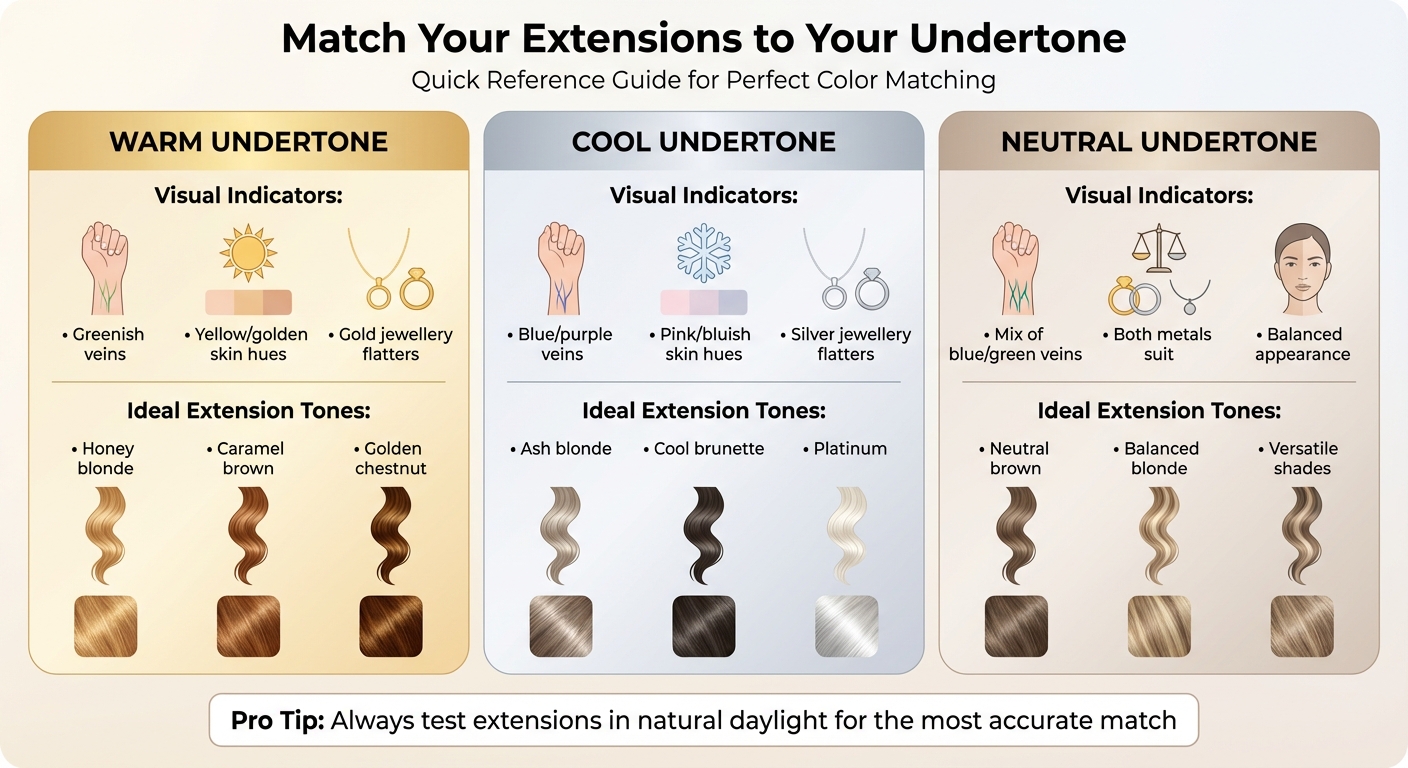
Hair Extension Undertone Matching Guide for Warm, Cool, and Neutral Skin Tones
To achieve a seamless blend with hair extensions, you need to identify two things: your hair's base shade, which determines its depth, and its undertone, which sets its temperature. Overlooking either can lead to mismatches, making your extensions stand out rather than blend in.
Undertones are especially tricky because they influence how light interacts with your hair. Extensions that seem to match under indoor lighting might look completely off in natural sunlight. For instance, pairing a dark brown with warm undertones alongside a dark brown extension with cool, ashy undertones can make your hair appear dull or even cause the extensions to look orange.
Here’s how to pinpoint your base shade and undertone, ensuring a flawless match.
How to Find Your Base Shade
The best way to determine your base shade is by examining your hair in bright, indirect daylight. Indoor lighting can distort the colour, so stand near a window where soft sunlight filters through. Use a handheld mirror to view your hair from multiple angles, giving you the most accurate picture of your natural colour.
Focus on the mid-lengths of your hair. Your roots are often darker due to regrowth, while the ends may be lighter or faded. The middle section typically gives the clearest representation of your dominant base shade. To ensure accuracy, take close-up photos from various angles and compare them to swatches.
Base shades generally fall into three main categories:
- Light: Blonde shades
- Medium: Light browns and dark blondes
- Dark: Deep browns and blacks
Keep in mind that most hair contains subtle variations - your base shade will likely include a primary colour with secondary highlights and natural shifts that become visible under different lighting conditions.
Finding Undertones in Dyed Hair
Once you’ve identified your base shade, it’s time to figure out your undertone. Undertones are the subtle hues beneath your hair's main colour and are classified as warm (yellow or golden), cool (pink or bluish), or neutral (a balance of both). Here are a few simple ways to determine yours:
- The Vein Test: Look at the veins on your wrist in natural light. Greenish veins suggest warm undertones, blue or purple veins indicate cool undertones, and a mix of both points to neutral undertones.
- The Jewellery Test: Notice which metal suits your skin best. Gold jewellery tends to flatter warm undertones, while silver or platinum complements cool undertones.
- The Fabric Test: Compare how pure white versus cream-coloured fabrics look against your skin. Pure white usually complements cool tones, while cream works better with warm tones.
Here’s a quick reference table to help match your undertone with ideal extension tones:
| Skin Undertone | Visual Indicators | Ideal Extension Tones |
|---|---|---|
| Warm | Greenish veins; yellow/golden skin hues; gold jewellery | Honey blonde, caramel brown, golden chestnut |
| Cool | Blue/purple veins; pink/bluish skin hues; silver jewellery | Ash blonde, cool brunette, platinum |
| Neutral | A mix of blue/green veins; both metals suit | Neutral brown, balanced blonde |
"Understanding your undertone is the secret to selecting hair extensions that enhance your natural beauty and create a harmonious look." – Naturyl Extensions
Match Extensions to Mid-Lengths, Not Roots
A common misstep when choosing hair extensions is trying to match them to your roots or the top layer of your hair. This often leads to disappointment because roots are usually darker due to regrowth and reflect light differently, making the colour appear misleading. Since extensions are meant to add volume and length to the lower sections of your hair, it’s much better to match them to the mid-lengths. The mid-lengths showcase the most natural tones and variations, which are crucial for achieving a seamless blend.
Why Mid-Length Matching Works Best
Once you’ve identified your base shade and undertones, focusing on the mid-lengths is the best way to ensure the extensions blend naturally. The mid-lengths typically carry the dominant colour that will be most visible once the extensions are in place. Unlike roots, which often appear more uniform in tone, mid-lengths reveal the depth and subtle variations of your hair colour. If you match extensions solely to your roots, you risk overlooking these nuances, making the extensions stand out rather than blend in.
"Poor colour matching can make your extensions stand out, ruining your hairstyle's flow".
How to Match Mid-Length Colour
To get the perfect match, it’s essential to test the colour against the mid-lengths of your hair. Always check the blend in natural daylight for the most accurate result. A great way to do this is by using the "underneath" method: place the extension tester piece beneath a section of your natural hair where the extensions will be attached. This approach reduces the chance of being misled by surface reflections and gives you a clearer idea of how the extension’s tones will blend with your hair.
"If you place extensions over your hair for comparison, the surface reflection can trick your eyes into thinking the colour is right when it's not".
Be sure to examine the blend from all angles to ensure consistency. Testing on a small section of mid-length hair allows you to confirm that the colours align perfectly, no matter the perspective.
Matching Extensions to Multi-Tone Hair Colours
Once you've mastered matching extensions to mid-length hair, tackling multi-tone hair colours takes things up a notch. Hair with highlights, lowlights, or balayage has a depth and complexity that calls for a more refined approach. The key here is to mimic the natural play of light and shadow in your hair, rather than searching for a single "perfect" shade - which likely doesn’t exist.
Using Multi-Tone Extensions
Multi-tonal extensions are designed with multiple shades woven together in each strand or weft. This makes them ideal for blending with hair that has highlights, lowlights, or balayage. For balayage styles, look for extensions labelled "rooted" or "balayage", which replicate the gradual fade from darker roots to lighter ends. On the other hand, if you have foil highlights that start closer to the scalp, opt for multi-tonal or highlighted extensions with consistent brightness for a seamless look.
When selecting multi-tone extensions, always match them to the lightest shade in your hair, not the darkest. As Maiden Hair Extensions explains:
"Always match your extensions to the lightest tone in your hair, not your darkest. It's easier to tone down warmth with gloss or purple shampoo than to lift a shade that's already too dark".
Check the match in natural daylight to ensure the extensions blend well with your highlights and lowlights. This step helps you see how the shades interact in real-world lighting. If one set of extensions doesn’t cover all the nuances of your colour, consider combining two shades for a fully tailored result.
Mixing Two Extension Shades
If a single multi-tone extension shade doesn’t quite capture the full depth of your hair colour, mixing two shades can be a game changer. By alternating between two complementary shades - representing your hair’s lightest and darkest tones - you can create a custom, multi-dimensional effect. Use clip-ins or wefts to layer these shades, alternating them during application for a natural blend.
To make the blend flawless, keep your hair's natural texture intact. Straightening your hair completely can highlight any slight tone mismatches, but natural waves or curls help disguise them. For an even more polished finish, ask your stylist for a "blend-cut" while wearing the extensions. This technique helps blend extensions with natural hair by adding layers that mirror your hair’s unique highlight patterns, ensuring a seamless look.
These methods make it easier to achieve a natural and harmonious blend, even with the most intricate hair colours.
Custom Colour Matching Options
Custom colour matching provides a personalised approach to blending hair extensions seamlessly with your unique shade. For dyed or multi-tonal hair, precise matching is key. Two popular methods to achieve this are sample kits for home matching and professional custom services.
Sample Kits for Home Matching
Sample kits, often referred to as Colour Rings, include up to 60 swatches that you can directly compare to your hair at home. This hands-on method is far more reliable than relying on online images, which can misrepresent colours due to screen variations. Many clip-in extension sets also come with a tester piece, so you can check the colour before opening the full package - keeping your return options intact.
When using sample kits, here are a few tips for accuracy:
- Assess swatches in natural daylight to avoid colour distortion.
- Test beneath your hair rather than on top, as surface light reflections can interfere with the match.
- Compare with your mid-lengths and ends, not your roots, for a more accurate blend.
Some Australian retailers, like Superior Hair, even offer a refund or discount on your next purchase if you return the colour ring after use.
For those seeking an even more tailored solution, professional services are another excellent option.
Professional Custom Services
Professional colour-matching services provide expert advice through platforms like WhatsApp or Live Chat. These services are often complimentary and deliver instant recommendations from specialists who understand undertones, light reflection, and multi-tonal blending.
To use these services, you'll typically send high-quality photos of your hair (front, back, and sides) taken in indirect natural daylight. Experts then analyse these images to recommend shades that mimic your hair's natural gradation and movement.
For example, Hair Wonderland offers free consultations via Live Chat. Simply send a photo of your hair in natural daylight, and their team will provide instant advice. This option is especially useful for complex or faded dyed hair, where subtle undertones play a big role. If you're unsure between two shades, professionals often suggest going lighter, as extensions can always be toned darker if needed.
Comparison: Sample Kits vs. Custom Services
| Feature | Sample Kits (Colour Rings/Testers) | Professional Custom Services (Photo Match) |
|---|---|---|
| Accuracy | High; allows direct comparison in real-world lighting | Very High; experts identify subtle undertones and multi-tonal needs, often recommending Russian or Mongolian hair based on your hair type |
| Cost (AU$) | Initial purchase price (often refundable or credited toward next order) | Usually free/complimentary |
| Suitability for Dyed Hair | Great for solid or standard dyed bases | Ideal for faded, unique, or multi-tonal dyed hair |
| Convenience | Requires waiting for shipping | Often offers instant or same-day advice via chat |
Both methods have their advantages, and many people find combining them works best. Start with professional photo matching to narrow down your options, then confirm your choice with a physical sample kit before making a final decision.
Dyeing Extensions to Match Your Hair
Can You Dye Hair Extensions?
You can safely dye 100% human hair extensions because they absorb pigment well. However, synthetic extensions are a no-go for dyeing - they won't take the colour and will get damaged by the chemicals. Keep in mind, extensions are ideal for adding or adjusting colour (like darkening or toning) rather than lightening through bleaching. Bleaching can severely harm the hair since extensions have already undergone chemical processing during manufacturing. This can lead to dryness, matting, and breakage. If you’re after lighter extensions, it’s better to buy a lighter shade from the start. Shades like light blonde or platinum are excellent bases for custom colouring.
With these factors in mind, here's how to dye your extensions the right way.
How to Dye Extensions Safely
Always dye your extensions before installing them, and stick to professional-grade, ammonia-based dyes for the best results. Avoid cheaper dyes, as they can compromise the quality. Start by testing the dye on a small strand to ensure the tone matches your expectations. Opt for a shade slightly cooler than your desired colour - this helps counteract future oxidation, which can cause brassiness over time due to UV exposure and heat styling. For minor adjustments, professional toners or colour-depositing conditioners can be gentler alternatives to a full dye job.
It’s important to remember that natural hair and extensions might not react the same way to the same dye formula. Hair expert Kate Soloshenko from I Love Slavic Hair explains:
"An experienced colourist will ensure that the quality of the hair is preserved, which is essential for both the look and durability of the extensions".
Once dyed, take care of your extensions with sulphate-free, colour-safe shampoos and rinse with lukewarm water to help the colour last. Store them in a cool, dark, and dry place to prevent discolouration. By following these precautions, you can achieve a seamless match with your natural hair while keeping your extensions in great condition.
Managing Colour Fading in Dyed Hair
How Fading Affects Colour Matching
Dyed hair and extensions don't fade at the same rate, which can lead to noticeable mismatches over time. Your natural hair is regularly exposed to washing, natural scalp oils, and the direct heat of styling tools. These factors strip colour more quickly than what extensions typically endure. As permanent or semi-permanent hair dye fades, it often reveals warm or brassy undertones, like orange or yellow. If your extensions don't fade in the same way, you might end up with an obvious line where your natural hair meets the extensions.
On top of that, the outer layers of your natural hair face constant UV exposure and environmental pollutants, which accelerate fading. Extensions, being more porous than natural hair, can absorb more pigment when using colour-depositing shampoos, potentially leading to an uneven look. Celebrity extension specialist Drea Jaclyn from LINEONE Hair explains:
"Color match extensions to the client's natural color, not what they want their color to be".
This advice suggests matching extensions to your hair's "settled" colour - usually the shade it takes on one to two weeks after a salon visit - rather than the fresh-from-the-salon colour that will inevitably change. Recognising these differences is key to managing fading and ensuring a seamless blend.
Keeping Dyed Hair Colour Fresh
To preserve your dyed hair's vibrancy, opt for sulphate- and paraben-free shampoos. Limit washing to two or three times a week to help retain colour.
Incorporate a daily UV protectant spray to slow down oxidation and fading. When you do wash your hair, use lukewarm or cool water, finishing with a cool rinse to close the cuticles and lock in both colour and moisture.
For consistent tone maintenance, use professional colour-depositing conditioners that work for both natural hair and extensions. To top it off, apply two to three pumps of a treatment oil, like argan oil, to the mid-lengths and ends each evening. This will keep your hair hydrated and your colour looking vibrant over time.
Blending Hair Wonderland Seamless Sets with Dyed Hair
Benefits of Hair Wonderland Seamless Sets
Hair Wonderland's Seamless Sets are designed with Invisi® weft technology, which features a thin, silicone-bonded weft that sits much flatter against the scalp compared to traditional lace wefts. This ultra-thin design makes these premium hair extensions almost invisible, creating a natural look that works beautifully with dyed hair. These wefts are flexible and lay close to your head, ensuring a smooth and seamless appearance, which is particularly important for colour-treated hair.
Made from 100% Remy European human hair, these extensions have aligned cuticles that reduce tangling and maintain a silky texture. This ensures they blend effortlessly with your natural hair. Plus, since they’re crafted from real human hair, they can be professionally toned or dyed to match your specific hair colour perfectly.
Blending Techniques for Dyed Hair
To achieve a flawless blend with dyed hair, focus on matching the extensions to the mid-lengths and ends rather than the roots. Since clip-ins are positioned lower on the head, this approach ensures a natural transition, especially if you have regrowth or varying tones near the scalp. Start applying the wefts at the nape of your neck and work upward, distributing the weight evenly to avoid bulky areas.
Style your natural hair and the extensions together as one unit. Use the same heat settings to curl or wave both at the same time. This creates a unified texture, making it hard to tell where your natural hair ends and the extensions begin. If the extensions have blunt ends, ask a stylist to use blending shears to layer them for a more cohesive look. For any slight colour differences near the scalp, a root concealer or colour spray can help create a seamless finish.
Caring for Extensions and Dyed Hair
Once you’ve achieved the perfect blend, proper care is key to maintaining the look. Wash your extensions every 15–20 wears to avoid over-washing, which can cause dryness and reduce their lifespan. Use colour-safe, UV-protectant shampoos on your natural hair to prevent fading and maintain a consistent colour match between your hair and the extensions.
Deep condition the mid-lengths and ends of the extensions, steering clear of the clips and weft bonds to prevent loosening. Detangle gently with a wide-tooth comb, starting from the ends and working your way up. When not in use, store your extensions in a cool, dry place - preferably in their original packaging or on an extension hanger - to avoid tangling and protect them from environmental damage.
Conclusion
Getting dyed hair and extensions to blend seamlessly comes down to a few essential steps. Start by focusing on the mid-lengths and ends of your hair when matching colours, as this is where the extensions will sit and blend most naturally. Pay close attention to your hair's base shade and undertones - whether they're warm, cool, or neutral - because matching undertones is just as important as matching the colour itself.
If your hair has highlights or multi-tonal shades, consider extensions with dimensional colours or even combining two shades to mimic the natural variation in your hair. Always check your match in natural light by placing the extension underneath a section of your hair. This helps ensure the tones work together without being affected by artificial lighting.
For the best results, invest in high-quality extensions. Options like Hair Wonderland’s Invisi® weft technology ensure the extensions lay flat and stay undetectable, even up close. This kind of premium design makes blending easier and styling more natural.
Once you've got the right match, style your natural hair and extensions together - whether curling or creating waves - to create a unified texture. A wide-tooth comb can help gently blend the two. To keep everything looking fresh, use sulphate-free, colour-safe products and wash the extensions sparingly, about every 15–20 wears, to maintain their quality and colour.
FAQs
How do I match extensions if my dyed hair has regrowth?
To ensure your extensions blend seamlessly with regrowth, focus on merging them naturally with the mid-lengths and ends of your hair. Pay attention to your hair's undertones - whether they’re warm, cool, or neutral - and select extensions that complement these tones. Use physical colour swatches and examine your hair under natural light to achieve the most accurate match. If you can’t find an exact match, techniques like layering or specific styling methods can help create a smooth, unified appearance.
What if my hair looks different in sunlight vs indoor light?
If your hair seems to change colour between sunlight and indoor lighting, try checking it in natural, indirect daylight. This type of light helps you see the true tones and undertones of your hair, making it easier to find extensions that blend perfectly. Natural light gives the clearest and most accurate view for a flawless match.
Can I tone or dye Hair Wonderland extensions to match my colour?
Yes, you can dye extensions, but there are a few things to keep in mind. Semi-permanent toners work well for adjusting or neutralising tones, just like with natural hair. However, dyeing extensions - especially high-quality human hair - requires extra care. It’s worth noting that doing so might void any warranties, and the results can be unpredictable. To play it safe, always test the dye on a small section first and take into account any previous processing the extensions have undergone to achieve the best results.