


To find the perfect match for hair extensions, a colour ring is your go-to tool. It features swatches of shades - ranging from icy blondes to rich brunettes - designed to help you match extensions to your natural hair. Here’s how to use it effectively:
- Check your hair in natural light: Avoid artificial lighting as it skews colours. Stand near a window or step outside for accuracy.
- Focus on mid-lengths and ends: Skip matching your roots; extensions blend better when matched to the mid-lengths and ends of your hair.
- Mix shades for dimension: Natural hair isn’t a single tone. Combine two or more shades to mimic highlights or lowlights.
- Test in various lighting conditions: Check your match under both natural and indoor lighting to ensure consistency.
- Replace colour rings regularly: Swatches can fade over time, so update your ring every 6–9 months for reliable results.
For extra help, many suppliers offer free colour-matching services. Take clear, natural-light photos of your hair and consult experts for tailored advice. Avoid common mistakes like relying on artificial light, matching to roots, or picking a flat, single-tone shade. The right colour match ensures your extensions blend naturally and look flawless.
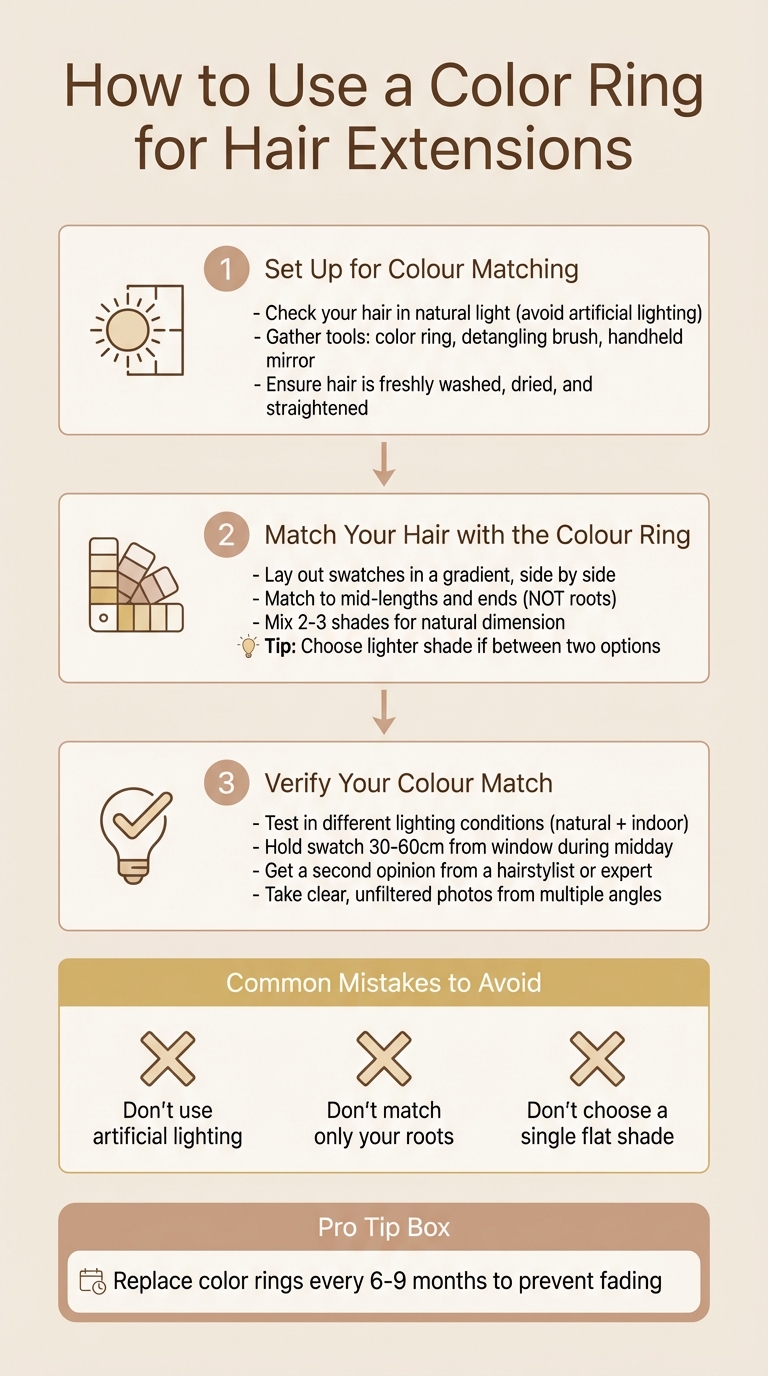
3-Step Guide to Matching Hair Extensions Using a Color Ring
Step 1: Set Up for Colour Matching
Check Your Hair in Natural Light
Natural daylight is your best friend when it comes to seeing your hair's true tone. Artificial lighting can throw off the colours, making it harder to get an accurate match. As SimplyHair puts it:
Standing in a poorly lit room will affect your perception of colour, meaning you may not match the colour correctly.
To avoid this, stand near a window or step outside to check your hair in direct natural light. Make sure your hair is freshly washed, dried, and straightened. This helps reveal its actual tones and dimensions, which can sometimes be hidden in wavy or curly textures. If natural light isn’t an option, a high-quality daylight photo can be a good backup.
Take a moment to inspect your hair from all angles - front, sides, and back. This thorough check ensures you don’t end up with extensions that look perfect in one light but completely different in another.
Once you've got a clear view of your hair's colour, it's time to match hair extensions to your colour by gathering the tools you'll need for an accurate match.
Gather Your Tools
Before diving into colour comparisons, make sure you have everything you need on hand. Start with the colour ring provided by the extension supplier - remember, colour codes can vary between brands, so using the right one is critical. Keep a detangling brush nearby to smooth out your hair, and grab a handheld mirror to check the match from behind and at different angles.
Having all your tools ready means you can take your time and avoid rushing through the process. A little preparation here can save you a lot of hassle later.
sbb-itb-dcde78e
Step 2: Match Your Hair with the Colour Ring
Spread Out the Colour Swatches
Think of your colour ring as a swatch book. Lay out the swatches in a gradient, placing similar tones side by side. This setup makes it easier to spot subtle undertones and narrow down potential matches. Once you've identified a few possibilities, separate those swatches and hold each one against your hair. This step-by-step comparison helps you see how each shade pairs with your natural colour.
It's worth noting that colour rings don't last forever. Regular handling and exposure to light can cause the samples to fade, so it's recommended to replace them every 6–9 months for accurate matching.
When you've narrowed down your options, focus on comparing these swatches to the mid-lengths and ends of your hair.
Match the Mid-Lengths and Ends
Skip matching your roots. Roots often differ in colour due to natural variation or regrowth, so they’re not the best reference point. Instead, concentrate on the mid-lengths and ends, as these are the areas where you can blend extensions with natural hair seamlessly. Pull your hair forward and hold the swatches against these sections to find the best match. As Cliphair explains:
When colour matching hair extensions, consider the shade of your hair from the mid-lengths to the ends, as this is where the extensions will blend.
If you're stuck between two shades, go for the lighter one. It's much easier to tone extensions darker than to lighten them.
Mix Multiple Shades for Natural Dimension
Once you've matched your hair tone, remember that natural hair isn't just one flat colour. It often features highlights, lowlights, and subtle tonal variations that add dimension. To mimic this, consider mixing two or more shades. This approach prevents your extensions from looking overly uniform or artificial. Compare several swatches at once to see how the tones interact, and pay attention to your hair's undertones - whether they're warm or cool - to avoid mismatched colours. As Cliphair points out:
By choosing a lighter shade, you can create natural-looking dimension and depth without needing a perfect colour match.
If you're aiming for a balayage or highlighted effect, pick two complementary shades. During installation, alternate the pieces to achieve a custom, multidimensional look that blends beautifully with your natural hair.
Step 3: Verify Your Colour Match
Test in Different Lighting Conditions
Before settling on a colour, it’s crucial to check how it looks under various lighting conditions. Stand about 30 to 60 centimetres away from a window during midday, when the light is even and neutral. Avoid direct sunlight, as it can distort the colour.
Hold the swatch underneath a section of your natural hair to minimise surface reflections and get a better idea of how the extensions will blend with your layers. Look at the match from multiple angles in a mirror and take clear, unfiltered photos from different perspectives for a thorough review.
Don’t stop there - test the match under indoor lighting too. Incandescent lighting tends to emphasise warm tones like reds and golds, while making cooler shades appear dull. On the other hand, fluorescent lighting casts a cooler glow, which can highlight unwanted green or grey tones and mute warm colours. By checking the colour in both indoor and outdoor settings, you can ensure it blends seamlessly in all environments.
Get a Second Opinion
Even with a careful match, a fresh set of eyes can spot subtle differences you might overlook. Ask a trusted hairstylist with experience in colour matching for advice, or take advantage of Hair Wonderland’s free colour-matching services available through WhatsApp, Instagram, or online forms.
If you’re opting for remote assistance, make sure you’re prepared. Take clear, filter-free photos of your hair in natural light, with your hair down, and from multiple angles. Hair Wonderland’s team of experts can assess your photos and provide tailored recommendations to ensure your extensions blend perfectly with your natural hair.
Common Mistakes to Avoid
Even the best colour ring can lead to disappointing results if you fall into common traps. Knowing what to avoid can save you time, money, and the hassle of extensions that don't blend seamlessly. Beyond color, choosing the right extension length is equally vital for a natural look. Here are the key mistakes to sidestep for a flawless match.
Don't Use Artificial Lighting
Artificial lighting can completely alter how colours appear, making it tricky to get an accurate match. Indoor lighting often skews true hair tones.
"Standing in a poorly lit room will affect your perception of colour, meaning you may not match the colour correctly, and once the day arrives that the hair extensions are due to be fitted you may wonder why the colour does not look as perfect as it did when you matched during consultation."
The best approach? Always match colours in natural light - stand near a window or step outside. If that's not possible, like during an evening appointment, ask your client for a clear, unfiltered photo of their hair taken in daylight.
Don't Match Only Your Roots
Matching extensions to your roots is another common misstep. Your roots aren't where the extensions will sit, and this can create an awkward, visible contrast.
"When the colour is off, it's like pointing a neon sign towards the fact you're wearing extensions. The goal is to blend seamlessly so your extensions are undetectable."
Instead, focus on your mid-lengths and ends. Hold the colour ring swatches against these areas to ensure the extensions blend naturally with the parts of your hair they'll be attached to.
Don't Choose a Single Flat Shade
Hair isn't typically one uniform colour, so opting for a single flat shade can make extensions look artificial. Natural hair often has highlights, lowlights, or subtle tonal variations.
If your hair features multiple tones, consider blending two or three shades from the colour ring to replicate its natural depth. Alternatively, balayage or ombre extensions can be a great option if an exact match is hard to find. These styles add dimension and create a more natural look without the need for a perfect match.
Hair Wonderland's Colour Matching Tips

Get the most out of your colour matching process with these handy tips from Hair Wonderland, designed to help you achieve flawless results every time.
Hair Wonderland's Quality Colour Rings
Hair Wonderland offers colour rings crafted from premium Remy human hair. These rings come in two varieties: Single Shade for consistent tones and Mixed/Balayage for dynamic, multi-tonal looks. With a selection of over 70 shades, there’s no shortage of options to find the perfect match.
To maintain accuracy, replace your colour ring every 6–9 months to prevent issues caused by fading. Not ready to commit to buying one? Hair Wonderland lets you rent a colour ring, and once you’re done, you can return it for a refund.
These colour rings are designed to streamline your matching process, working hand-in-hand with the steps outlined earlier.
Contact Hair Wonderland for Help
If you’re still feeling uncertain, Hair Wonderland has your back. They offer a hair color match finder service, run by experienced professionals who are ready to guide you every step of the way. You can connect with them through WhatsApp, Instagram DMs, or their online form.
"This service is run by real experts who are here to make your life easier. You can ask questions, get shade recommendations, and even get product advice tailored just for you." - Heather Collier, Author
When reaching out, make sure to send clear, unfiltered photos of your hair. Snap them in natural light, with your hair down and visible from multiple angles. Based on your photos, their experts will provide personalised shade suggestions and product recommendations, whether you’re after clip-in extensions or more permanent options. And if you happen to pick the wrong shade? No worries - Hair Wonderland offers free colour exchanges to ensure you get it just right.
Conclusion
To get the perfect match, work in natural light, spread out the swatches, and focus on the mid-lengths and ends of your hair. Since lighting can change how colours appear, it’s a good idea to test the swatches in a variety of settings.
"Getting the right colour match is the secret sauce to making your extensions look like they're part of your natural hair." - Heather Collier, Author, Cliphair
Avoid common pitfalls like relying solely on artificial light, matching just your roots, or choosing a flat, single-tone shade. If your hair has highlights or lowlights, embrace its natural depth by mixing shades or opting for a balayage or ombre effect. Still feeling unsure? Hair Wonderland’s free colour matching service is ready to help you every step of the way.
FAQs
What if my hair sits between two shades?
If you're deciding between two hair shades, go with the slightly darker one for a more natural look. Another option is to mix two shades together. This can create added depth and help you get a closer match to your natural hair colour.
How do I match extensions to highlighted hair?
To ensure your hair extensions blend perfectly with highlighted hair, use a colour ring or physical hair samples for exact matching. Hold the extension shades up against your natural hair or highlights to find the closest match. Aim to match the lighter or highlighted sections for a smooth, natural finish that’s virtually undetectable.
Can I tone or dye extensions after colour matching?
Yes, you can tone or dye extensions after matching their colour to your hair, but it’s important to do so carefully to preserve their quality. If done incorrectly, it could damage the extensions and make blending with your natural hair more challenging. Always start by testing the colour on a small section of the extensions first, and stick to proper techniques to ensure the extensions stay in good condition.