


When buying hair extensions, cuticle quality is key to ensuring they last long and look natural. Here’s how to check:
- Shine: Look for a natural glow, not overly shiny or plastic-like.
- Ends: Thick and blunt ends indicate better quality. Avoid thin or frayed ends.
- Thickness: Consistent thickness from root to tip suggests higher quality.
- Slide Test: Run fingers along the strand. Resistance from tip to root shows intact cuticles.
- Wash Test: Shampoo a small section. If it tangles or feels rough after washing, the cuticles may be damaged. Using a detangling brush can help manage minor knots without further stripping the hair.
- Professional Testing: Lab analysis can confirm cuticle alignment and overall hair quality.
These checks help you avoid extensions with stripped or misaligned cuticles, which tend to tangle, dry out, and wear out quickly. Always inspect before purchasing to ensure durability and a natural look.
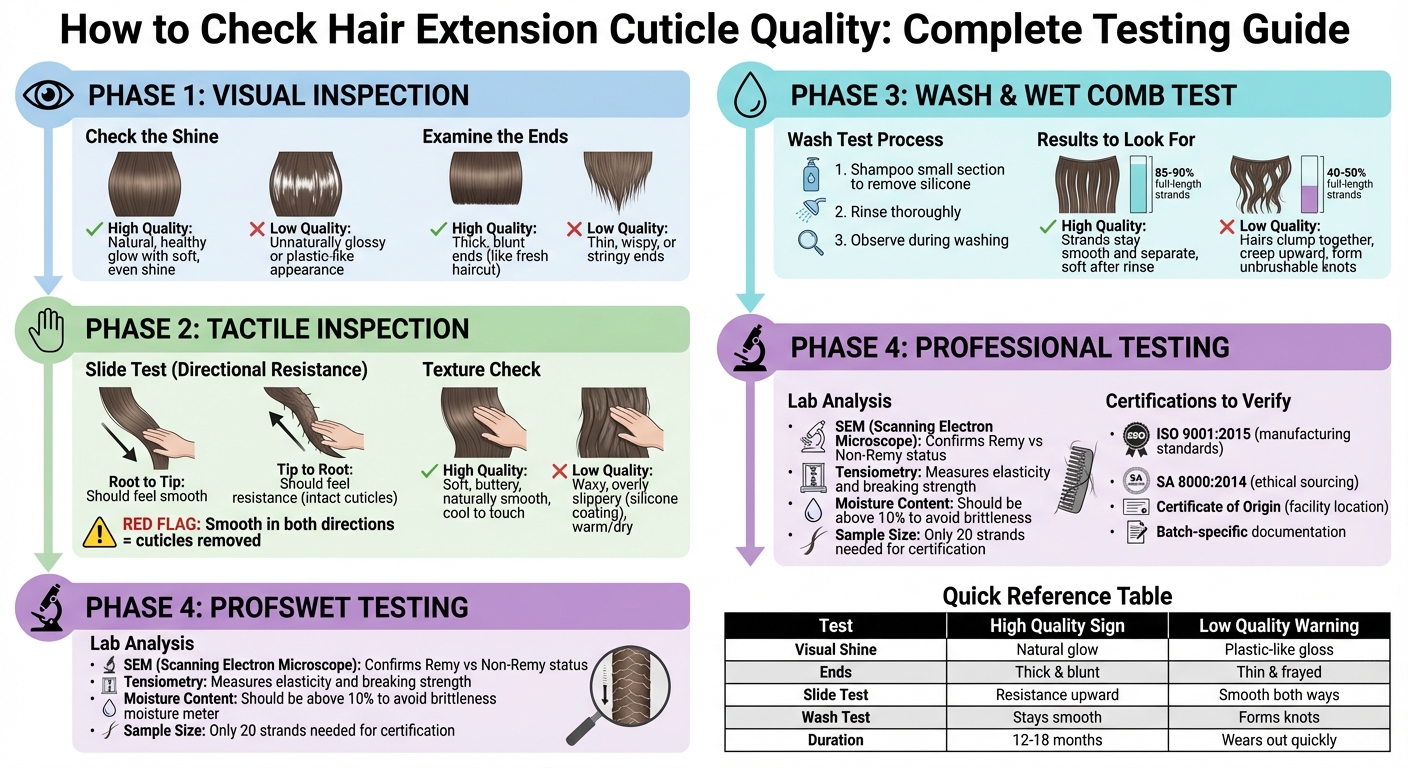
Complete Hair Extension Cuticle Quality Testing Guide
Testing for Cuticle Remy Hair by Hand | 100% Indian Remy Hair
sbb-itb-dcde78e
Visual Inspection Checklist
Before touching the hair, start with a visual inspection to assess the cuticle quality. Use bright, natural light or a strong lamp to examine the bundle. These visual clues can help you predict how well the extensions will blend and endure daily wear. Below are key indicators to evaluate cuticle integrity.
Check the Shine and Lustre
High-quality extensions have a natural, healthy glow - not an overly shiny, plastic-like appearance. The shine should look soft and even, rather than harsh or "glassy." Extensions with well-aligned cuticles reflect light uniformly along their length, creating a gentle radiance. If you notice dull spots or uneven shine, it may signal damaged or misaligned cuticles. Additionally, high-quality extensions often feature consistent colour with slight natural variations, such as subtly lighter tips. Authentic virgin hair typically shows this sun-bleached effect, which is a good sign as long as the lighter tips remain smooth and healthy, not dry or frizzy. Carla Lawson highlights the risks of silicone coatings:
"Silicones prevent moisture from penetrating the hair shaft and can attract dirt and build up. Some low-grade hair extensions have a silicone coating which may make the hair look lustrous but after several washes, the coating is gone and the hair becomes rough."
Look for Split Ends or Fraying
Pay close attention to the ends of the bundle. High-quality extensions will have thick, blunt ends that resemble a fresh haircut. Thin, wispy, or "stringy" ends often indicate a lower percentage of full-length strands and damaged cuticles. Spread the hair between your fingers to check for gaps or sparse areas at the tips. Extensions with intact cuticles maintain consistent thickness, while those with damage may appear brittle or straw-like.
Check Thickness from Root to Tip
Consistency in strand thickness is another critical factor. Hold the bundle at the top and slide your hand downward at regular intervals. The thickness should feel nearly the same from root to tip. If the volume noticeably decreases toward the tips, the hair is likely single-drawn, containing only 40–50% full-length strands. In contrast, double-drawn extensions include 85–90% full-length strands, resulting in a fuller, more uniform appearance. Carla Lawson explains:
"Premium extensions contain a higher percentage of full-length strands... the ends of the wefts are almost as thick as the top of the weft."
| Visual Feature | High Quality (Intact Cuticles) | Low Quality (Compromised Cuticles) |
|---|---|---|
| Shine | Natural, healthy glow | Unnaturally glossy |
| Ends | Thick, blunt, and uniform | Thin, tapered, or frayed |
| Texture | Smooth and flat | Frizzy, brittle, or straw-like |
| Thickness | 85–90% full-length strands | 40–50% full-length strands |
Tactile Inspection Checklist
Once you've visually inspected the hair, it's time to use your hands to evaluate the cuticle quality. This step uncovers details that aren't always visible, such as whether the cuticle scales are aligned or damaged. By sliding your fingers along the hair, you can detect if the cuticles are intact, stripped, or misaligned.
Perform the Slide Test
To check cuticle alignment, run your thumb and index finger along two to three strands of hair, starting from root to tip. High-quality hair should feel smooth in this direction. Then, slide your fingers from tip to root - this should create resistance, which indicates intact cuticles. Jen from Big Kizzy highlights what to watch for:
"If you get resistance when you are doing so [running fingers from tip to root] you are actually feeling the cuticle. If it feels the same in both directions- RED FLAG! Cuticle has probably been removed."
You can also gently scrunch the hair to test its integrity. If your fingers move through the strands easily, it's a good sign the cuticles are intact. On the other hand, hair without intact cuticles tends to dry out quickly and is more prone to common hair extension problems like tangling.
Feel the Overall Texture
Beyond the slide test, assess the overall texture of the hair. Quality extensions should feel soft, silky, and naturally smooth - often described as "buttery." The strands should also have slight elasticity, which indicates healthy moisture levels. Be cautious of hair that feels overly slippery or waxy, as it might be coated with silicone. Christian Michael Hair Extensions warns:
"True quality hair maintains a natural softness without feeling slippery or waxy. If it feels too good to be true - it might be coated with something fake."
Healthy hair is typically cool to the touch, while hair that feels warm may be dry and of lower quality. As you run your hand along the length of the hair, check for consistent thickness. Noticeable thinning at the mid-shaft or ends could indicate the presence of short filler strands rather than full-length, premium hair.
Here’s a quick reference for the tactile indicators of cuticle quality:
| Tactile Test | High-Quality Indicator | Low-Quality Indicator |
|---|---|---|
| Slide Test (Upward) | Resistance/roughness | Smooth or slippery in both directions |
| Scrunch Test | Fingers slide through freely | Hair snags, tangles, or knots |
| Temperature | Feels cool to the touch | Feels warm or dry |
| Surface Feel | Natural, buttery softness | Waxy, oily, or overly silky coating |
Wash and Wet Comb Test Checklist
The wash test builds on earlier visual and tactile checks by assessing how well the hair's cuticle holds up under water-based stress. This test strips away silicone coatings that can hide underlying issues, offering a clearer picture of the hair's quality. Washing mimics the mechanical stress of regular maintenance, helping to uncover problems like cuticle inversion - a manufacturing defect where cuticles face opposite directions, causing the strands to snag like misaligned fish scales.
Conduct a Wet Comb Test
Start by shampooing a small section of the extensions to remove any silicone coatings that might mask imperfections. Hold the hair at the root, gently swish it in shampooed water, and rinse thoroughly. After rinsing, use a wide-tooth comb to work through the damp hair. High-quality Russian or Mongolian extensions with well-aligned cuticles will let the comb glide through easily. If the comb catches or tears the strands, this could point to cuticle damage or misalignment. As Jen from Big Kizzy puts it:
"If you can't get your comb through the hair beyond natural tangling - you've got inversion."
Finish with a cool water rinse to help seal the cuticles. Run your fingers through the wet hair. If you feel significant snagging or catching, that's a warning sign. This test adds depth to the tactile assessment by exposing hidden cuticle issues that become apparent during washing.
Perform a Wash Test
The wash test focuses on how the hair reacts to agitation and drying, particularly in revealing cuticle inversion. One of the most telling signs is when strands creep upward toward the root during washing. Misaligned cuticles create friction, causing the hair to tangle into knots near the roots - knots that even conditioner or brushing can't fix. Carla Lawson, Founder of Carla Lawson Hair Extensions, explains:
"If hair cuticles have been inverted with roots and ends now at opposite ends, the hairs will creep up on each other creating a tangled knot near the roots that cannot be removed, even with brushing and conditioner."
Once the hair is dry, rub the extension between your hands. High-quality extensions will stay smooth and brushable, while inverted cuticles lead to rough, tangled, and brittle hair as the protective coating wears off.
| Test Phase | High-Quality Result | Low-Quality/Inverted Result |
|---|---|---|
| During Wash | Strands stay smooth and separate | Hairs clump together |
| After Rinse | Hair feels soft and manageable | Hair feels rough, gummy, or straw-like |
| Wet Combing | Comb glides with minimal effort | Comb catches or tears through strands |
| Post-Dry Rub | Hair remains smooth and brushable | Hair forms unbrushable knots |
To complete your cuticle evaluation, proceed with the directional resistance test.
Directional Resistance Test
The directional resistance test, sometimes referred to as the "cuticle test", is another way to confirm the integrity of hair cuticles. Hair cuticles are structured like overlapping shingles or fish scales, and in premium Russian hair extensions, these cuticles remain intact and aligned from root to tip.
Testing Smoothness and Resistance
Take 2–3 strands from the hair bundle for this test. Start by holding the strands at the root and sliding your fingers gently toward the tip. The hair should feel completely smooth. Now, reverse the process: hold the strands by the tip and slide your fingers back toward the root, against the natural cuticle direction. Here, you should feel slight resistance or friction as your fingers catch on the cuticle edges. This resistance is a clear sign of intact and properly aligned cuticles.
If the hair feels smooth in both directions, consider it a warning sign. Jen from Big Kizzy highlights this concern:
"If it feels the same in both directions- RED FLAG!"
This smoothness in both directions suggests the cuticle layer has likely been chemically stripped, a common practice in lower-quality hair to avoid tangling. Additionally, if the hair tangles or snags during the test, it may indicate that the cuticles are inverted - facing in opposite directions within the bundle. Carla Lawson, Founder and Hair Extension Specialist, explains:
"This tangling occurs because the edges of the cuticles are inverted and catching on each other creating friction, rather than laying flat in a uniform direction like fish scales."
Some experts also pay attention to a faint squeaking sound when sliding fingers against the cuticle direction. This sound can indicate a healthy, uncoated cuticle layer. This straightforward test serves as a final check to ensure the cuticles are intact and properly aligned, complementing earlier inspections.
Professional Testing and Certification
While at-home tests can provide some insights, professional lab testing ensures a definitive evaluation of cuticle quality. These lab tests go beyond what the eye can see, offering molecular-level insights that reinforce findings from visual, tactile, and wash assessments. They provide measurable, verifiable data to confirm quality.
Lab-Based Cuticle Testing
Professional labs rely on advanced tools, like scanning electron microscopes (SEM), to analyse individual hair strands at the molecular level. This process determines whether extensions are "truly Remy" - meaning all cuticles are aligned in one direction - or Non-Remy. Hair & Compounds, Inc. highlights the importance of this technology:
"This is key to our research as the microscope lets us see with certainty if any hair extension is truly Remy or Non-Remy."
In addition to microscopic analysis, labs use tensiometry to evaluate elasticity and breaking strength. This method measures surface tension, helping predict how well the hair will respond to treatments and conditioners. Moisture content is another critical factor - levels below 10% can lead to brittleness. Remarkably, labs only need 20 strands of hair to produce a traceable quality certificate, complete with a unique batch identifier .
Certifications for Premium Extensions
Beyond lab testing, certifications offer an added layer of assurance. Look for extensions with ISO 9001:2015 certification, which confirms high manufacturing standards. Ethical sourcing is verified through SA 8000:2014 certification, while Certificates of Origin validate the facility's location and the hair's source.
Traceable lab certificates are especially valuable. For example, Hair Wonderland ensures their premium extensions undergo stringent quality checks to maintain cuticle integrity. With proper care to make them last longer, these extensions can last 12–18 months.
When purchasing premium clip-in extensions, always request batch-specific documentation. This not only safeguards your investment but also guarantees you’re receiving high-quality hair with intact cuticles, ensuring the durability and natural look you expect. Following a daily care routine further protects this investment.
Conclusion
To assess the quality of cuticles in hair extensions, rely on visual checks, touch, and professional methods. Most human hair extensions are coated with silicone, which can hide cuticle damage. A simple way to check is by running your fingers against the grain of the hair. If you feel slight resistance, it’s a sign that the cuticles are intact.
The wash test is another effective method for identifying hidden cuticle issues. After shampooing the extensions, pay attention to how easily a comb glides through the strands. If the hair feels rough or tangles, it’s likely that the cuticles are damaged. Carla Lawson, Founder and Hair Extension Specialist, highlights this issue:
"Some low-grade hair extensions have a silicone coating which may make the hair look lustrous but after several washes, the coating is gone and the hair becomes rough and difficult to comb through".
This simple test can reveal the true quality of the cuticles before committing to a purchase. When combined with professional evaluations, these methods provide a more complete picture of the hair’s condition.
Professional testing also plays a key role in confirming cuticle integrity.
FAQs
How can I spot silicone-coated extensions?
Silicone-coated extensions can initially feel overly smooth or waxy to the touch. However, after a few washes, the silicone layer begins to wear away, revealing a rougher texture that makes the hair more difficult to comb through. This noticeable shift in texture is a clear sign of silicone-coated extensions.
What’s the fastest at-home test for cuticle alignment?
The fastest way to check cuticle alignment at home is by using the Strand and Cuticle Test. Take a strand of hair and gently run your fingers along it, starting from the root and moving toward the tip. If the strand feels smooth and even, your cuticles are probably aligned. However, if you notice any rough or uneven patches, it could mean the cuticles are misaligned.
When is lab testing worth paying for?
Lab testing can be a helpful step when you want to ensure the cuticle quality, authenticity, and overall condition of hair extensions. It provides confirmation that the extensions are high-quality, genuinely remy, and free from damage or synthetic coatings. This is particularly crucial if you're looking for long-lasting extensions with a natural appearance.