


Running a hair extension salon in Australia means following strict rules to protect clients, staff, and your business. Non-compliance can lead to fines, closures, or serious health risks. Here's what you need to focus on:
- Hygiene and Safety: Maintain clean, ventilated spaces, use washable surfaces, and keep sterilisation logs. Staff must hold the right qualifications, like the SHB30416 Certificate III in Hairdressing.
- Chemical Safety: Use high-quality products like Russian vs Mongolian hair extensions to avoid harmful substances like lead and VOCs. Keep Safety Data Sheets (SDS) for all chemicals.
- Local Permits: Get zoning approval and register with your local council. Home-based salons need the same permits as commercial spaces.
- Record Keeping: Maintain sterilisation logs, client consent forms, and chemical handling records. Regular audits help stay inspection-ready.
- Client Care: Prevent issues like traction alopecia by following proper techniques and scheduling maintenance every 5–8 weeks.
Compliance ensures safety, builds trust, and protects your salon from legal risks. Stay organised and informed to keep your business running smoothly.
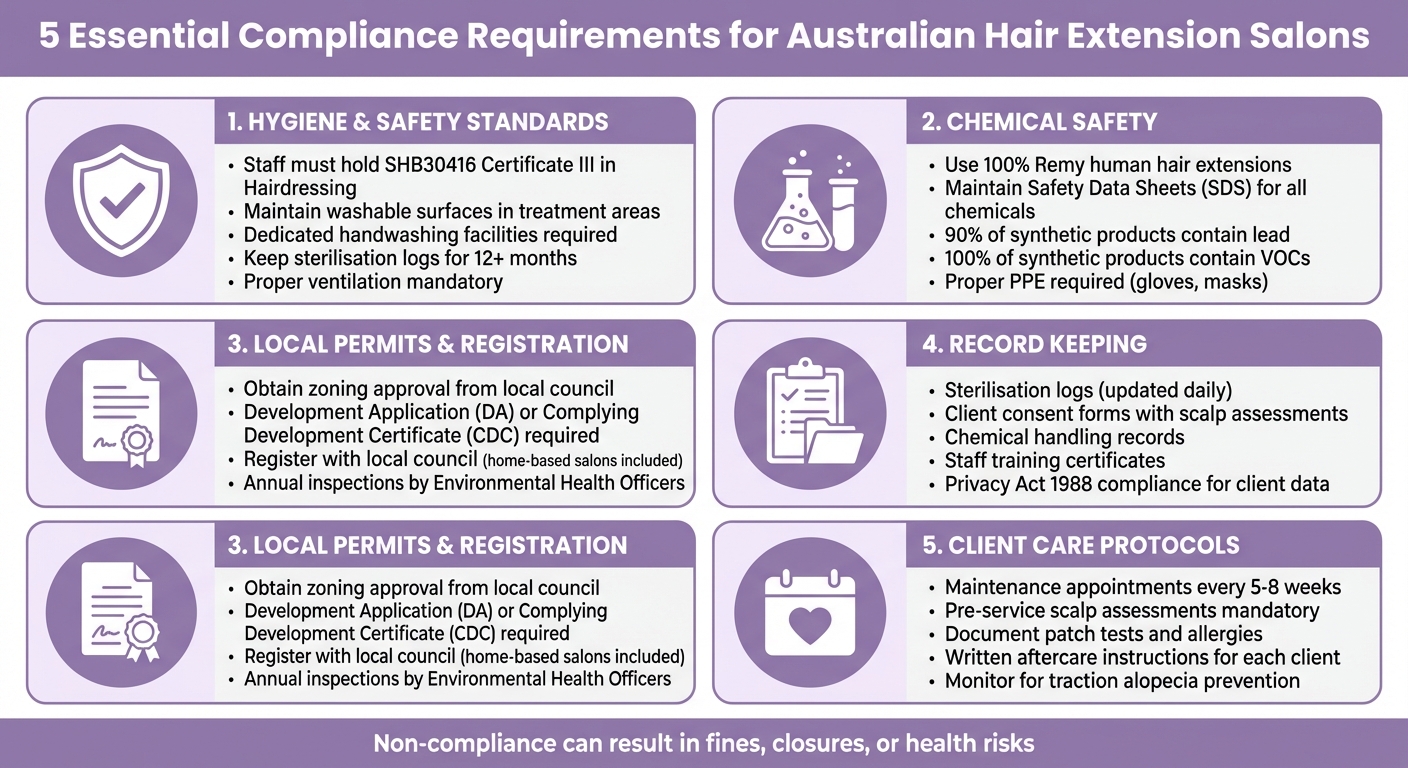
5 Essential Compliance Requirements for Australian Hair Extension Salons
Australian Salon Regulations for Hair Extensions
Hair extension salons in Australia must adhere to a range of state and local regulations. These rules are enforced through legislation and regular inspections by local councils. Failure to comply can lead to fines, business closures, or even risks to client health.
Hygiene and Safety Standards
In New South Wales (NSW), the Public Health Act 2010 and the Hairdressers Act 2003 lay out the essential hygiene, safety, and professional requirements for salons. As the Central Coast Council highlights:
"Unsafe or unhygienic procedures and/or premises can spread infectious diseases and may compromise individuals' personal health."
Professional qualifications are non-negotiable. In NSW, anyone working as a hairdresser for payment must hold a SHB30416 Certificate III in Hairdressing or an equivalent qualification. Apprentices may assist but must be directly supervised and cannot work independently.
Maintaining strict infection control is another critical aspect. Salons must ensure treatment areas have washable surfaces, provide dedicated handwashing facilities, and maintain proper ventilation. If your salon offers services involving skin penetration, such as microblading or piercing, you must register as a skin penetration business with the local council. Additionally, sterilisation records, including autoclave logs, must be kept for at least 12 months.
When it comes to hair extensions, safety is paramount. Traction alopecia - a form of permanent hair loss caused by excessive tension on the scalp - can be avoided with proper techniques. Stylists should always conduct a pre-service scalp assessment and discuss the client’s hair history to identify potential risks. A key principle from EH Hair Extensions is:
"Pain is NOT normal – if it hurts, it's too tight."
Chemical safety is equally crucial. Recent tests have uncovered high contaminant levels in some synthetic hair products. Using premium options like 100% Remy human hair extensions (e.g., from Hair Wonderland) can mitigate these risks. However, salons must still maintain Safety Data Sheets (SDS) for all adhesives, solvents, and chemicals used during application.
Finally, securing the appropriate permits is a necessary step for operating legally.
Local Council Permits and Zoning
Before leasing a space or setting up your salon, confirm zoning approval with your local council. In many areas, you may need development consent or a "change of use" approval to operate a hairdressing business. As Alex Solo from Sprintlaw advises:
"In many areas, commercial beauty services may need development consent or a change of use approval."
It’s important to consult a Duty Planner to ensure your premises has the correct Development Application (DA) or Complying Development Certificate (CDC) for a hair salon. This requirement applies to both commercial shopfronts and home-based salons - there are no exemptions for home businesses. Camden Council makes this clear:
"All skin penetration, hairdressing and non-skin penetration home businesses require a Complying Development Certificate or Development Consent before commencement."
Once zoning approval is obtained, you must register with your local council. This triggers annual inspections by Environmental Health Officers, who will review sterilisation records, cleaning protocols, and staff qualifications.
If you’re considering expanding your services - for example, by offering laser hair removal or IPL treatments - be aware that states like Western Australia, Queensland, and Tasmania require specific operator licences for these technologies. Always check the regulations in your state before adding new services to your salon’s offerings.
sbb-itb-dcde78e
Compliance for Adhesive-Based Hair Extensions
Skin Penetration Regulations
Adhesive-based extensions like tape-ins generally don’t fall under skin penetration registration requirements. However, salons that provide invasive beauty treatments must register with their local council. The ACT Government defines skin penetration as "any process that involves piercing, cutting, puncturing, or tearing of a human body".
In Victoria, the Public Health and Wellbeing Act 2008 requires businesses performing skin penetration procedures to register with their local council. Similarly, New South Wales enforces this under the Public Health Act 2010. If you’re registered, it’s mandatory to notify your local authority within seven days of any changes to your business details.
Registered salons must display a notice approved by the Department of Health at their entrance. This notice clarifies that the registration covers infection control standards, not the safety or quality of procedures performed. Annual inspections focus on hygiene practices, waste disposal (including sharps), and equipment disinfection. Additionally, salons must maintain thorough client records for all skin penetration procedures and provide clients with approved information sheets detailing potential risks and precautions.
Beyond registration, salons need to implement strict daily practices, particularly when working with adhesives and chemicals.
Safe Handling of Adhesives and Chemicals
Tape extensions rely on medical-grade adhesives like polyurethane or cyanoacrylate, which are similar to those used in wound closure. Handling these materials correctly is crucial. Your salon should keep up-to-date Safety Data Sheets (SDS) readily available and ensure all staff are trained in proper handling techniques and first aid.
Store adhesives and chemicals securely in well-ventilated spaces, away from sunlight, and always follow the manufacturer’s guidelines. Staff applying these products should wear appropriate personal protective equipment (PPE), such as gloves and masks, to limit exposure to volatile organic compounds (VOCs). A 2025–2026 study revealed that 100% of synthetic hair products tested contained VOCs like acetone and isopropylbenzene, highlighting the need for proper ventilation during application and removal processes.
Following a daily hair extension care routine is equally important. Advise clients to avoid washing their hair for 48–72 hours after application, allowing the adhesive to set properly. When removing extensions, always use professional alcohol-based or oil-based solutions to dissolve the adhesive bonds, as DIY removal often leads to hair damage. Schedule repositioning appointments every 6–8 weeks to prevent matting and reduce strain on natural hair. Lastly, document patch tests and any client allergy disclosures in consent forms to manage potential risks effectively.
Sourcing Quality Hair Extensions for Compliance
Choosing Certified Hair Extensions
Maintaining high product standards is essential to align with Australia's strict salon safety regulations. A 2026 study revealed that 90% of synthetic braiding products contain lead, and all tested products include VOCs. To meet compliance requirements, salons should opt for 100% Remy human hair.
For the best results, premium double-drawn vs single-drawn extensions sourced from Russian, Mongolian, or European regions are ideal. These extensions maintain intact cuticles, which ensures a natural blend with clients' hair, prevents matting, and eliminates the need for harsh chemical treatments. Hair Wonderland stands out in this category, offering professional-grade extensions exclusively to certified stylists through trade accounts. This ensures that only trained professionals handle these products, adhering to proper safety protocols.
In addition to material quality, it’s crucial to work with suppliers that meet ISO 9001 quality management standards. This certification guarantees that each batch of extensions meets strict safety and ethical sourcing benchmarks. Lightweight, well-designed products that evenly distribute weight are not just a preference but a necessity for both compliance and client safety.
Investing in these high-quality products does more than meet safety requirements - it also establishes strong, reliable supplier relationships.
How Quality Products Support Compliance
Choosing certified, premium hair extensions creates a solid foundation for compliance and supplier support. Trusted suppliers help safeguard your salon from non-compliance risks while enhancing your reputation for client safety. For example, Hair Wonderland products come highly recommended, with over 1,000 five-star reviews from professional stylists. Their six-week warranty requires the use of specific sulfate-free, protein-free aftercare products, which helps salons maintain proper documentation for inspections.
Reliable suppliers also provide clear instructions on safe application and maintenance schedules. Hair Wonderland, for instance, advises professional maintenance every 5–6 weeks - or every four weeks for clients with fine hair - to prevent traction damage caused by natural hair shedding reducing the support section. Following these structured protocols not only protects client hair health but also gives your salon a defensible compliance framework to present during council inspections, showcasing your dedication to safety and professional standards.
Maintaining Records and Preparing for Inspections
Keeping accurate records is essential for protecting your salon during inspections. In Australia, salons are required to maintain sterilisation logs that include details like the date, time, method, and the staff member responsible for sanitising tools between clients. These logs not only reflect your dedication to hygiene but also need to be updated daily - or after every client use for shared tools like scissors and combs - so they’re always ready for review.
Beyond sterilisation logs, maintaining detailed client records is another key compliance measure. These should include signed consent forms that cover scalp assessments, hair history, and extension methods. Additionally, ensure you have up-to-date Safety Data Sheets (SDS) for all chemicals stored in a clearly labelled folder near your chemical storage area. Every time you purchase new products, update this folder to make it easier to respond to inspection requests.
A weekly internal audit can help you stay on top of things. Use this time to check that maintenance logs, incident reports, and staff training certificates are up to date. Also, make sure your disinfection procedures are clearly displayed and keep waste collection receipts from approved providers readily available.
Protecting client information is just as important. Follow the guidelines set out in the Privacy Act 1988 by storing client data securely and having a clear data handling policy. Many salons in 2026 use digital systems to manage maintenance schedules, which can also send reminders for 5–8 week repositioning appointments - helping to prevent issues like traction alopecia while keeping your records in order.
Don’t forget to document your aftercare protocols. Provide each client with written instructions and keep a record that these were given. This practice not only upholds professional standards but also helps manage risks effectively. With well-organised records and premium Russian hair extensions, your salon can confidently demonstrate its commitment to compliance, complementing its hygiene, safety, and chemical handling standards.
Conclusion
Operating a hair extension salon in Australia means navigating a variety of rules designed to protect your clients, staff, and business. From securing local council permits to keeping sterilisation logs and Safety Data Sheets up-to-date, every step plays a role in maintaining safety and professionalism. As Alex Solo, Co-founder and Principal Lawyer at Sprintlaw, explains:
"Compliance isn't there to slow you down. It protects clients' health, your team's safety and your salon's reputation".
Equally important is the quality of the products you use. Sticking to 100% Remy human hair not only reduces health risks, such as exposure to lead and VOCs, but also ensures your insurance remains valid. Many insurers require proof that your materials meet industry standards before covering claims, which can sometimes amount to tens or even hundreds of thousands of dollars.
Strong record keeping further supports your compliance efforts. Keeping sterilisation logs, client consent forms, and maintenance schedules demonstrates your dedication to professional standards, especially during inspections. It also offers protection in case of liability disputes. Regular maintenance appointments every 5–8 weeks can help prevent issues like traction alopecia, safeguarding your clients' natural hair in the long run.
FAQs
Do I need council approval to run a home-based hair extension salon?
In Australia, setting up a home-based hair extension salon typically doesn't require council approval, provided you meet certain conditions. These include employing no more than two people (not counting residents), maintaining the peace and character of the neighbourhood, and refraining from activities like skin penetration procedures or food preparation. It's essential to review your local council's guidelines to ensure you're following all relevant rules.
What records are required for council inspections?
You need to maintain records of your registration with the local council, along with inspection reports and any compliance documents related to hygiene and safety standards. Make sure these records are always current and easily available for review during inspections.
When do hair extension services count as skin penetration?
Hair extension services are classified as skin penetration procedures only when they involve breaking the skin, such as with techniques like microdermabrasion or skin needling. However, methods like clip-in extensions, which are applied to the surface without affecting the skin, are not included in this category.