


When choosing hair extensions, it’s important to understand two key factors: volume and thickness. Volume refers to the overall weight and fullness of the extensions, measured in grams, while thickness describes the diameter of individual hair strands, measured in millimetres. Selecting the right combination ensures a natural blend with your hair and avoids discomfort or damage.
Key Points:
- Thickness: Fine strands (0.08–0.12mm) suit delicate hair; thicker strands (0.15–0.20mm) work well for dense hair.
- Volume: Light sets (40–90g) are ideal for fine hair, medium sets (100–130g) for average density, and heavy sets (150–200g+) for thick hair.
- Weft Type: Double-drawn extensions offer consistent thickness from root to tip, while single-drawn extensions taper naturally for a softer look.
- Weight Consideration: Extensions that are too heavy can strain your scalp, so match the weight to your natural hair type.
Quick Comparison:
| Feature | Single-Drawn Extensions | Double-Drawn Extensions |
|---|---|---|
| Density | Tapered ends | Even thickness throughout |
| Hair Type Suitability | Best for fine hair | Best for medium to thick hair |
| Weight | Lighter | Heavier |
| Use Case | Temporary styles | Long-term wear |
| Maintenance | Easier | Requires more care |
To achieve the look you want, consider your natural hair type, the desired style, and how much maintenance you’re willing to commit to. For example, fine hair benefits from lighter, single-drawn extensions, while thick hair pairs better with heavier, double-drawn options. Always consult a professional to ensure the extensions are a good fit for your hair and scalp.
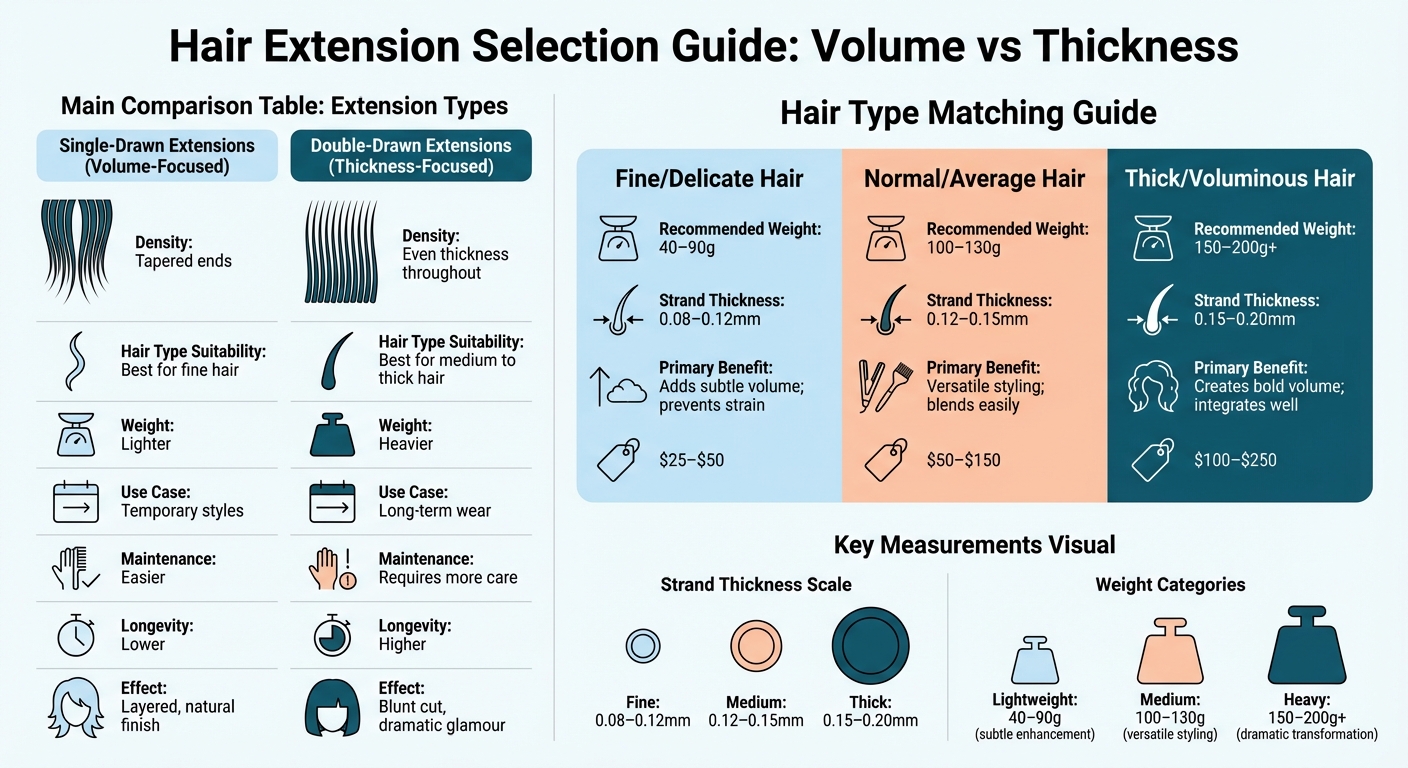
Hair Extension Selection Guide: Volume vs Thickness by Hair Type
1. Volume in Hair Extensions
Density of Hair Strands
The thickness of individual hair strands plays a major role in how full your hair looks. Fine strands (ranging from 0.08–0.12mm) are ideal for creating a subtle, natural look, especially for those with delicate hair. On the other hand, thicker strands (0.15–0.20mm) can deliver bold, noticeable volume, making them a great match for naturally dense hair types.
However, there’s a balance to strike. Extensions with strands that are much thicker than your natural hair can look bulky and unnatural. Conversely, strands that are too fine may not blend well if your hair is thicker. Beyond strand thickness, the way extensions are constructed also impacts how volume is distributed.
Weft Construction
The structure of hair extensions significantly affects how volume is distributed. Double-drawn extensions are a popular choice for those seeking consistent thickness from root to tip, which creates a bold, full-bodied appearance. In contrast, single-drawn extensions taper naturally towards the ends, forming a V-shape that mimics natural hair growth. While this tapering offers a more natural look, it provides less volume at the tips.
Another factor to consider is the weight-to-length ratio. Shorter extensions, like a 10-inch set, will appear much thicker than longer ones, such as a 30-inch set of the same weight. This is because the hair is concentrated over a shorter length, creating a denser look. Understanding how these factors work together helps you choose the right extensions for your hair type.
Hair Type Suitability
Your natural hair type plays a key role in determining which extensions will work best for you. For those with fine or thin hair, lightweight sets (40–90g) are ideal. These sets minimise strain on your natural hair while adding subtle volume. If your hair is of average density, medium-weight sets (100–130g) offer great versatility and are easy to blend. For thick or naturally voluminous hair, heavier sets (150–200g or more) can create a dramatic transformation.
| Natural Hair Type | Recommended Set Weight | Strand Thickness | Primary Benefit |
|---|---|---|---|
| Fine / Delicate | 40–90g | 0.08–0.12mm | Adds subtle volume; prevents strain |
| Normal / Average | 100–130g | 0.12–0.15mm | Versatile styling; blends easily |
| Thick / Voluminous | 150–200g+ | 0.15–0.20mm | Creates bold volume; integrates well |
Weight and Maintenance
The weight of your extensions is another crucial factor in achieving the desired look without sacrificing comfort. Lighter sets (under 100g) are mostly suited for adding length with minimal volume, while heavier sets (over 100g) deliver a noticeably fuller effect. Double-drawn extensions, which are naturally thicker, often require fewer pieces to achieve a full look, but they do demand more maintenance to keep them in top condition.
It’s also important to ensure that your scalp can handle the weight of the extensions. Choosing extensions that are too heavy can put unnecessary strain on your natural hair. A professional consultation can help you find the right thickness and weight to match your hair, ensuring both comfort and durability.
sbb-itb-dcde78e
2. Thickness in Hair Extensions
Strand Diameter and Density
When we talk about thickness in hair extensions, we're referring to two things: the diameter of each strand and how dense the hair is overall. Here's a quick breakdown: fine strands measure between 0.08–0.12mm, medium strands range from 0.12–0.15mm, and thick strands fall between 0.15–0.20mm. While volume focuses on how full the hair looks overall, thickness is all about how solid and strong each individual strand feels, as well as how much body the extensions provide from the roots all the way to the tips.
Interestingly, shorter extensions can appear thicker because the same amount of hair weight is concentrated into a smaller length. This means shorter extensions can create a bold, blunt look with more impact per gram compared to longer options.
Construction Methods
Strand thickness is just one piece of the puzzle. The way extensions are constructed also plays a big role in their overall consistency. Double-drawn extensions are designed to maintain uniform thickness from root to tip. This is achieved by manually removing shorter hairs, leaving strands that are mostly the same length. The result? A sleek, "blunt cut" effect that feels full and thick all the way through. Heather Collier from Cliphair explains it well:
Double drawn means each strand is as thick at the root of the extension as they are at the ends.
On the other hand, single-drawn extensions include strands of varying lengths within each bundle. This creates a more natural taper, mimicking the way real hair grows, but it also means the thickness diminishes towards the ends.
For those chasing maximum density, the construction of the wefts matters too. Double wefts involve sewing two wefts together, doubling the hair in one attachment. If that's not enough, quad wefts take it a step further by combining four wefts, offering even more thickness. These construction choices directly affect how seamlessly extensions blend with your natural hair.
Matching Your Natural Hair
It's not just about volume - matching the thickness of your extensions to your natural hair is key to achieving a seamless look. Extensions that align with your hair's natural thickness prevent awkward mismatched textures and ensure your own hair stays hidden beneath.
Double-drawn extensions are often preferred for permanent installations because they offer more versatility for cutting and layering. They also tend to last longer since their ends don't thin out as quickly as those in single-drawn hair. However, thicker extensions do require extra care. To keep them in top condition, it's important to use hydrating, plant-based haircare products made specifically for human hair extensions. This helps prevent dryness and keeps the extensions looking their best over time.
The BEST Hair Extensions for All Hair Thicknesses! | Thin Hair | Hair Loss | Thick Hair
Pros and Cons
Deciding between volume-focused and thickness-focused extensions boils down to what each option brings to the table. Both have their perks and challenges, influencing everything from how they feel day-to-day to how much effort they need over time.
Volume-focused (single-drawn) extensions are lightweight and budget-friendly. They’re perfect for fine hair, as they blend seamlessly with natural strands and avoid putting too much strain on the roots. The downside? Their thinner ends make them less durable, which is why they’re best for temporary use, like clip-ins.
Thickness-focused (double-drawn) extensions, on the other hand, are all about fullness and durability. They deliver a bold, blunt-cut look and are designed for long-term wear. But they do need extra care - think moisture-rich shampoos and hydrating masks. Plus, if you have fine hair, the added weight might feel uncomfortable or even lead to damage.
Here’s a quick comparison to help you decide:
| Feature | Volume-Focused (Single-Drawn) | Thickness-Focused (Double-Drawn) |
|---|---|---|
| Density | Tapered; thinner at the ends | Uniform; thick from root to tip |
| Weft Construction | Layered effect | Blunt effect |
| Hair Type Compatibility | Ideal for fine or delicate hair | Best for normal, thick, or voluminous hair |
| Weight | Lighter weights | Heavier weights |
| Maintenance | Lower longevity; easier daily care | Higher longevity; requires dedicated hydration |
| Best Use | Temporary (clip-ins); subtle enhancement | Permanent installations; dramatic glamour |
Your choice should reflect your hair type and how much maintenance you’re ready to commit to. This breakdown makes it easier to pick the option that best suits your style and routine. Once you've chosen, learn how to blend extensions for a flawless finish.
How to Choose the Right Extensions
When selecting hair extensions, start by considering your natural hair type and density. Extensions come in different weight sets: lightweight (40–90g), medium (100–130g), and heavy (150–200g+). For fine or delicate hair, stick to lightweight sets to avoid putting stress on your strands. Medium-density hair pairs well with 100–130g sets, while thicker hair benefits from heavy sets to maintain a balanced, natural look and avoid a stringy appearance.
Your desired style also plays a major role in your choice. If you're aiming for a relaxed, natural finish or a layered effect, single-drawn vs. double-drawn extensions are a great option. As Cliphair explains:
"For clients who are less concerned about dramatic volume and are looking for a more natural and relaxed finish, single drawn hair is a great choice".
On the other hand, if you're chasing a bold, red-carpet-worthy look with consistent thickness from roots to ends, double-drawn wefts are the way to go.
Length matters too. A shorter extension (e.g., 10-inch) will appear fuller compared to a longer one (e.g., 30-inch) at the same weight. If you’re adding length to already thick hair, consider a higher-gram set, like a 200g+ double-drawn option, to ensure a smooth and seamless blend. For instance, Hair Wonderland’s Seamless Set 22" (200g, $499.00) uses double-drawn Russian/Mongolian hair (see our Russian vs. Mongolian hair comparison) with Invisi® weft technology, offering a flat, natural finish.
Customise your choice based on the level of transformation you want. For subtle enhancements, go for lighter sets or single-drawn extensions. If you’re after a dramatic change, heavier sets (200g+) or double-drawn wefts will deliver the volume and fullness you need.
Finally, consider your budget. Pricing varies with weight and quality. Thin extensions (40–90g) usually cost between $25 and $50, medium sets (100–130g) range from $50 to $150, and thicker extensions (150–200g) typically fall between $100 and $250. Double-drawn wefts, while more expensive due to the extra labour and premium materials, often last longer and provide a more polished finish.
Conclusion
Understanding how volume and thickness affect your overall look is crucial when choosing the right extensions. Thickness refers to the diameter of individual hair strands and the density of the extensions, while volume focuses on how full and consistent the hair looks from root to tip.
Your natural hair type should guide your decision. For fine or delicate hair, lighter sets (40–90g) are ideal to prevent strain. If you have medium-density hair, extensions in the 100–130g range will blend seamlessly. For those with thicker hair, heavier sets (150–200g or more) are necessary for a natural finish. For a sleek, polished look, double-drawn extensions are the way to go, while single-drawn extensions offer a softer, more natural appearance.
When choosing extensions, consider the weight, draw type, and overall quality. If you're aiming for a smooth, blended result, a heavier set - such as a 200g+ double-drawn option - can be the perfect choice.
Premium extensions, like those from Hair Wonderland, offer an impressive combination of quality and comfort. Their Seamless Set 22" (200g, $499.00) features Invisi® weft technology, providing a flat and discreet finish that’s perfect for adding both length and volume. Made from Russian and Mongolian human hair, these extensions are designed for durability and a natural look.
Whether you're going for a subtle enhancement or a bold transformation, matching the right extensions to your natural hair and matching your hair colour ensures a seamless, long-lasting result.
FAQs
How do I know if my hair is fine, normal or thick?
To figure out if your hair is fine, normal, or thick, pay attention to both its volume and density. Fine hair usually feels thin and tends to have less volume. Normal hair strikes a balance, with a medium level of density. Meanwhile, thick hair stands out for its fullness and dense texture. Understanding these traits can guide you in picking the extensions that best match your hair type.
What grams should I choose if I want more length but not extra bulk?
For added length without unnecessary bulk, choose hair extensions that weigh about 100 grams. This strikes the perfect balance, giving you longer hair while keeping the look natural and avoiding excessive volume.
Can double-drawn extensions be too heavy for my scalp?
Double-drawn extensions might feel a bit too heavy for some people, especially if you have fine or fragile hair. The thicker, weightier ends can sometimes put extra pressure on the scalp, leading to discomfort. It’s important to think about your hair type and how much weight your scalp can handle when selecting extensions to keep things comfortable and achieve a natural appearance.