


When your hair extensions don’t look natural, mismatched undertones are often the problem. Even if the colour depth matches, clashing undertones - cool vs warm - can create harsh contrasts, making your extensions stand out unnaturally.
Here’s the key takeaway:
- Warm undertones: Golden, honey, or copper hues
- Cool undertones: Ashy, silvery, or platinum shades
To avoid mismatches:
- Identify your undertone: Use tests like the white paper, vein colour, or jewellery preference.
- Match mid-lengths and ends: Don’t just match your roots; focus on where extensions meet your natural hair.
- Choose multi-tonal extensions: These mimic natural highlights and lowlights, blending better than single-tone options.
Extensions that clash with your undertone can look grey, brassy, or unnatural. Always check colours in natural daylight, and consider rooted or multi-tonal options for a smoother blend.
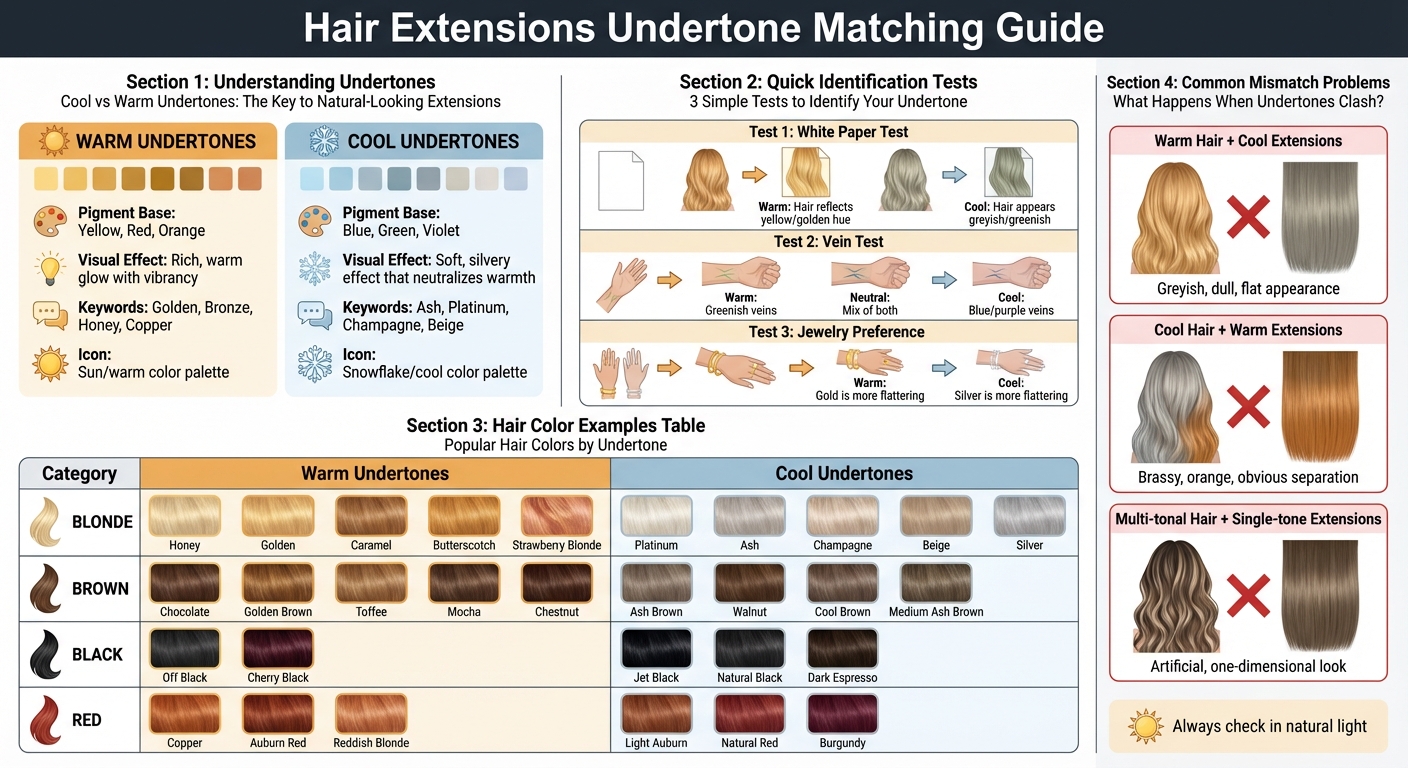
Cool vs Warm Hair Undertones: Visual Identification Guide and Color Examples
How to Color Match Hair Extensions Like a Pro
What Are Cool and Warm Undertones?
Undertones are the subtle hues beneath your hair’s surface colour. While your hair might appear to be brown or blonde at first glance, its underlying pigments determine whether it leans warm, cool, or neutral. This is why two shades with the same depth - like honey blonde and ash blonde - can look so different.
Warm undertones are made up of yellow, red, or orange pigments. Hair colours with warm undertones often feature descriptions like "golden", "bronze", "honey", or "copper." These shades reflect light with a rich, warm glow that adds vibrancy and depth.
Cool undertones, on the other hand, are based on blue, green, or violet pigments. These are often described with terms like "ash", "platinum", "champagne", or "beige." Cool tones create a soft, silvery effect that can neutralise redness or warmth.
When undertones don’t match, the difference is noticeable. For instance, pairing cool ash blonde extensions with warm caramel hair can make the extensions look greyish and dull, highlighting the separation between your natural hair and the extensions.
How to Identify Your Hair's Undertone
Figuring out your hair’s undertone doesn’t require a professional - it’s something you can do at home with a few simple tests:
- The white paper test: Stand in natural daylight and hold a plain white sheet of paper next to your hair. If your hair reflects a yellow or golden hue, you likely have warm undertones. If it appears greyish or greenish, you’re probably cool-toned.
- The vein test: Look at the veins on the inside of your wrist under natural light. Greenish veins suggest warm undertones, while blue or purple veins indicate cool undertones. If you see a mix of both, you likely have neutral undertones.
- Jewellery preference: Try on gold and silver jewellery. If gold complements your skin better, you’re warm-toned. If silver looks more flattering, you’re cool-toned.
Other clues include how your skin reacts to the sun. People who tan easily tend to have warm undertones, while those who burn or blush are usually cool-toned. You can also do a blush test: apply peach blush to one cheek and pink to the other. Peach enhances warm undertones, while pink highlights cool ones. Always perform these tests in natural daylight for the most accurate results, as artificial lighting can skew your perception.
Examples of Cool and Warm Undertones
Here’s a breakdown of popular hair colours and how they align with warm and cool undertones:
| Category | Warm Undertones | Cool Undertones |
|---|---|---|
| Blonde | Honey, Golden, Caramel, Butterscotch, Strawberry Blonde | Platinum, Ash, Champagne, Beige, Silver |
| Brown | Chocolate, Golden Brown, Toffee, Mocha, Chestnut | Ash Brown, Walnut, Cool Brown, Medium Ash Brown |
| Black | Off Black, Cherry Black | Jet Black, Natural Black, Dark Espresso |
| Red | Copper, Auburn Red, Reddish Blonde | Light Auburn, Natural Red, Burgundy |
For those with neutral undertones, the options are even broader. Shades like "bronde" (a mix of brown and blonde) work particularly well, as they balance both warm and cool tones.
Understanding your undertone makes choosing extensions much easier and ensures a seamless match. Up next, we’ll explore common mistakes to avoid when selecting extensions.
Common Mistakes When Matching Hair Extensions
Even when you know your undertone, it’s surprisingly easy to pick the wrong hair extensions. Mistakes like matching extensions to the wrong hair area, choosing an unsuitable shade, or viewing them in poor lighting can turn a seamless blend into an obvious mismatch. Let’s dive into the specific errors you should avoid when matching extensions.
Ignoring Base and Root Undertones
One of the most common mistakes is matching extensions to your roots instead of your mid-lengths and ends. Roots are naturally darker because they haven’t been exposed to sunlight or heat styling. Matching extensions to this darker section can create a harsh, two-toned effect, where the extensions look too dark compared to the lighter, sun-kissed lengths of your hair.
"A common mistake is matching extensions to your roots rather than your lengths, which can make the extensions look unnatural." - Cliphair UK
When it comes to tape-ins or micro-beads, it’s important to match the extension root for discreet blending. But for overall colour harmony, focus on where your natural hair and extensions meet - usually the mid-lengths and ends.
Another frequent misstep? Checking extension swatches under indoor lighting. Fluorescent or yellow-toned lighting can distort undertones, making it harder to find the right match. Always view swatches in natural daylight for the most accurate colour assessment.
Choosing Single-Toned Extensions
Natural hair isn’t flat - it has highlights, lowlights, and subtle variations that single-toned extensions simply can’t replicate. Using single-tone extensions against multi-dimensional natural hair creates an obvious and artificial look.
"Unlike flat, single-tone extensions, these shades mimic real hair's natural variations, allowing for a perfect blend even if your hair isn't an exact match." - Endaring Hair
Single-tone extensions tend to look one-dimensional, failing to blend with your hair’s natural texture and colour depth. Multi-tonal extensions, on the other hand, incorporate highlights and lowlights, offering a more natural and dynamic appearance. These extensions are especially helpful if your hair has subtle variations, as they ensure a smoother, more believable blend.
How Undertone Clashes Affect Your Look
Mismatched undertones can ruin the overall effect. Combining warm-toned extensions with cool-toned hair - or vice versa - creates a patchy, unnatural appearance. This clash can make your hair look muted, brassy, or overly contrasting, drawing unwanted attention to the extensions.
| Natural Hair Undertone | Mismatched Extension Undertone | Resulting Look |
|---|---|---|
| Warm (Golden, Caramel, Honey) | Cool (Ash, Platinum, Beige) | Looks greyish, dull, or flat; lacks vibrancy |
| Cool (Ash, Platinum, Silver) | Warm (Golden, Copper, Honey) | Appears brassy or orange; creates obvious separation |
| Multi-tonal (Highlights/Lowlights) | Single-tone (Flat Colour) | Artificial and one-dimensional; lacks movement |
| Dark Roots (Natural Regrowth) | Solid Light Shade (Non-rooted) | Patchy, two-toned appearance with a visible "line" |
When undertones clash, it becomes painfully clear where your extensions meet your natural hair. This disrupts the seamless look you’re aiming for. Up next, we’ll explore how to select extensions that align perfectly with your undertones for a flawless finish.
sbb-itb-dcde78e
How to Choose Extensions That Match Your Undertone
Finding hair extensions that perfectly match your undertone is easier than you might think, especially with the right guidance and tools. With expert advice and multi-tonal options, you can achieve a seamless, natural look. Here’s how to use Hair Wonderland’s resources to get the perfect match.
Using Hair Wonderland's Colour Matching Assistance
Hair Wonderland provides professional colour matching assistance to take the guesswork out of choosing extensions. Instead of relying on poor lighting or random trial and error, simply take a high-quality photo of your hair in natural light. The key is to capture your hair from root to tip near a window - but avoid direct sunlight for the most accurate results.
"The best way to match your hair extensions to your natural hair is to focus on the mid-lengths and ends of your hair." - Showpony Hair Extensions
Once you send in your photo, their experts will analyse your hair's depth, tone, and undertone to recommend the most compatible shade. This process is especially useful if you're unsure whether your undertone is warm, cool, or neutral. After identifying your ideal shade, you can explore multi-tonal options to add depth and dimension to your look.
Blending Multi-Tonal Extensions for Natural Results
Multi-tonal extensions, like Hair Wonderland’s Seamless Set 22" ($499.00 AUD), are designed to mimic the natural highlights and lowlights in your hair. These extensions adapt to warm, cool, or neutral variations, creating a more natural blend.
"Multi-tonal hair extension colours offer a more natural appearance, as they blend various shades to mimic the natural highlights and lowlights in your hair." - Milk & Blush
If your hair has subtle sun-kissed tones or natural regrowth, multi-tonal extensions are much more forgiving than solid colours. And if you’re torn between two shades, go lighter - stylists can tone extensions darker, but lightening them is much trickier.
Products for Maintenance and Styling
Extensions require extra care since they don’t benefit from your scalp’s natural oils. To keep them looking fresh, Hair Wonderland’s Tangle Tamer Brush ($21.95 AUD) is a must-have. It detangles without causing breakage or matting, preserving the extensions’ smoothness and shine.
To maintain their colour and vibrancy, pair your extensions with salon-recommended products. Proper care ensures your extensions blend seamlessly with your natural hair, enhancing the overall flow for an undetectable finish.
How to Fix Undertone Mismatches
Sometimes, even with careful planning, your extensions might not perfectly match your natural undertone. But don’t worry - there are simple ways to adjust and blend them seamlessly. Let’s dive into a few practical solutions to fix undertone mismatches.
Layering Extensions with Compatible Shades
Layering different shades can create a more natural, dimensional effect. If your extensions look too flat or overly uniform, this technique can add depth and prevent that overly "wig-like" appearance. For instance, combining golden blonde with honey blonde can enhance the overall look.
"Blending multiple extension shades creates a multi-dimensional, natural look, especially for coloured or highlighted hair." - Platform Hair Extensions
An effective way to do this is by alternating shades row-by-row when using clip-ins or tape-ins. This approach helps blend the extensions with your natural highlights and lowlights. When selecting shades, focus on matching your mid-lengths and ends rather than your roots, as that’s where the extensions will primarily sit.
Using Rooted Extensions
Rooted extensions are designed with a darker base that gradually transitions to a lighter shade, mimicking the natural look of hair growth. This "root smudge" effect can soften the contrast between your natural roots and the extensions, eliminating harsh lines.
These extensions are especially helpful if your roots are much darker than the rest of your hair. The darker root acts as a transition point, allowing for a smoother blend even if the extension's tone isn’t a perfect match. For tape-in extensions, matching the root colour is particularly important to keep the adhesive tabs discreet.
Comparison of Warm, Cool, and Neutral Extension Options
Understanding the undertone of your extensions can make all the difference in achieving a harmonious look. Here’s a quick breakdown:
| Undertone Type | Visual Characteristics | Best Suited For | Common Shade Keywords |
|---|---|---|---|
| Warm | Golden, yellow, honey, or copper hues | Skin with greenish veins; tans easily | Honey, Caramel, Copper, Golden, Butterscotch |
| Cool | Ashy, silvery, platinum, or bluish/violet tints | Skin with blue/purple veins; fair skin with rosy undertones | Ash, Platinum, Champagne, Icy, Silver |
| Neutral | A balanced mix, often appearing beige or bronde | Skin that suits both gold and silver jewellery | Beige, Bronde, Sandy, Natural |
If your extensions lean too warm, try using a purple shampoo or a semi-permanent toner to tone down brassiness and achieve a cooler shade. Just remember, these treatments should only be applied to 100% Remy human hair, as synthetic hair doesn’t absorb colour and may get damaged by chemicals. For the final touch, style your natural hair and extensions together - waves and curls are particularly great for blending the two seamlessly.
Conclusion: Getting the Right Undertone Match
Finding the right undertone match is crucial for achieving extensions that look natural and blend effortlessly with your hair. When done correctly, this match ensures your extensions not only harmonise with your natural hair but also enhance your overall appearance. As Bennetts & Jackson Hair + Extensions emphasise:
"A perfect colour match is step 1 in achieving our goal of natural-looking luxury hair extensions"
Even minor mismatches can disrupt the seamless look you're aiming for. Mistakes like matching extensions to your roots, relying on single-tone options, or checking colours under artificial lighting often lead to noticeable contrasts. These small errors can make extensions stand out in ways that feel less than ideal.
Hair Wonderland’s double-drawn human hair extensions are carefully designed to reflect the natural variations found in real hair. Their multi-tonal options mimic these variations, making it easier to achieve a flawless blend. This aligns perfectly with the earlier tips on multi-tonal blending. Plus, their colour matching service simplifies finding your perfect shade. And because the extensions are made from 100% Remy human hair, they can even be professionally toned to suit your needs.
High-quality extensions not only blend well but also reflect light naturally, adapt to colour changes, and move like your own hair. Multi-tonal extensions, in particular, provide depth and dimension that single-tone options simply can’t replicate. If you’re unsure between two shades, opt for the lighter one, match to your ends rather than your roots, and always assess colours in natural daylight for the best results.
The right undertone match transforms extensions from obvious add-ons to seamless enhancements. Taking the time to evaluate your undertone, recognise the natural variations in your hair, and select extensions that complement your unique colouring is the key to achieving a polished, natural look. By following these steps, your extensions will enhance your style rather than detract from it.
FAQs
How can I figure out if my hair has warm or cool undertones?
To figure out your hair's undertones, start by looking at the veins on the inside of your wrist under natural light. If they look blue or purple, you probably have cool undertones. If they appear greenish, you’re likely working with warm undertones.
Your eyes can also give you a hint. Golden or hazel flecks in your eyes often suggest warm undertones, while blue or grey flecks lean towards cool undertones. Another trick? Try on some jewellery. Gold jewellery tends to flatter warm undertones, while silver usually looks better on cool undertones.
These quick tips can help you identify whether your natural hair and skin undertones are warm or cool, making it easier to pick extensions that blend naturally or add that extra flair to your look.
Why do extensions with multi-tonal colours blend more naturally than single-tone ones?
Extensions with multi-tonal colours offer a more natural appearance because they imitate the natural variations in real hair - like highlights, lowlights, and subtle shade changes. Real hair isn’t just one flat colour; it has layers of depth and dimension, which these extensions are specifically crafted to reflect.
By combining different shades and undertones, multi-tonal extensions make it simpler to match your hair’s unique colour, whether it leans towards cool or warm tones. This helps avoid noticeable mismatches and ensures a smooth, natural blend that looks like an extension of your own hair.
What can I do if my hair extensions don’t match my undertone?
If your extensions don’t quite match your undertone, the first step is figuring out whether your skin has cool or warm undertones. An easy trick is to check the veins on your wrist - if they appear greenish, you likely have warm undertones, while blue or purple veins usually point to cool undertones.
Once you know your undertone, choose extension shades that complement it. For cool undertones, go for ash or cooler colours. Warm undertones, on the other hand, work well with golden, caramel, or warmer shades. If your current extensions don’t align, you might want to consult a professional for colour-matching tips or add highlights or lowlights to blend everything more naturally. Matching your extensions to your undertone is key to achieving a seamless, natural look.