


Matching hair extensions online can be tricky, but getting it right ensures they blend perfectly with your natural hair. Here’s how to avoid common mistakes and choose the right shade:
- Know Your Hair Colour and Undertones: Identify your base colour (e.g., blonde, brunette) and undertones (warm, cool, or neutral). Match extensions to your mid-lengths and ends for a natural look.
- Use Natural Light: Check your hair colour in indirect daylight to see its true tones. Artificial lighting can distort colours.
- Take Clear Photos: Capture unedited photos of your hair from multiple angles in natural light to compare with colour charts.
- Order Colour Swatches: Test physical swatches against your hair in different lighting conditions to ensure a good match.
- Choose Multi-Tonal Shades: If your hair has highlights or lowlights, opt for multi-tonal extensions for a seamless blend.
Avoid These Mistakes:
- Relying on screen colours without swatches.
- Matching extensions to your roots instead of mid-lengths and ends.
- Using filters or editing photos.
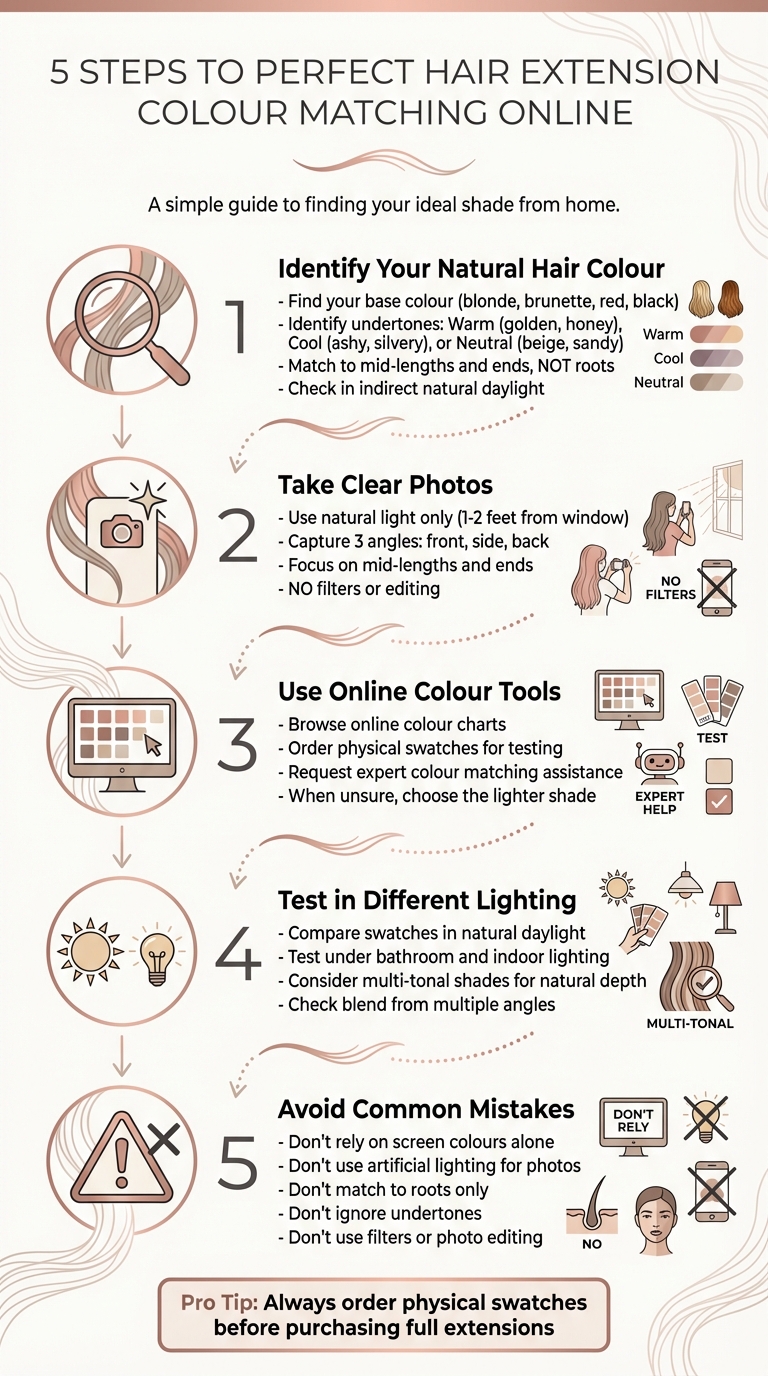
5-Step Guide to Matching Hair Extensions Online
Use this trick to find your RIGHT hair extensions color | how to find the perfect tone
Step 1: Identify Your Natural Hair Colour and Undertones
Before diving into colour charts, take a moment to figure out your natural hair colour and undertones. Hair has a base colour, but it also carries undertones that can make or break how well extensions blend.
Find Your Base Colour
Start by categorising your hair: blonde, brunette, red, or black. This gives you a general idea of where to begin. For extensions, match their colour to the mid-lengths and ends of your hair, where the most noticeable variations occur. If you're selecting extensions for a ponytail or updo, however, match them to your roots.
Why? Roots are often darker due to regrowth or less exposure to sunlight, while ends tend to be lighter and more porous. Extensions should blend seamlessly with the area they’ll sit - usually the ends - so you don’t end up with a harsh line where your natural hair stops.
Recognise Warm, Cool, and Neutral Undertones
"Most importantly, differentiate between undertones: warm, cool or neutral." – LullaBellz
Understanding undertones is key. Here's a quick guide:
- Warm undertones: These include golden, yellow, honey, or copper hues. Colours like Caramel or Auburn fall into this category.
- Cool undertones: Think ashy, silvery, or icy tones, such as Platinum Blonde or Ash Brown.
- Neutral undertones: A balanced mix of both warm and cool, often appearing beige or sandy.
Even if two shades share the same base colour, mismatched undertones can stand out. For example, a warm golden brown and a cool ash brown might both be "brown", but they won’t blend naturally.
Check Your Colour in Natural Light
Artificial lighting can warp how your hair colour appears. Bathroom lights might add a yellowish tint, while certain LEDs can give your hair a bluish cast. The best way to see your true colour? Use indirect natural daylight.
Stand near a window during daylight hours or step outside into the shade. Avoid direct sunlight - it can cause glare and make your hair look brighter than it actually is. Pull your hair forward and examine it from root to tip, checking from different angles. This will help you spot the highlights, lowlights, and subtle dimensions that make your hair unique.
Once you've nailed down your natural colour and undertones, you’re ready to move on to the next step: capturing clear photos for comparison.
Step 2: Take Clear Photos for Colour Comparison
Once you've identified your natural hair colour in Step 1, it's time to document it accurately with clear photos. This step is crucial for avoiding mismatches when selecting extensions and ensuring a seamless blend.
Photograph in Natural Light
Natural light is ideal for capturing the true tones of your hair. It highlights the subtle details like balayage, highlights, and lowlights that make your hair unique.
"Natural lighting is your best friend when taking photos so take advantage of the sun while it's out!" – Cashmere Hair
To get the best results, stand about 1–2 feet away from a window during daylight hours. Look for soft, diffused light and avoid direct sunlight, which can cause overexposure. Turn off any artificial lights, like overhead bulbs or lamps, as they can create unwanted reflections or colour distortions. If you're outdoors, find a shaded spot - like under a verandah - to enjoy natural light without glare.
Check for soft shadows in your photos. Sharp shadows often mean the light is too direct. Artificial lighting can introduce unwanted tints, such as blue or yellow, making your hair appear different than it actually is. Capturing your hair accurately ensures your extensions will blend perfectly.
Capture Multiple Angles
Hair colour can look different depending on the angle and how the light hits it. Make sure to take photos from at least three perspectives - front, side, and back. This gives a complete view of your hair’s colour and texture. A side profile and a full-back shot (with help from a friend if needed) are especially useful for capturing your hair’s depth and dimension.
Focus on your mid-lengths and ends, as these areas are where extensions will be applied. Use a clean lens and a simple background to keep the focus on your hair. These clear, detailed photos will make the next step of colour matching much easier.
Don't Use Filters or Editing
Stick to unedited photos - no filters or touch-ups. Even minor edits can alter the way your hair colour appears.
"Regarding filters, although they may make you feel better about your photo, they don't do much in the way of showing off your hair colour." – Additional Lengths
Filters and editing tools can mask the highlights and lowlights that professionals rely on for accurate matching. They can also shift the perceived tone of your hair, such as making it look warmer or cooler than it is. Plus, differences in screen displays can further distort colours. Unaltered photos are essential for tools like the Hair Wonderland Colour Chart, giving you the most precise match possible.
Step 3: Use Hair Wonderland's Online Colour Matching Tools

Once you've got your clear, unedited photos ready, it's time to dive into Hair Wonderland's online colour matching tools. These tools rely on your accurate photos to help you find the perfect match for your extensions.
Browse the Hair Wonderland Colour Chart
Head over to Hair Wonderland's colour chart at hairwonderland.com.au. This chart allows you to compare shades side-by-side, focusing on subtle highlights and lowlights that add natural depth to quality extensions. These details can help you narrow down your options.
When matching, focus on your mid-lengths and ends, as roots often appear darker. If you wear your hair up frequently, you may want to match closer to your roots or choose a slightly darker shade. For hair worn down, stick to matching the mid-lengths for a more seamless blend.
Keep in mind that screen resolutions can alter how colours appear. Some brands use descriptive names like "liquorice" for Jet Black or "butterscotch" for Champagne Blonde to make the selection process easier. Use your earlier evaluation of your hair's undertones - warm, cool, or neutral - to guide your choice. Look for shade names such as "Golden", "Ash", or "Beige" to ensure the extensions complement your natural tone.
Still unsure? Go for the lighter shade. It's always easier to darken extensions than to lighten them.
Order Colour Swatches for Physical Testing
For the most accurate match, consider ordering colour swatches before making your final purchase. Swatches let you see exactly how the extensions will blend with your natural hair, helping you avoid costly mistakes.
"Colour Swatch Samples provide a tangible way to see how the Hair Extensions will look against your natural hair. This eliminates the guesswork and helps you make an informed decision first time." – LullaBellz
Test the swatches against your mid-lengths and ends in indirect daylight to ensure a good match. Check them from various angles to see how the tones interact with your natural hair, and brush them together to observe how they blend when in motion.
This simple step can save you both time and money, reducing the chances of needing to return or exchange your extensions. Combined with your earlier photo evaluation, swatches provide a thorough way to confirm your choice.
Request Hair Wonderland's Colour Matching Assistance
If you're still unsure after using the colour chart or swatches, Hair Wonderland offers expert help. Submit your photos for a complimentary shade consultation from their professional team.
Make sure your photos show your hair from multiple angles - front and back - and are taken in indirect natural daylight. Avoid using filters, flash, or artificial lighting, and focus on capturing your mid-lengths and ends, as these are the areas where the extensions need to blend perfectly. Their experts will assess your hair's undertones and tonal variations to recommend the ideal shade, giving you confidence in your selection.
sbb-itb-dcde78e
Step 4: Test the Match in Different Lighting
After you've chosen your swatches, it's crucial to see how they hold up under different lighting conditions. Hair colour can shift dramatically depending on the light source. A shade that seems perfect under your bathroom lights might look entirely different outdoors. That’s why testing your swatches in varied lighting is a must before committing to a full set.
Compare Swatches in Natural and Indoor Light
Once your colour swatches arrive, examine them under natural sunlight, bathroom lighting, and standard indoor lighting. Each type of light can reveal different aspects of the colour. Natural daylight is the most reliable for showing true base tones and subtle highlights without interference from artificial hues. On the other hand, indoor lighting - especially from yellow or white bulbs - can distort the colour, often making it appear warmer or darker than it actually is.
"Any colour discrepancies between your natural hair and the colour swatch will be much more obvious outdoors, rather than indoors where the shade can appear darker or inaccurate" – LullaBellz
Hold the swatches against your mid-lengths and ends in each lighting scenario, observing how well they blend with your natural hair from different angles. A good match should look consistent across all lighting conditions. If the swatch doesn’t align in every setting, it might be worth exploring other options for a better match.
Consider Multi-Tonal Shades for Natural Depth
If a single shade doesn’t blend perfectly, multi-tonal options could be the solution. These shades mimic the natural highlights and lowlights found in real hair, creating a more seamless and realistic look. Unlike flat, single-tone colours, multi-tonal extensions adapt to light, giving your hair depth and avoiding harsh transitions.
These extensions are designed to replicate the way light interacts with natural hair, ensuring a smooth blend. Some brands even offer up to 33 multidimensional shades, crafted to replicate the subtle variations of human hair. If your natural hair falls between two shades, opting for a multi-tonal colour can provide a much smoother and more natural blend than a solid block shade.
Step 5: Common Colour Matching Mistakes to Avoid
When ordering hair extensions online, a small mistake can lead to frustrating colour mismatches. The good news? These common errors are easy to sidestep with a little knowledge and preparation. Building on Steps 1-4, here's how to avoid costly missteps and ensure your extensions blend beautifully with your natural hair.
Mistakes and Solutions
Here’s a handy guide to common colour matching errors and how to fix them:
| Mistake | Solution |
|---|---|
| Relying on screen colours | Always order physical swatches for a more accurate match. |
| Taking photos in artificial lighting | Check your hair colour in natural, diffused light for the most accurate results. |
| Matching to roots only | Match your extensions to the section they’ll be applied to, not just the roots. |
| Choosing a single-tone shade | Opt for multi-tonal shades with highlights and lowlights for a natural look. |
| Using photo filters or editing | Submit raw, unedited photos for accurate colour assessment. |
| Ignoring undertones | Examine your hair’s undertones (warm, cool, or neutral) in natural light before choosing a shade. |
| Choosing a shade too dark | If you're unsure, go for the lighter shade - it’s easier to darken extensions than to lighten them. |
Pro Tip: Match extensions to the specific part of your hair they’ll blend with. For example, if you’re wearing your hair down, match the extensions to your mid-lengths and ends. For updos or ponytails, focus on matching the roots and crown.
Additional Tips to Avoid Costly Errors
- Know Your Extensions: Synthetic extensions, often made from materials like acrylic or nylon, are pre-dyed and cannot be recoloured. Always confirm the hair type before attempting to dye them.
- Consider the Style: Extensions for styles worn down (like clip-ins) need to match your ends, while those for updos should match your roots. Choosing the wrong match for your style can cause noticeable colour differences, even if the shade seems correct.
Conclusion
Confidently match your hair extensions without the worry of mismatched shades. By carefully following steps like identifying your base colour and checking it under different lighting, you can achieve a flawless blend.
Take your time and explore all available tools. Order physical swatches to compare directly with your hair in various lighting conditions, or reach out to Hair Wonderland for expert shade advice. Professional input can be the difference between a perfect match and an expensive mistake.
Focus on matching your mid-lengths and ends, rather than your roots, for a natural transition. Opt for multi-tonal shades that include highlights and lowlights to mimic the depth of natural hair, ensuring your extensions look seamless no matter the lighting.
With a little patience and the right techniques, your extensions will blend beautifully, giving you a polished and natural appearance.
FAQs
How can I identify my hair's undertones for the perfect colour match?
To find the perfect colour match for your hair, it’s essential to identify your undertones - whether they’re cool, warm, or neutral. Cool undertones typically show hints of blue or pink, while warm undertones lean more towards peach, yellow, or golden shades. Neutral undertones are a balanced mix of the two.
Use natural lighting to examine your skin and focus on the mid-lengths and ends of your hair, as these areas reveal your true hair tone better than the roots. Here’s a handy trick: check the veins on your wrist. If they appear blue, you likely have cool undertones, and if they look green, warm undertones are more likely. Pinpointing your undertone makes it easier to choose extensions that blend effortlessly with your hair, giving you a seamless and natural finish.
Why should I take photos of my hair in natural light for colour matching?
Taking photos of your hair in natural light is key to getting an accurate colour match for hair extensions. Artificial lighting or indoor setups can change how your hair colour looks, often making it seem warmer or cooler than it actually is.
Daylight offers a more reliable and true-to-life representation of your hair's tones and highlights. This ensures your extensions blend smoothly with your natural hair, helping you avoid the hassle and cost of dealing with mismatched colours.
Why should I choose multi-tonal hair extensions?
Multi-tonal hair extensions are an excellent option for achieving a natural, blended look. If your hair naturally features a mix of shades, these extensions can replicate that variation, creating a harmonious appearance.
The combination of tones in these extensions allows them to complement your hair's primary colour effortlessly. This makes them a flexible choice for anyone looking to achieve a polished and consistent finish.