


Blending hair extensions with your natural hair can be tricky, but most issues - like visible tracks, mismatched textures, or unnatural transitions - can be resolved with the right techniques. Here’s the short version:
- Colour Match: Focus on matching the mid-lengths and ends of your hair, not just the roots. Use natural light to check undertones.
- Texture Match: Pair extensions with your natural hair's air-dried texture (straight, wavy, or curly) for a consistent look.
- Correct Placement: Avoid visible tracks by keeping wefts below the brow line and spacing them evenly.
- Length & Layers: Trim extensions to blend naturally with your haircut and avoid an abrupt "shelf effect."
- Volume Balance: Match extension density to your natural hair to prevent a bulky or sparse appearance.
- Product & Heat Use: Use sulphate-free products, apply heat protectant, and avoid over-washing to maintain extension quality.
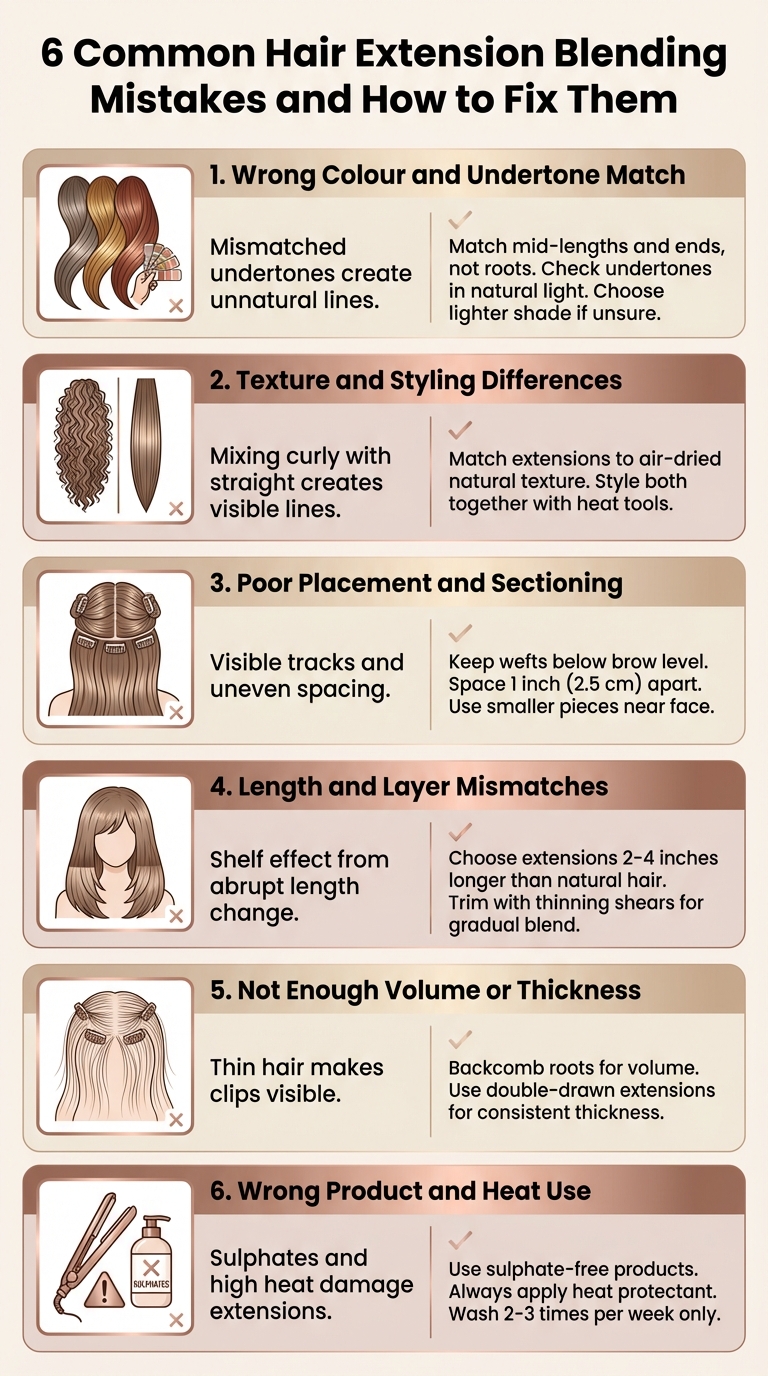
6 Common Hair Extension Blending Mistakes and How to Fix Them
Why your extensions don't blend with your hair | Bebonia Curly Hair Extensions
Mistake 1: Wrong Colour and Undertone Match
Choosing the wrong extension colour can ruin the seamless, natural look you're aiming for. Even when shades seem close, mismatched undertones can throw everything off. As Showpony Hair Extensions puts it: "The best way to match your hair extensions to your natural hair is to focus on the mid-lengths and ends of your hair." Relying solely on your root colour often results in a sharp, unnatural line where the extensions begin.
What Are Undertones?
Undertones are the subtle pigments that influence your hair's overall hue. Warm undertones bring out golden, honey, or copper shades; cool undertones lean towards ashy, platinum, or violet hues; and neutral undertones sit somewhere in the middle, often becoming more apparent in sunlight or when your hair is lightened.
To figure out your undertones, try the white paper test. Hold a plain white sheet next to your hair in natural sunlight. If your hair makes the paper look yellow or golden, you likely have warm undertones. If the paper appears bluish or violet, your undertones are probably cool. Another trick is to check your wrist veins - greenish veins suggest warm undertones, while blue or purple veins point to cool. Heather Collier from Cliphair explains: "Cooler skin tones typically vibe better with icier, ashier blondes, while warmer complexions shine alongside more honey, golden-infused shades of blonde."
Matching Your Root Colour
Understanding your undertones is crucial when choosing an extension colour that blends with your roots. Always assess your hair in natural light for the most accurate match. If you're stuck between two shades, go for the lighter one - it’s easier for a stylist to darken extensions than to try and lighten them.
For those with darker roots or colour-treated hair, balayage or ombre extensions are a great alternative to single-tone options. These styles create a gradual colour transition, avoiding the stark line that single-tone extensions can create. As CurlsQueen points out: "Balayage or ombre extensions work well for adding color without a harsh line of demarcation." Premium options from Hair Wonderland are crafted to blend naturally, ensuring a realistic and forgiving finish for your new look.
Mistake 2: Texture and Styling Differences
If your natural waves meet straight extensions, the contrast creates a visible line where the two textures meet. Experts stress that combining curly hair with sleek extensions - or the other way around - only highlights this mismatch. These differences in texture make it essential to match your extensions as closely as possible to your natural hair.
Inconsistent density or weight can also be a problem, making extensions look either sparse or overly bulky. And don't underestimate the importance of matching shine - this can make or break the natural appearance of your hair.
Choosing the Right Texture
The best way to start is by matching your extensions to your natural hair's air-dried texture - whether that's straight, wavy, or curly. This ensures your extensions blend effortlessly into your everyday look without needing constant heat styling. To get it right, test a single strand to gauge your hair's thickness and choose extensions that match this weight.
Check the blend in natural daylight rather than relying on artificial lighting, which can mask subtle differences in shine and texture. Beauty Works offers this advice:
"For a natural blend, we generally advise to match the thickness / weight of your hair extensions with the weight of your natural hair."
Extensions made from double-drawn Russian and Mongolian human hair, like those from Hair Wonderland, are crafted to reflect light naturally. This helps their shine align with your own hair, avoiding the overly glossy or synthetic look.
Styling Extensions and Natural Hair Together
Once you've matched the texture, styling both your natural hair and extensions together is key to achieving a seamless look. Use heat tools to curl or straighten both at the same time, blending the two textures into one uniform style. Adding waves or movement works particularly well, as the curl pattern can disguise the "join" between your hair and the extensions. Straight hair, on the other hand, tends to reveal any separation more easily.
For braid-outs or twist-outs, make sure to include the extension hair in the braids or twists. This ensures the final pattern is consistent across your entire head. Always apply a heat protectant when using styling tools to keep your hair and extensions healthy. If your natural hair falls somewhere between two textures, you can mix extension textures to create a custom match that moves and blends effortlessly with your own hair.
Mistake 3: Poor Placement and Sectioning
Even the best extensions can look unnatural if they're not placed correctly. One of the biggest giveaways? Visible tracks. This happens when wefts are clipped too close to your hairline or parting, leaving them exposed when you move or style your hair. To keep your extensions undetectable, you need enough natural hair above the tracks to act as a cover.
Another common issue is poor sectioning, which can make extensions look uneven or bulky. Instead of clustering wefts together, space them out evenly and follow your hair's natural layers and growth patterns. Thoughtful placement ensures extensions blend effortlessly, rather than sitting on top of your hair like an afterthought.
Hiding Visible Tracks
To avoid visible tracks, start by braiding or twisting the bottom section of your natural hair and pinning it flat against your scalp. This creates a smooth base, especially helpful if you have short layers at the back that tend to stick out.
When clipping in wefts, keep them below brow level. This ensures there's always enough natural hair above the extensions to fully conceal the tracks. If your hair is fine, try backcombing slightly above the weft to help secure and hide it. For clip-in extensions, place them about 1 cm below your parting to keep them flat and invisible.
This method pairs perfectly with the next step: proper spacing and clipping.
Spacing and Clipping Correctly
Once the tracks are hidden, focus on spacing the wefts evenly for a natural look. Leave about a one-inch (2.5 cm) gap between horizontal sections to spread the extensions evenly. Start at the nape of your neck and work your way up.
To prevent bumps or creases, stretch each weft evenly from the centre to the sides before securing it. This simple step ensures the extensions lie flat against your scalp. For the front sections near your face, opt for smaller one-clip or two-clip pieces instead of full wefts. These smaller pieces are easier to hide and frame your face naturally without adding extra bulk.
If your hair is short or blunt, focus on placing extensions in the lower layers. This helps create a gradual transition in length and conceals any blunt ends.
Mistake 4: Length and Layer Mismatches
One of the quickest ways to make hair extensions look unnatural is the dreaded "shelf effect." This happens when your natural hair ends abruptly, creating a visible line where the extensions start. It’s even more noticeable with blunt or very short haircuts, where the lack of gradual blending makes the extensions look disconnected and obvious.
Trimming Extensions for a Natural Blend
The solution? Precise trimming. Using blending razors and thinning shears (not regular scissors) can help remove bulk and create a tapered finish that mimics the way natural hair grows. This technique eliminates harsh, blunt edges that scream "extensions."
For the best outcome, have a professional stylist trim your extensions while they’re installed. This ensures the layers flow naturally with your own hair, especially at the point where your hair ends and the extensions begin. If your haircut is short or blunt, pay extra attention to the underlayers. Placing extensions in the lower sections of your head can help disguise those blunt ends and create a smoother, more natural flow.
Picking the Perfect Length
Trimming isn’t the only key to blending - choosing the right extension length is just as important. Aim for extensions that are only 5 to 10 centimetres (2 to 4 inches) longer than your natural hair. This keeps the overall look proportional and avoids a noticeable jump in length. For example, if your hair is shoulder-length, going for waist-length extensions will create a stark, unflattering gap that’s hard to hide.
Short hair, in particular, needs extra care. If your natural hair is very short, ultra-long extensions (around 60 centimetres) can stand out in all the wrong ways. With so little natural hair to cover the tracks, the extensions will lack that seamless transition. Brands like Hair Wonderland offer premium double-drawn extensions in a variety of lengths, making it easier to find a match that blends naturally and avoids overdoing it.
sbb-itb-dcde78e
Mistake 5: Not Enough Volume or Thickness
Thin or fine hair can make extension clips and bonds more noticeable, and using extensions that are too heavy can make the problem worse. Getting the extension density to match your natural hair is key to achieving a seamless look.
Creating Volume at the Roots
One of the easiest ways to address this issue is by adding volume where it matters most - at the roots. Backcombing, also known as teasing, is a simple technique that creates a textured base to help hide clips and bonds. Take small sections of hair at the roots and gently backcomb to give your hair some lift and conceal attachment points.
Using volumising products can also make a big difference. A lightweight mousse or a root-lifting spray applied to damp hair before blow-drying can create the fullness you need. Pay special attention to the crown and mid-sections, as these are the areas where extensions are typically placed. This extra volume acts as a natural barrier, making it much harder to see where your natural hair ends and the extensions begin.
Beyond adding volume to your natural hair, selecting the right type of extensions can further enhance the overall look.
Benefits of Double-Drawn Extensions
Not all extensions are created equal when it comes to density. Double-drawn extensions are designed to offer consistent thickness from root to tip, which is ideal for those with fine hair seeking a fuller appearance.
For example, Hair Wonderland's Seamless Set 22" ($499.00) features premium double-drawn Remy European human hair. Weighing 200 grams, the extensions are distributed across the wefts to provide even density. Thanks to Invisi® weft technology, these extensions remain lightweight while delivering impressive fullness. By using more wefts and placing them strategically, you can achieve complete coverage - especially helpful if your natural hair is short or has blunt ends that need extra blending.
Mistake 6: Wrong Product and Heat Use
Using the wrong styling products or misusing heat tools can wreak havoc on your extensions. Since extensions don't receive natural nutrients from the scalp, they’re particularly vulnerable to chemical damage. Products containing protein, keratin, sulphates, or high alcohol levels should be avoided, as they can leave extensions dry and difficult to manage - even after just one use. Similarly, oils, serums, or heavy conditioners applied near the bonds can weaken the adhesive, leading to slippage or peeling. If you’ve just had tape extensions applied, hold off on washing your hair for 48–72 hours to give the adhesive enough time to set properly.
Choosing the Right Styling Products
To keep your extensions in top shape, opt for sulphate-free hair care products. These help prevent tape slippage and maintain the strength of the bonds. For added hydration, apply 1–2 pumps of a lightweight treatment oil like argan oil to the mid-lengths and ends. For example, Hair Wonderland's Moisture Magic treatment ($39.95) is designed to moisturise extensions without affecting their attachment points.
Keep hair washing to a minimum - 2 to 3 times per week is ideal. If you’re using toning or purple shampoos, limit their use to once every two weeks to avoid potential colour damage.
Protecting Extensions from Heat Damage
Heat protection is key to keeping your extensions looking their best. Always use a heat protectant spray or blow-dry cream before applying heat tools. When blow-drying, stick to a medium heat setting and avoid letting the nozzle directly touch the extension bonds. Using high-quality styling tools with built-in heat protection can also help reduce damage.
For a flawless look, style your natural hair and extensions as one unified piece. This technique ensures a seamless blend between your natural hair and the extensions. If you have short or blunt haircuts, concentrate heat styling on the underlayers to soften blunt edges and create a more natural transition in length.
Maintaining Your Blended Look
Once you've nailed the perfect blend with your hair extensions, the real work begins - keeping that blend looking flawless. Extensions need extra TLC since they don't benefit from your scalp's natural oils. To keep them soft and easy to manage, try this routine: apply 1–2 pumps of treatment oil to the mid-lengths and ends in the morning and increase to 2–3 pumps before bedtime. This simple habit helps prevent dryness and brittleness.
Don't skip professional maintenance! Plan a visit every 5–6 weeks to ensure your extensions stay in place and look natural. Since natural hair sheds over time, re-sectioning the extensions is crucial to avoid uneven weight distribution. If your hair is on the finer side, you might want to schedule check-ups every 4 weeks to minimise strain on your strands.
Caring for Extensions at Night
Your bedtime routine can make or break the longevity of your extensions. Start by brushing your hair thoroughly, working from the tips upward, using a brush made specifically for extensions. After applying treatment oil, tie your hair into a low, loose plait or ponytail to reduce friction and tangling while you sleep[18, 19]. Also, avoid going to bed with wet hair - it can lead to excessive matting[18, 19].
Switching to silk pillowcases, bonnets, or scarves can also make a huge difference. Silk reduces friction by 43% compared to cotton, which can absorb moisture and leave you feeling overheated. Silk, on the other hand, is breathable and helps maintain smoothness. For extra care, use oversized silk scrunchies instead of tight elastic ties to avoid breakage and tension around the attachment points[19, 20].
Accessories for Extension Care
The right tools and accessories can help extend the lifespan of your extensions while keeping your style intact. A tangle tamer brush and a clip-in storage bag are must-haves. For example, Hair Wonderland's Tangle Tamer Brush ($21.95) is gentle on bonds and detangles without causing damage. If you're using clip-in extensions, the Clip In Bag ($54.00) is perfect for keeping them organised and in great condition.
Pair these tools with the Moisture Magic Treatment ($39.95) to create a complete care routine. Together, these products help maintain your extensions' natural blend with your hair, ensuring a seamless look day after day. With consistent care and the right accessories, you'll keep your extensions looking effortlessly natural for the long haul.
Conclusion
Blending hair extensions seamlessly comes down to a few essential steps: matching undertones, styling textures uniformly, and placing wefts strategically. Picking extensions that align with your hair's density - whether it's fine, medium, or thick - helps avoid a bulky or unnatural look while ensuring smooth, natural movement.
Start with clean, dry, and tangle-free hair to ensure clips stay secure, reducing the chance of slippage and helping your extensions last longer. A gentle detangling brush and proper storage can also keep your extensions in great condition.
The quality of your extensions matters too. High-grade double-drawn hair, like the seamless options from Hair Wonderland, provides the weight balance and colour variety needed for a flawless, undetectable finish. Combined with good care, precise placement, and effective styling techniques, these extensions can blend so naturally they feel like your own hair.
FAQs
How do I choose extensions if my hair is between two shades?
When selecting hair extensions between two shades, it's all about the undertones. Matching these ensures a natural and seamless look. Extensions with clashing undertones can stand out in an awkward way, making the blend look less authentic. Always opt for the shade that’s closest to your natural hair colour, especially if you’re considering toning or colouring the extensions later. Not sure which to pick? A professional stylist can guide you to the best match for your hair's tone and undertones.
What extensions work best for very fine or thin hair?
For those with very fine or thin hair, the best extensions are lightweight and subtle, designed to avoid causing any damage. Halo hair extensions are an excellent option - they provide added volume while remaining gentle on delicate strands, ensuring a natural and comfortable appearance.
Can I blend extensions without using heat tools?
Blending extensions without heat tools is absolutely possible! You can try air-drying your hair with curlformers or use rollers to shape your hair and extensions into natural curls. Another easy option? Style your hair in a tight bun while it dries. These methods not only give you a seamless blend but also help you steer clear of heat damage.