


Curly hair extensions are perfect for adding length, volume, and protecting natural curls. They cater to various curl types, from loose waves to tight coils, and are designed to match your natural texture. Here's what you need to know:
- Types and Durability: Human hair extensions can last up to a year, while synthetic ones typically last 3–6 months. Curly extensions cost more due to the sourcing and processing involved.
- Choosing Extensions: Match your curl pattern (e.g., 3A spirals or 4C zig-zags), colour, and thickness for a natural blend. Opt for double-drawn bundles for consistent thickness.
- Installation Options: Clip-ins are temporary, while sewn-in, tape-in, micro-link, and K-tip methods offer longer-lasting results.
- Care Routine: Keep extensions hydrated, detangle gently, and avoid harsh chemicals. Wash every 10–14 days and use a silk pillowcase to prevent frizz.
- Styling: Use heat-free methods like flexi rods or pin curls to maintain the curl pattern. If using heat, apply a protectant and limit usage to preserve the extensions.
Curly extensions require consistent care but can transform your look when matched and maintained properly.
Curly Clip-In Hair Extensions Routine with Olivia Calabio | Bebonia Clip-In Extensions

How to Choose Curly Hair Extensions
Picking the right curly hair extensions involves more than just grabbing the first set that looks good. You’ll need to match your curl pattern, colour, length, and thickness to create a seamless blend with your natural hair. Let’s break it down.
Matching Your Curl Pattern
Your curl pattern is all about the shape of your hair follicles. To get extensions that mimic your natural curls, it’s best to figure this out when your hair is wet. Why? Because that’s when your true curl shape shows, free from the effects of styling products.
A handy tip: use everyday objects to gauge your curl size. For example:
- Type 3A curls resemble the width of sidewalk chalk.
- 3B curls match the diameter of a Sharpie marker.
- 3C curls are similar to a straw or pencil.
- 4A curls compare to a crochet needle.
If you’re unsure, try the pencil test. Wrap a curl around a pencil - if it hugs tightly with little give, you’re likely dealing with a 3C curl. If it’s looser and stretches out, it’s probably a 3B curl.
"The real beauty of identifying your hair type is that you're better at understanding how to care for your texture so you can have more versatility."
- Anthony Dickey, Hairstylist and Salon Owner
For a natural look, opt for double-drawn Russian or Mongolian human hair extensions. These maintain consistent thickness from root to tip, avoiding the thin or wispy ends that can ruin the illusion. At Hair Wonderland, you can even email photos of your hair (taken in natural light from the back and sides) to get expert advice on the best match.
Once you’ve nailed your curl pattern, it’s time to focus on colour.
Finding the Right Colour Match
Your natural hair probably isn’t one flat shade. It’s likely a mix of highlights, lowlights, and undertones. To blend your extensions seamlessly, start by identifying your base colour - whether that’s blonde, brunette, or red - and then figure out your undertones. Are they warm (golden, honey, or copper), cool (ash, platinum, or silver), or neutral?
A good rule of thumb is to stick within one to two shades of your natural colour for a realistic blend. Lighting also plays a huge role in how colour appears, so always check your match under natural sunlight, not just indoor lighting.
"Lighting can significantly affect how your hair colour looks. Always check your hair colour under both natural sunlight and artificial light to ensure you get an accurate match."
If you’re unsure, take photos of your hair in natural light (avoiding direct sunlight). Make sure your hair is down and fully visible from root to tip, and capture it from multiple angles. For balayage or ombre styles, choose extensions that mimic your gradient to avoid an obvious line where your natural hair ends. And if you can’t find a perfect match, premium human hair extensions can often be coloured or toned by a professional after purchase.
Now that you’ve got curl pattern and colour sorted, let’s talk about length and thickness.
Selecting Length and Thickness
Curly hair naturally looks shorter than straight hair because of shrinkage. This is especially true for tighter curl types like 4C, which can shrink significantly. When choosing the length of your extensions, keep the tightness of your curls in mind to achieve your desired look.
Density is just as important. You’ll want extensions that match the thickness of your natural hair. Here’s a quick guide:
- Slavic hair is ideal for fine or thin curls.
- Russian hair works well for medium-thickness hair.
- Uzbek hair suits medium-thick textures.
- European Remy (premium Asian hair) is perfect for very thick, coarse hair.
Double-drawn extensions are a great choice if you’re after maximum volume. These bundles keep 90–95% of the hairs at the same length, creating a full, thick appearance. On the other hand, single-drawn bundles taper naturally towards the ends, giving a lighter, more natural finish. For example, Hair Wonderland’s Seamless Set at 22" offers 200 grams of double-drawn hair for $499.00, delivering a thick, transformative effect.
If you’re using weft-based extensions, you’ll typically need two to three bundles, depending on the length and volume you’re after. Just remember, thicker or heavier extensions may require salon maintenance every 4–6 weeks to keep your natural hair healthy. The goal is always to achieve a flawless, natural blend that looks effortless.
Installation Methods for Curly Extensions
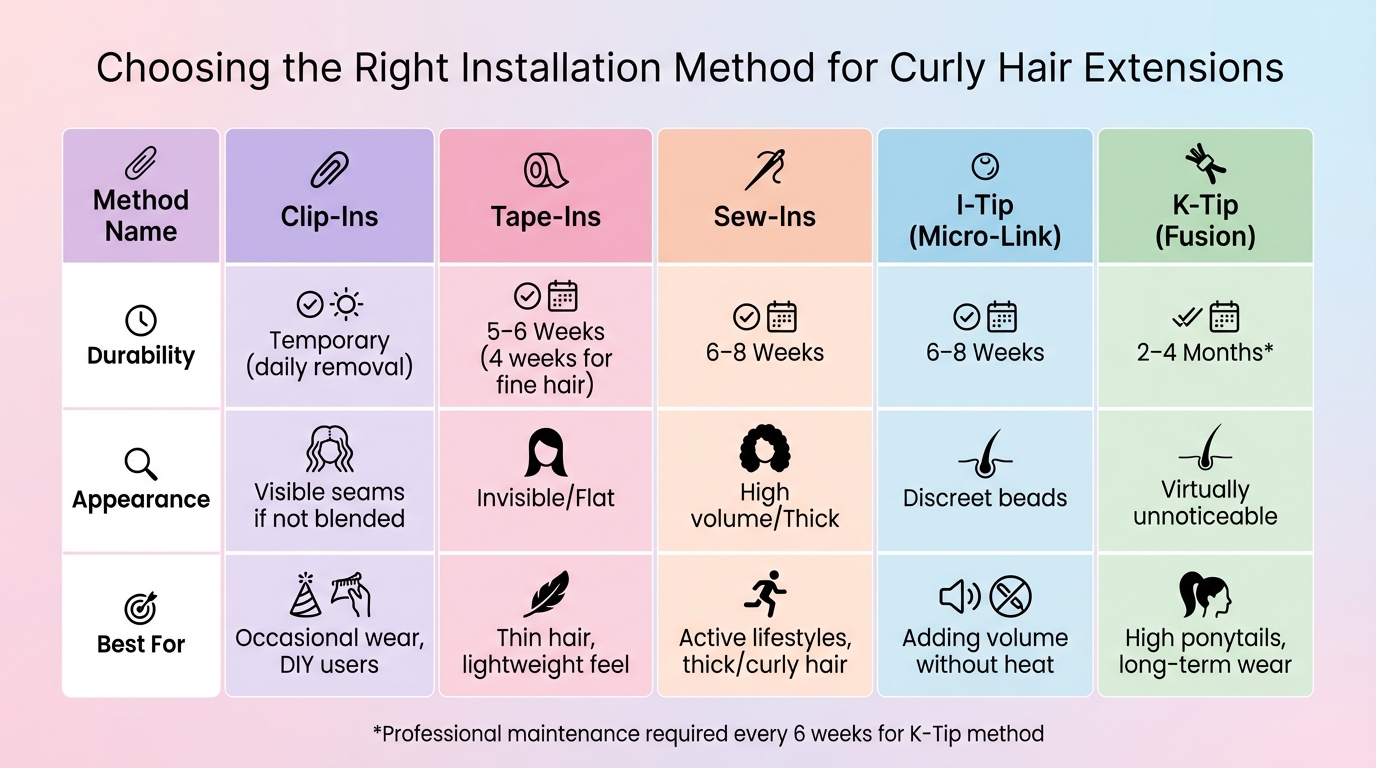
Curly Hair Extension Installation Methods Comparison Chart
Once you've chosen your curl pattern, colour, and preferred length, the next step is deciding how to install your extensions. The right method depends on your lifestyle, how much maintenance you're comfortable with, and how long you want the extensions to last. Here’s a breakdown of the most popular options.
Clip-In Extensions
If you're after a no-commitment option, clip-in extensions are your go-to. These are perfect for anyone who likes to change their look on a whim. You can easily attach them at home, wear them throughout the day, and take them out before bed. Modern clip-ins, featuring Invisi® weft technology, sit snugly against your scalp, giving a polished, professional appearance.
The lightweight design ensures comfort, while the gentle clips minimise any risk of damage to your natural curls. Since clip-ins are designed for temporary use, they should be removed daily and aren’t suitable for overnight wear.
Sewn-In Extensions
For a longer-lasting solution, sewn-in extensions are a fantastic choice. This method involves sewing hair wefts onto a base, which could be a horizontal cornrow braid or a "flat track" created using micro rings in the LA Weave technique. This secure method blends seamlessly with thick or naturally curly hair, offering a natural, voluminous look.
Sewn-in extensions typically last 6–8 weeks before needing maintenance. If properly cared for, the hair itself can be reused for 6–12 months with professional refitting. Installation time varies, ranging from 15 minutes to 1.5 hours, depending on the technique. Genius wefts are a popular choice here - they’re thin like hand-tied wefts but as durable as machine wefts, and they can be customised to fit perfectly. However, sew-ins can feel a bit bulky at the seam and may not be ideal for those with very fine or fragile hair.
Tape-In, Micro-Link, and K-Tip Methods
Tape-ins are thin wefts (about 1 to 1.5 inches wide) that are taped between layers of your natural hair. They’re lightweight, nearly invisible, and a great option for people with fine hair, as they don’t put much strain on the scalp. Maintenance is required every 5–6 weeks (or every 4 weeks for finer hair), as the adhesive needs replacing as your hair grows. After application, avoid washing your hair for 48–72 hours to allow the adhesive to set properly.
Micro-link (I-Tip) extensions are installed using small beads or pliers to attach individual strands of hair. This method is heat-free and ideal for adding volume. On the other hand, K-Tip (U-Tip) extensions use heat to bond keratin tips to your natural hair, creating a seamless look. They’re perfect for styles like high ponytails or updos and can last 2–4 months with professional check-ups every 6 weeks. Both methods require the expertise of a professional to ensure safe application and removal, as improper handling can lead to scalp tension or hair breakage.
| Method | Durability | Appearance | Best For |
|---|---|---|---|
| Clip-Ins | Temporary | Visible seams if not blended | Occasional wear, DIY users |
| Tape-Ins | 5–6 Weeks | Invisible/Flat | Thin hair, lightweight feel |
| Sew-Ins | 6–8 Weeks | High volume/Thick | Active lifestyles, thick/curly hair |
| Fusion (K-Tip) | 2–4 Months* | Virtually unnoticeable | High ponytails, long-term wear |
| I-Tip | 6–8 Weeks | Discreet beads | Adding volume without heat |
*Requires professional maintenance checks every 6 weeks.
sbb-itb-dcde78e
Caring for Curly Hair Extensions
Once your curly hair extensions are installed, keeping them in great shape requires consistent care. Since these extensions don't have natural oils, they need regular moisture to stay soft, maintain their curl, and avoid issues like frizz or tangling.
Daily Care Routine
Start each morning by brushing your extensions gently, working from the ends upward, using a specialised extension brush. Add 1–2 pumps of argan or jojoba oil to the mid-lengths and ends for hydration. Then, spritz your hair with a mix of water and leave-in conditioner to refresh the curls and restore bounce.
Before heading to bed, brush through your extensions again and apply 2–3 pumps of treatment oil. Secure your hair in a loose plait, a gentle ponytail, or a 'pineapple' style to protect the curls overnight. Never sleep with wet extensions, as this can cause severe matting and permanently damage the curl pattern. For extra protection, switch to a silk or satin pillowcase to reduce friction, which helps prevent tangling and frizz.
"Curly hair extensions are dead hair and do not receive nutrients from your scalp. Avoid using products with protein, keratin, sulfates, and high alcohol contents." - Hair Wonderland Care Guide
Daily maintenance is crucial, but washing and drying your extensions correctly is equally important to preserve their curl and moisture.
Washing and Drying Methods
Curly extensions should be washed every 10–14 days to avoid drying them out. Before you wet your hair, gently detangle it with a wide-tooth comb or the Tangle Tamer Brush ($21.95). Use a sulfate-free shampoo and apply conditioner only from the mid-lengths to the ends to avoid loosening the bonds. Wash your hair in a downward motion without scrubbing or twisting, and finish with a cool rinse to seal the cuticles and lock in moisture.
When drying, use a microfibre towel to gently blot your hair - this helps reduce frizz. Air-drying is ideal for maintaining the curl pattern. If you're pressed for time, a blow dryer with a diffuser attachment on the lowest heat setting works, too. Another option is the 'plopping' method: wrap your hair in a microfibre towel or a cotton t-shirt to encourage the curls to form as they dry. While the hair is still damp, apply a curl-defining cream or leave-in conditioner and scrunch the curls upward to help reshape them.
Tools and Products to Use
Using the right tools and products is just as important as your daily routine. For styling, the Styling Comb ($12.95) is perfect for creating neat parts and smoothing edges without straining the hair. To keep your extensions hydrated and shiny, try the Moisture Magic Treatment ($39.95), and use a sulfate-free deep conditioner (around $17.00) weekly to keep the curls soft and manageable.
Always apply a heat protectant spray before using any heated styling tools to prevent damage to the curl pattern. If you're spending time outdoors, protect your hair by wearing a wide-brimmed hat or using a UV-protectant spray, as the sun's heat and UV rays can dry out curly extensions. Before swimming, coat your hair with a leave-in cream to shield it from salt or chlorine, and style it in a low plait for added protection.
Taking these steps ensures your curly extensions stay gorgeous, bouncy, and full of life for as long as possible.
Styling Curly Hair Extensions
Taking care of your curly hair extensions not only keeps them looking great but also opens up a range of styling possibilities. Whether you're going for a polished look or casual waves, the trick lies in using techniques that protect the extensions while achieving your desired style.
Heat-Free Styling Methods
Using heat-free methods is a fantastic way to maintain the natural curl pattern of your extensions and extend their lifespan. Since extensions don’t benefit from the natural oils produced by your scalp, they can be more prone to dryness and damage, especially from heat tools. Start with clean, damp hair and apply a lightweight mousse or curl-enhancing cream. Then, choose one of these heatless styling options:
- Flexi rods: Wrap sections of hair in a windmill motion for tight spirals.
- Overnight braids: Use tight braids for defined waves or loose braids for a softer look.
- Velcro rollers: Opt for jumbo rollers to create volume and lift.
- Pin curls: Wrap damp hair around your finger, starting at the roots, and pin it securely for a defined curl.
Another great option is heatless curling bands - soft, silk-covered rods placed on top of your head to create smooth, uniform waves with minimal frizz. Once your extensions are completely dry, gently separate the curls with your fingers or a wide-tooth comb. Avoid brushing, as it can disrupt the curl pattern.
"Heatless curls are a great way to make sure your hair extensions are staying beautiful, healthy, and long-lasting." - Private Label
If you need to use heat tools, there are ways to do so safely.
Safe Heat Styling Practices
When heat styling is unavoidable, protecting your extensions is essential. Limit the use of heated tools to once or twice a month. Always apply a heat protectant spray or serum - preferably one with silicone or keratin - to seal the cuticle before styling. When blow-drying, attach a diffuser, use medium or low heat, and keep the dryer about 15 centimetres away from your hair. For curling or straightening irons, stick to the lowest effective temperature and avoid contact with extension bonds, tapes, or rings, as heat can damage them.
Natural human hair extensions generally handle heat better than permed ones, which may lose their curl pattern under high temperatures. After styling, apply a small amount of argan or jojoba oil to the mid-lengths and ends to replenish moisture. To maintain your styled look overnight, sleep with your extensions in a silk or satin bonnet or use a silk pillowcase to reduce friction.
Blending Extensions with Your Natural Hair
For a flawless, natural look, blending your extensions with your own hair is key. Have a stylist trim or layer the extensions while they’re installed to avoid any noticeable "ledge" where your natural hair ends. If you have shorter hair, braid or pin the lower sections before attaching the extensions to conceal the transition line.
To ensure a secure hold, tease your natural hair at the roots and apply a light hairspray or dry shampoo before clipping in the extensions. A great blending trick is to curl a small section of your natural hair together with a section of the extension using a curling wand. This helps to blur the line between the two. If your extensions feel too sleek straight out of the box, washing them before the first wear can add volume and texture, making them better match your natural curls. For a soft, face-framing effect, try clipping two-clip wefts diagonally rather than in a straight line.
"Ensuring the extensions blend seamlessly with your natural hair colour and texture is crucial for a cohesive look." - Cliphair UK
Conclusion
Curly hair extensions can completely transform your look when you understand the essentials. The first step? Match the extensions to your unique curl pattern, whether you have loose 2A waves or tight 4C coils. This ensures a seamless and natural blend. And don’t overlook quality - extensions made from 100% Remy human hair not only last longer but also look far more natural compared to synthetic or chemically treated options.
Caring for curly extensions does take more effort than straight ones. A consistent routine is key: keep them hydrated, detangle gently, and schedule professional salon visits every 4–6 weeks. Since extensions don’t get natural oils from your scalp, they depend on external moisture from products like treatment oils and deep conditioning masks. Avoid harsh chemicals to keep them looking their best.
Using the right products also makes a big difference. Hair Wonderland offers 100% Remy European human hair extensions, backed by a 6-week warranty when paired with their recommended care products. Their Seamless Set 22" ($499.00) is known for its durability and natural finish. To protect your investment, consider accessories like the Tangle Tamer Brush ($21.95) and Moisture Magic treatment ($39.95), which are designed to maintain the quality and longevity of your extensions.
FAQs
How can I figure out my curl pattern when choosing extensions?
Understanding your curl pattern is crucial when choosing extensions that blend effortlessly with your natural hair. Curl patterns generally fall into three main categories: wavy (Type 2), curly (Type 3), and coily (Type 4). For instance, if your hair forms loose, S-shaped waves, it’s likely wavy. Tighter corkscrew shapes suggest a curly pattern, while sharp, zigzag-shaped strands point to a coily texture.
To identify your curl type, take a close look at your natural hair under good lighting when it’s clean and free of any products. Focus on the shape, tightness, and overall texture of your curls. Keep in mind that external factors like humidity or your hair care routine can influence how defined your curls appear. For the most natural look, opt for extensions that match your curl pattern as closely as possible. This ensures a seamless blend and a polished, natural finish.
How do I care for curly hair extensions to keep them looking their best?
Proper care for curly hair extensions is essential to keep their texture, shine, and durability intact. Regular visits to the salon every 4–6 weeks are highly recommended, especially if you have finer hair, to ensure both your natural hair and extensions remain in great shape.
At home, stick to gentle, stylist-approved products. Avoid anything containing sulfates, keratin, proteins, or high alcohol content, as these ingredients can harm the extensions. When detangling, use a specialised extension brush and handle the hair with care. If you’re using heat styling tools, always apply a heat protectant spray to minimise frizz and preserve the curls.
For washing, opt for lukewarm water paired with a mild, sulfate-free shampoo, followed by a rich, nourishing conditioner. Don’t over-wash, as this can lead to dryness. Let the extensions air dry whenever possible, or use low heat settings if needed. With consistent, gentle care and the right products, your curly extensions will remain soft, bouncy, and stunning for much longer.
What’s the best way to blend curly hair extensions with my natural curls?
To seamlessly blend your curly hair extensions with your natural curls, start by carefully detangling both. Use a wide-tooth comb or a brush designed for extensions to minimise frizz and prevent breakage. If you’re finding it tricky, a light mist of detangling spray can make the process smoother.
When it comes to styling, apply a curl-defining product or serum to both your natural hair and the extensions. This step enhances the texture while keeping frizz under control. If you plan to use heat tools, don’t skip the heat protectant spray - it’s key to preserving the curl pattern and avoiding damage. However, try to limit heat styling to keep your extensions looking their best for longer.
For ongoing care, wash your extensions with sulphate-free shampoos and conditioners. Steer clear of products with high alcohol content, as these can dry out the hair. By following these steps, you’ll keep your curls looking healthy, bouncy, and perfectly blended for a polished, natural finish.