


When caring for hair extensions, leave-in conditioners and serums are two key products that serve different purposes. Extensions lack natural scalp oils, so these products help maintain hydration, protect against damage, and keep them manageable.
- Leave-in conditioners: Lightweight, water-based products that hydrate deeply, reduce tangles, and protect against heat and UV rays. Best applied to damp hair after washing.
- Serums: Silicone- or oil-based treatments that coat the hair surface, control frizz, add shine, and shield against humidity. Ideal as a finishing touch on dry hair.
Key takeaway: Use leave-in conditioner for hydration and detangling, and serum for frizz control and shine. Combining both in your routine can extend the life of your extensions.
Quick Comparison
| Feature | Leave-In Conditioner | Hair Serum |
|---|---|---|
| Purpose | Hydration, detangling | Shine, frizz control |
| Formulation | Water-based, lightweight | Silicone- or oil-based |
| Application | Damp hair after washing | Dry hair after styling |
| Hydration Level | High (deep hydration) | Low (surface hydration) |
| Frizz Control | Moderate | High |
| Heat Protection | Often included | Excellent |
Focus on applying both products to the mid-lengths and ends, avoiding the roots to prevent bond slippage. Together, they help maintain soft, smooth, and healthy-looking extensions.
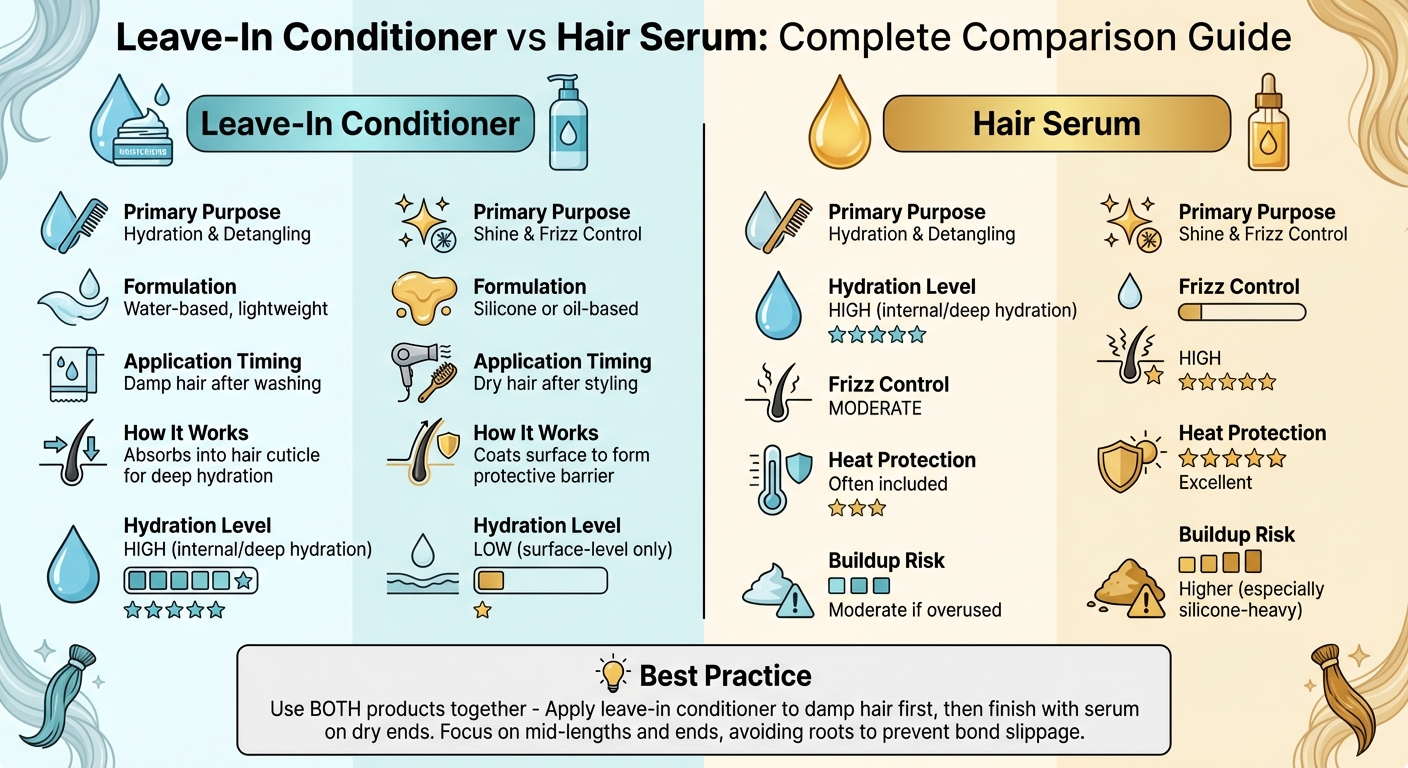
Leave-In Conditioner vs Hair Serum for Extensions Comparison Chart
Kerastase Serums, Leave-ins and Oils: EXPLAINED! | guide + review
What is a Leave-In Conditioner for Extensions?
A leave-in conditioner is a lightweight haircare product designed to hydrate and protect your extensions without the need to rinse it out. It keeps extensions soft, detangled, and shields them from daily wear and environmental factors. Unlike natural hair, extensions don’t benefit from the scalp’s natural oils, so they rely entirely on external products for moisture. Most leave-in conditioners are sulfate-free, paraben-free, and low in alcohol to avoid drying out the strands or weakening the bonds that hold your extensions in place. Let’s break down how these products work to maintain your extensions in top shape.
How Leave-In Conditioner Works
The magic of leave-in conditioners lies in their ingredients. They typically include glycerin (to attract moisture), panthenol (Provitamin B5), lactic acid, botanical extracts, and shea butter. Together, these components hydrate, smooth, and protect each strand.
- Glycerin and panthenol draw moisture into the hair and seal it in.
- Lactic acid helps relax the cuticle, reducing frizz and tangles.
- Botanical extracts like bamboo or Australian fruits provide minerals and antioxidants to nourish the hair.
- Shea butter delivers fatty acids and Vitamins A and E, restoring shine and combating dryness.
These ingredients work in harmony to address the specific needs of extensions, keeping them looking and feeling their best.
Benefits for Hair Extensions
By locking in moisture and smoothing the cuticle, leave-in conditioners tackle two of the biggest challenges for extensions: dryness and tangling. They also provide a protective barrier against heat styling, UV rays, and environmental stressors like chlorine or salt water.
To use, apply the conditioner to damp, towel-dried hair, focusing on the mid-lengths to the ends. Avoid the roots to prevent bond slippage. If you’re heading for a swim, applying leave-in conditioner beforehand can create a shield against harsh chemicals like chlorine.
What is a Serum for Extensions?
A hair serum is a liquid treatment that coats the surface of your hair rather than soaking in like traditional oils. Think of it as a protective barrier that sits on each strand. Since extensions don’t produce natural sebum, serums provide the hydration and protection they need from external sources.
Serums designed for extensions often contain silicones to smooth and oils like argan or jojoba to moisturise. They’re carefully formulated without sulphates, high alcohol content, or even proteins and keratin, which can make extensions hard to manage or prone to breakage. As L'Oréal Professionnel puts it:
Hair serum is a liquid-based treatment usually formulated using silicones that provide a protective layer over the hair fibre, assisting in smoothing frizz.
This unique formulation offers multiple benefits, which we’ll break down below.
How Hair Serum Works
Hair serums work by coating the cuticle, sealing in moisture, and reflecting light to give a shiny appearance. They also protect against external stressors like pollution, humidity, and heat. Silicones such as dimethicone and cyclomethicone smooth the cuticle, while natural oils add nourishment and softness.
By sealing the cuticle, serums not only lock in hydration but also make detangling easier, reducing the risk of breakage. Many serums also include UV filters to protect colour-treated extensions from fading - especially important under Australia’s intense sun.
These features make serums a must-have for maintaining the health and appearance of your extensions.
Benefits for Hair Extensions
Serums help tame flyaways and give your extensions a sleek, polished look without weighing them down. Since extensions don’t get natural moisture from the scalp, using a serum regularly is key to keeping them hydrated and extending their lifespan.
For best results, apply 1–2 pumps of serum to the mid-lengths and ends, steering clear of the roots to avoid loosening the bonds. Use it on damp hair after washing to lock in moisture, or on dry hair post-styling to control frizz and add shine. With consistent use, a good serum can help your extensions last up to 12 months by preventing brittleness and breakage.
Leave-In Conditioner vs Serum: Key Differences
Let’s break down the contrast between leave-in conditioners and serums to help you understand their roles better. Leave-in conditioners are designed to deeply hydrate by penetrating the hair shaft, while serums focus on coating the hair surface, providing protection and enhancing shine.
Leave-in conditioners are typically water-based with a lightweight, milky consistency. They often feature nourishing ingredients like jojoba oil, aloe vera, and shea butter. On the other hand, serums are highly concentrated, usually silicone- or oil-based, with a slick texture. While leave-in conditioners work by absorbing into the hair to deliver moisture, serums form a protective barrier that locks in shine and shields against humidity.
Their application methods also differ. Leave-in conditioners are best applied to towel-dried hair after washing, making detangling easier and providing hydration from within. Serums, however, can be used on both damp and dry hair, although they shine (literally!) as a finishing touch on dry hair to seal in moisture and fight frizz. For both products, focus application on the mid-lengths and ends to avoid issues like bond slippage.
Comparison Table
Here’s a quick side-by-side look at how these products differ:
| Feature | Leave-In Conditioner | Hair Serum |
|---|---|---|
| Primary Goal | Hydration and nourishment | Shine and frizz control |
| Formulation | Water-based, lightweight milk or cream | Silicone- or oil-based, slick |
| How It Works | Absorbs into the hair cuticle for deep hydration | Coats the surface to form a protective barrier |
| Application Timing | Best on towel-dried hair | Works on damp or completely dry hair |
| Hydration Level | High (internal) | Low (surface-level) |
| Frizz Control | Moderate | High |
| Heat Protection | Often included | Excellent with silicone-based formulas |
| Buildup Risk | Moderate if overused | Higher, especially with silicone-heavy formulas |
| Extension Benefit | Prevents breakage and matting | Adds shine and blocks humidity |
This breakdown highlights how each product serves a distinct purpose, especially when it comes to hair extension care.
sbb-itb-dcde78e
When to Use Each Product
Use leave-in conditioner for deep hydration and serum for surface-level protection. Hairstylist Michelle Lee from Salon Eva Michelle highlights the importance of proper product layering:
Knowing the correct order of application for your hair is just as important as your skincare routine... Products penetrate differently in your hair, and the right order ensures proper use and benefits.
Here’s a guide to help you decide when to use each product.
When to Use Leave-In Conditioner
Leave-in conditioner works best when applied immediately after washing. On towel-dried extensions, focus the product on the mid-lengths and ends to minimise breakage. Before heat styling, layer leave-in conditioner first, followed by a heat protectant.
If you're planning to swim, rinse your extensions with tap water and apply a leave-in cream to shield against saltwater or chlorine damage. Spending time outdoors? Opt for a leave-in spray with UV protection to guard against sun exposure and colour fading. For extensions that are dry, porous, or chemically treated, leave-in conditioners provide the hydration that serums alone cannot.
Now, let’s explore how and when to use serum effectively.
When to Use Serum
Serum is your go-to for taming frizz and adding shine, but it’s best applied to dry hair. Use it as a finishing touch on styled hair, applying 1–2 pumps to the mid-lengths and ends for daily frizz control and a polished look.
In humid conditions, silicone-based serums are ideal for forming a barrier that blocks frizz. Consumer Hair Editor Karen Marie Shelton explains:
In general, serums are used after hair is 100% dry to seal in hydration and block out humidity and frizz causing environmental factors.
For fine extensions, choose a lightweight serum to avoid weighing them down. Keep serum away from the bonds or tapes, as it can compromise attachment.
Using Both Products Together
Combining a leave-in conditioner with a serum creates a care routine that mimics the natural oils your extensions would typically get from your scalp. The secret lies in the order of application: start with a lightweight leave-in conditioner on damp hair, then finish with a serum on the dry ends.
Begin with freshly washed, towel-dried extensions. Spray the leave-in conditioner from mid-shaft to ends and gently comb through to distribute it evenly. Once the hair is dry, take a small amount of serum, rub it between your palms, and apply it to the ends. This seals in moisture and adds a layer of protection against humidity.
This two-step process does more than just hydrate - it also offers chemical protection for your extensions. AIIR Professional explains the science behind it:
Leave-in conditioner penetrates the hair's cuticle to boost moisture and heal damage, while hair oil flattens the hair's cuticle for a super-shiny finish.
This method is especially helpful for premium extensions like those from Hair Wonderland, which are made from 100% Remy European hair. Since these extensions don’t benefit from natural scalp oils, daily hydration is crucial. For the best results, use 1–2 pumps in the morning to style and 2–3 pumps in the evening to replenish moisture.
Be careful to avoid applying oils near bonds, tapes, or rings, as they can weaken adhesives and lead to slippage. Concentrate on the mid-lengths and ends where the extensions need the most care. With proper maintenance and layering, high-quality Remy human hair extensions can last up to 12 months.
Conclusion
Knowing how leave-in conditioners and serums work differently allows you to customise your care routine and keep your extensions looking their best. Leave-in conditioners are perfect for hydrating and detangling, while serums excel at adding shine and taming frizz. Since extensions don't produce natural oils, these products play a crucial role in replenishing moisture and protecting against damage. As Angel Extensions puts it:
Hydration is your extensions' best friend... Investing in high-moisturising products helps maintain that beautiful shine and combat frizz, ensuring that your extensions last longer.
With the right care, high-quality Remy human hair extensions can be reused for up to 12 months, and darker shades may last even longer - between 12 and 18 months. To preserve their quality, apply these products to the mid-lengths and ends, steering clear of bonds and tapes. Opt for sulfate-free and alcohol-free products to avoid stripping away essential moisture.
Ultimately, the choice between these products depends on what your extensions need most. Using both in a thoughtful, layered approach can enhance their longevity and keep them vibrant.
For those who value premium extensions, Hair Wonderland offers double-drawn Russian/Mongolian human hair extensions that are crafted for durability and comfort. However, proper care is essential to maximise their performance.
Check out Hair Wonderland's collection of extensions and care tools, like the Tangle Tamer Brush ($21.95) or the Clip In Bag ($54.00), to keep your extensions looking salon-fresh for months.
FAQs
Can I use leave-in conditioner and serum together on my hair extensions?
Yes, you can use both leave-in conditioner and serum on your Hair Wonderland extensions, but getting the order and quantity right is key. After washing your extensions, start by applying a sulphate-free leave-in conditioner to the mid-lengths and ends while the hair is still damp. This step helps replenish moisture and makes detangling much easier. Once the hair is towel-dried or slightly damp, follow up with a few drops of a lightweight serum. The serum locks in hydration, adds shine, and helps control frizz.
Since extensions don’t produce natural oils like your own hair, combining these products is essential for proper care. The leave-in conditioner provides hydration, while the serum creates a protective layer for added smoothness and gloss. Be mindful not to overdo it - apply sparingly and keep serum away from the bonds or attachment points to avoid any slippage. Depending on how dry your extensions feel, you can follow this routine daily or a few times a week to keep them looking their best.
How can I prevent my hair extensions from slipping when using leave-in conditioner or serum?
To keep your extensions in place and looking their best, steer clear of applying any liquid or oily products near the bonds where the extensions are attached. Products like leave-in conditioners or serums can weaken the adhesive or micro-weave if they come into contact with the roots or attachment points. Instead, focus on using these products from the mid-lengths to the ends of your extensions.
For optimal results, give the bonds at least 24 hours to settle after installation before introducing any products. When you're ready to apply, start by gently brushing your extensions with a detangling or boar-bristle brush to remove any tangles. Use a small amount of leave-in conditioner or serum, ensuring it's evenly distributed through the mid-lengths and ends while avoiding the roots. If you're rinsing out a product, take care to keep it away from the bonds. Allow your hair to air-dry or use a low-heat setting on your dryer to prevent any damage. When styling, apply heat protectant only to the mid-lengths and ends to preserve the bonds' strength.
By following these steps, your Hair Wonderland extensions will stay secure, hydrated, and beautifully shiny.
What are the benefits of using a serum on hair extensions?
Hair serums can work wonders for maintaining your extensions, making them a must-have in your hair care routine. These lightweight, oil-based products are designed to seal in moisture, ensuring your extensions stay soft, silky, and free from the dryness or brittleness that can result from frequent washing or styling.
Beyond hydration, serums act as a shield against damage from heat tools, humidity, and everyday friction. This protective layer helps minimise frizz, split ends, and breakage, keeping your extensions looking their best. Many serums also include ingredients that enhance shine, giving your extensions a smooth, glossy finish that blends effortlessly with your natural hair.
Using a serum is an easy yet effective way to keep your extensions looking healthy and vibrant for longer.