


When choosing hair extensions, it's not just about appearance. The source and production of extensions have significant impacts on people, the environment, and product quality. Ethical hair extensions come from voluntary donations with fair compensation and transparent sourcing, ensuring high quality and durability. Non-ethical extensions often involve exploitation, harsh chemical processing, and poor quality.
Key Points:
- Ethical Extensions: Sourced from voluntary donors (e.g., Indian temples), fair wages, traceable origins, and superior quality (lasts 12–24 months).
- Non-Ethical Extensions: Often involve exploitation, untraceable origins, harsh chemicals, and lower quality (lasts 1–3 months).
- Environmental Impact: Ethical brands use sustainable practices like cold bleaching and recyclable packaging, while non-ethical options contribute to pollution and waste.
Quick Comparison
| Feature | Ethical Extensions | Non-Ethical Extensions |
|---|---|---|
| Sourcing | Voluntary, fair compensation | Exploitation, untraceable |
| Quality | Remy hair, durable (12–24m) | Non-Remy, short lifespan (1–3m) |
| Processing | Minimal chemicals, eco-friendly | Harsh chemicals, pollutants |
| Price | Higher upfront cost | Cheaper, but frequent replacement needed |
| Social Impact | Supports communities | Exploits vulnerable populations |
Choosing ethical extensions means better quality, longer-lasting results, and supporting fair practices. Non-ethical options may be cheaper but come with hidden costs for people and the planet.
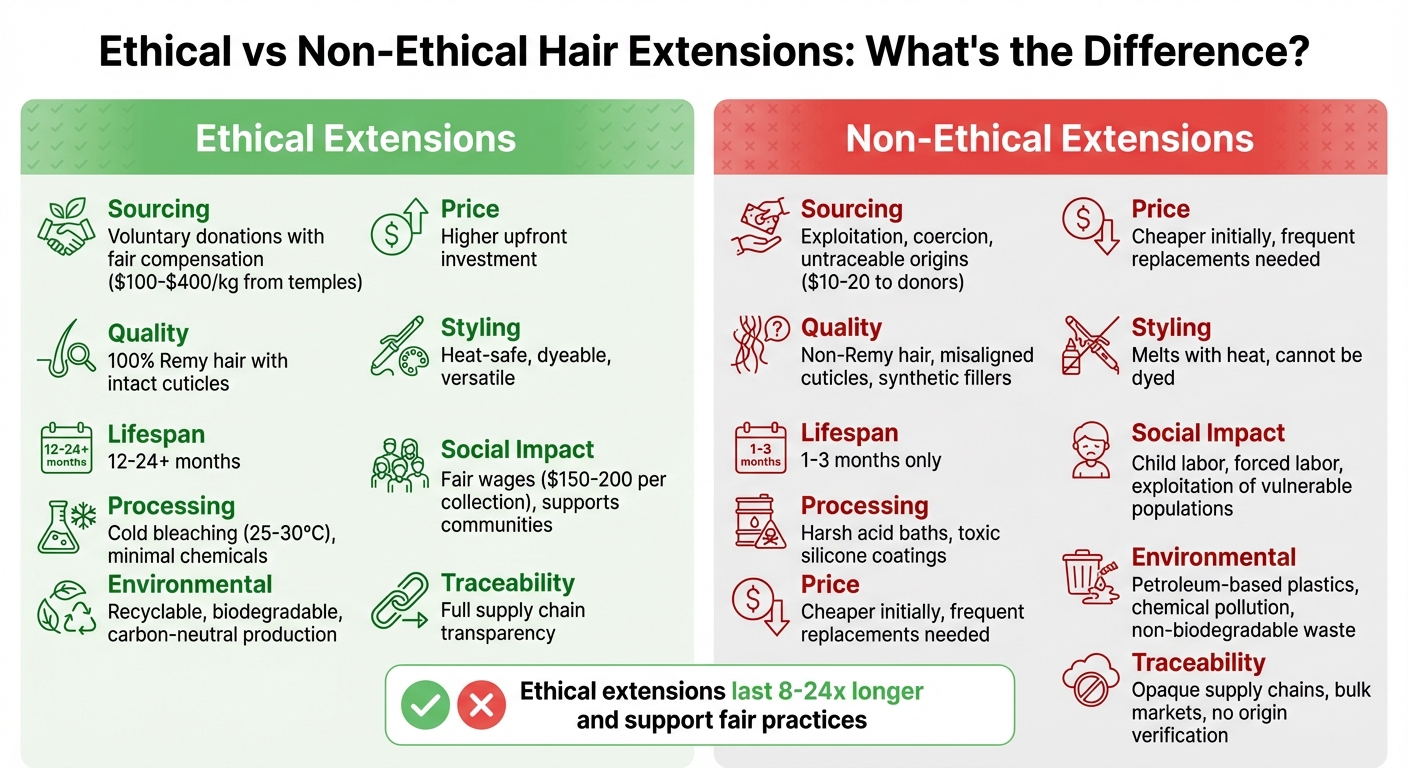
Ethical vs Non-Ethical Hair Extensions Comparison Chart
What Makes Hair Extensions Ethical?
Core Principles of Ethical Sourcing
Ethical hair extensions are built on three key principles: voluntary donation, fair payment, and traceability. These practices ensure respect for individuals, fair treatment, and transparency throughout the supply chain. Let’s break this down.
Voluntary donation means hair is given freely, without coercion. A great example of this is Indian temple donations. During religious tonsuring ceremonies, devotees shave their heads as an act of faith. Temples then auction the hair for $100 to $400 per kilogram, with the proceeds funding essential community services like healthcare and education.
Fair compensation is another critical factor. Dan Angus, the CEO of Remy Cabello, takes a hands-on approach by sourcing hair directly from women in rural Southeast Asia. He pays £150 to £200 per collection - about ten times the $15 to $20 typically offered by unethical brokers. This fair payment can be transformative for these women and their families.
Traceability ensures accountability at every step. For instance, Great Lengths, the only hair extension brand with B Corp certification, sources hair exclusively from Indian temples like Tirupati Venkateswara, maintaining full traceability from donation to the final product. Similarly, Loxys enforces strict standards: donors must be over 19 years old, and their leadership personally inspects factory conditions to ensure ethical practices.
"If you're not there, you don't actually know where that hair has come from." – Dan Angus, CEO, Remy Cabello
In contrast, unethical sourcing thrives on secrecy and exploitation.
Non-Ethical Practices and Their Consequences
Non-ethical hair sourcing operates in the shadows, relying on exploitation and unverified origins. Instead of respecting donors, these practices often gather "waste hair" from places like salon floors, brushes, drains, and even sewers. This hair undergoes harsh chemical treatments, and the resulting waste is often dumped into local waterways, polluting the environment.
Coercion is another hallmark of unethical practices. In impoverished areas of Cambodia and Vietnam, brokers pressure women to sell their hair for as little as $10 to $20 - just a fraction of its real worth. Investigations have uncovered horrifying conditions in some factories, including child labour (with children as young as three) and accounts of prisoners being forced to shave their heads without compensation.
The lack of traceability is what allows these abuses to continue. Hair often passes through multiple middlemen and bulk markets, making it impossible to verify its origin. Dr Sarah Daniels, a social ethics expert from Georgetown University, highlights the human toll of such practices:
"These women are being deceived. They're robbed of something that often has emotional or cultural significance, for a fraction of its worth." – Dr Sarah Daniels, Georgetown University
Without transparency, buyers have no way of knowing if the hair was freely donated or obtained through exploitation. This lack of accountability perpetuates unethical practices across the industry.
Quality and Durability Differences
Ethical Extensions: Higher Quality Standards
Ethical hair extensions are crafted from Remy hair, which retains the cuticle intact and aligned. This meticulous process reduces tangling and ensures a smooth, shiny finish that mimics natural hair perfectly.
These extensions are often double-drawn, meaning shorter hairs are removed to maintain consistent thickness from root to tip. The sourcing of hair also plays a major role - Russian and European hair, prized for its ultra-soft and fine texture, blends effortlessly with natural hair. Plus, Remy extensions allow for heat styling, curling, and even dyeing. With proper care, these extensions can last anywhere from 12 to 24 months or even longer. This commitment to quality delivers results that look and feel natural while standing the test of time.
"Ethical standards don't just protect donors and workers, they also mean higher-quality hair, safer processing, and longer-lasting results" – Kate Gardien, Hair by Loxys
Non-Ethical Extensions: Frequent Problems
Non-ethical extensions, on the other hand, often use non-Remy hair, where the cuticles are misaligned. This leads to frequent tangling and matting. In many cases, these extensions are made from synthetic fibres or non-Remy hair coated with silicone to create a temporary shine. Unfortunately, this coating quickly wears off, revealing brittle and damaged strands underneath.
Synthetic extensions have a distinct, plastic-like texture that lacks the softness and sheen of real hair. They cannot withstand heat styling and are prone to melting. Additionally, their lifespan is short - lasting only one to three months before needing replacement.
"This factory hair... has a short wear-time and will never look as natural and beautiful as you like" – LDL International
Quality Comparison Table
Here’s a side-by-side look at how ethical and non-ethical extensions measure up:
| Feature | Ethical (Remy Human Hair) | Non-Ethical (Synthetic/Non-Remy) |
|---|---|---|
| Texture | Soft, silky, and natural with intact cuticles | Stiff, plastic-like, and unnaturally shiny |
| Lifespan | Approximately 12 to 24+ months | 1 to 3 months |
| Styling | Can be curled, straightened, and dyed | Prone to melting under heat; not dyeable |
| Maintenance | Minimal tangling; behaves like natural hair | High tangling and matting |
| Composition | 100% human hair with no fillers | Often contains synthetic fibres or silicone coatings |
Environmental and Social Effects
Eco-Friendly Practices in Ethical Extensions
Ethical hair extension brands are stepping up to minimise their environmental impact in creative ways. One standout method is cold bleaching technology, which processes hair at a gentle 25°C–30°C over several days. This avoids the need for harsh acid treatments or synthetic dyes, preserving the hair's integrity.
Waste reduction is another major focus. Extensions that have outlived their purpose find new uses through programs like Matter of Trust, where discarded hair becomes oil spill cleanup mats. Some brands even donate old extensions to create wigs for children dealing with medical hair loss [11, 24]. Companies like Great Lengths take it further by recycling water at their production sites and running carbon-neutral offices.
When it comes to packaging, ethical brands are ditching plastic for recyclable materials and FSC-certified paper. They’re also opting for bulk shipping to cut down on emissions [11, 24]. Some brands are even experimenting with biodegradable options like banana fibre braids, which naturally decompose, unlike petroleum-based synthetics.
"We lower wastage through clever practices including the use of recycled water in our manufacturing and using hair unsuitable for extensions for other things." – Great Lengths
These efforts clearly set ethical brands apart from their less sustainable counterparts.
The True Cost of Non-Ethical Extensions
Non-ethical hair extensions come with a hefty environmental and social price. Many are made from petroleum-based plastics, which linger in landfills and contribute to pollution. A staggering 90% of hair extensions globally are processed in China, where transparency around chemical use is limited. Factories often rely on harmful acid baths and silicone coatings, which pollute nearby water sources and add to the industry's carbon footprint [20, 22].
The social consequences are equally troubling. In countries like Cambodia and Vietnam, hair traders exploit vulnerable families, pressuring women and children to sell their hair for as little as $10. There are even reports of hair theft, highlighting the unethical practices tied to this industry.
"These women are being deceived. They're robbed of something that often has emotional or cultural significance, for a fraction of its worth." – Dr. Sarah Daniels, Expert in Social Ethics, Georgetown University
While donors receive mere pennies, the final products often sell for hundreds or even thousands of dollars in Western markets. Despite the human hair extension industry being projected to hit $3.9 billion in revenue by 2024, those supplying the raw material see almost none of the profits. Alarmingly, in 2020, 38% of the 100 million hair units sent to Africa were counterfeit, often mixed with synthetic fibres or animal hair like horse or yak.
Environmental Impact Comparison Table
| Feature | Ethical Hair Extensions | Non-Ethical/Synthetic Extensions |
|---|---|---|
| Material | 100% human Remy hair or plant fibres (e.g., banana) | Plastic fibres (petroleum-based) or mixed human/animal hair |
| Chemical Treatment | Cold bleaching at 25°C–30°C; no acid baths or silicone | Harsh acid baths, textile dyes, silicone coatings |
| Packaging | Recyclable materials; FSC-certified paper; plastic-free | Standard plastic packaging |
| End-of-Life | Recyclable (e.g., oil spill mats) or biodegradable | Non-biodegradable; adds to landfill waste |
| Carbon Footprint | Often carbon neutral; locally sourced | High emissions from opaque global supply chains |
| Water Usage | Recycled water systems in production | No water conservation; chemical runoff into waterways |
Certifications and Transparency Standards
Recognised Certifications for Ethical Extensions
The hair extension industry doesn't have a single, universal certification system, which means buyers need to rely on various indicators to assess ethical practices. One standout is B Corp Certification, which evaluates a business's social and environmental impact across its entire operations.
Leaders in the industry also adhere to frameworks like the UN Global Compact principles and the Materials Matter Standard, which becomes mandatory in December 2025. These ensure fair pricing, ethical sourcing, and responsible production of raw materials.
Some companies go further by conducting independent social compliance audits and tracking their supply chains to verify supplier standards.
"We have found that hair collectors and factories have desired to rise up and improve not only transparency, but also traceability. The onus comes on the brands to say here's the standard, here's how to get there." – Derrick Porter, CEO, Beauty Industry Group
The next step is recognising when claims of ethical sourcing are just marketing spin.
How to Identify Misleading Claims
Without proper verification, ethical sourcing claims can become little more than marketing buzzwords. Kate Gardien, writing for Loxys, highlights this challenge:
"There's no universal certification system for ethically sourced hair. That makes it hard to tell who's genuinely committed to good practice, and who's just using the language to increase sales".
Here are some warning signs to watch for:
- Bulk resellers or middlemen: Brands buying from these sources can't guarantee the hair wasn't collected unethically, such as being swept from temple floors or taken without consent.
- Opaque supply chains: If a company doesn't disclose factory locations, supplier relationships, or processing methods, it raises questions about their practices. Non-independent audits are another red flag, as they lack objectivity.
- Suspiciously low prices: Hair that’s unusually cheap might suggest exploitative labour, poor compensation for donors, or harsh chemical treatments.
To ensure you're supporting ethical practices, ask detailed questions. For example, inquire about the length of the brand’s relationship with its manufacturers, whether factories have been personally inspected, and what steps are taken to confirm donor consent. Truly ethical brands can trace their hair back to specific temples or voluntary donors, rather than relying on generic "bulk markets".
Certification Standards Table
The table below outlines key certification standards and highlights where unethical practices often fall short.
| Certification/Standard | Focus Area | Ethical Sourcing Benefits | Common Failures in Non-Ethical Practices |
|---|---|---|---|
| B Corp | Social & Environmental Impact | Ensures fair labour, transparency, and accountability across the business | Often skips external audits of business practices |
| UN Global Compact | Human Rights & Labour | Upholds international standards for human rights and anti-corruption | May involve forced labour or poor factory conditions |
| Materials Matter Standard | Raw Material Production | Sets strict guidelines for land use, water, energy, and labour conditions | Fails to address environmental or social impacts effectively |
| Traceability Systems | Supply Chain Transparency | Tracks the journey from donor to consumer | Relies on bulk markets with no origin or consent documentation |
| ILO Conventions | Labour Standards | Protects against child labour, ensures fair wages, and promotes safe workplaces | Often involves unsafe conditions or child labour |
sbb-itb-dcde78e
Why Ethical Hair Extensions Matter for Australian Buyers
A Quality Choice for Personal and Professional Use
When Australian consumers choose ethical hair extensions, they’re making a decision that prioritises both quality and longevity. Ethically sourced Remy hair is known for its durability and natural appearance. By keeping the cuticles intact and aligned, these extensions resist tangling and maintain their natural shine. With proper care, they can last for at least two years - far outlasting non-ethical alternatives, which often show wear and tear within months.
Extensions made from double-drawn hair take quality a step further. With 70–80% of strands matching in length, they create thicker, fuller results. Hair Wonderland’s premium double-drawn Russian and Mongolian extensions are a perfect example, offering salon-level results that blend seamlessly with your natural hair while maintaining their density throughout their lifespan.
"Remy hair is the best option if you want to get beautiful natural hair extensions... These are high-quality products that have undergone delicate processing without the use of aggressive and harmful chemicals".
The gentle, chemical-free processing of these extensions ensures the hair retains its natural strength and elasticity. But beyond just the quality, choosing ethical hair extensions also means supporting fair trade practices and environmental responsibility.
Championing Fair Trade and Sustainability
Ethical hair extensions in Australia symbolise a commitment to fair trade and sustainability. Great Lengths Australia stands out as the only hair extension brand globally to achieve B Corp certification. Their Sydney office operates as 100% carbon-neutral, and they’ve swapped out plastic packaging for FSC-certified paper in their shipping process. Additionally, they partner with the Little Princess Trust, donating used extensions to create wigs for children undergoing cancer treatment.
The social benefits of ethical sourcing are profound. Hair donated through Indian temples - one of the primary sources - fetches between $100 and $400 per kilo. This money is reinvested into the local community, funding essential services like food, housing, and medical care. In contrast, non-ethical sourcing often involves coercion or exploitation.
Australian brands also play a role in supporting local communities and promoting sustainable practices.
"When you invest in ethically sourced, high-quality Remy hair extensions, you not only guarantee a superior product, but you also take a stand against exploitation".
For Australian buyers, these purchases go beyond aesthetics. They support transparent supply chains, ensure fair compensation for workers, and uphold environmentally responsible practices - values that strongly align with local priorities.
Great Lengths - Ethically Sourced Hair Extensions
Conclusion: Making an Informed Choice
Choosing ethical hair extensions isn't just about aesthetics - it's about investing in quality and making a positive impact. Ethically sourced Remy hair can last anywhere from 6 months to over 2 years, far outlasting the typical 3-month lifespan of non-ethical options. This durability comes from intact cuticles and minimal chemical treatment, keeping your extensions soft, tangle-free, and stunning throughout their use.
Your purchase has the power to do good. Ethical sourcing ensures fair wages and safe working environments, while temple hair auctions provide funding for vital community programs. On the flip side, non-ethical practices often exploit vulnerable populations.
"If a company isn't willing to be transparent about its sourcing process, then there is probably a reason."
There’s also an environmental advantage. Ethical hair extensions are biodegradable and free from harsh chemicals, unlike synthetic options made from petroleum-based materials that add to plastic pollution. These factors combined make choosing ethical extensions a decision that benefits both you and the world around you.
FAQs
How can I tell if the hair extensions I’m buying are ethically sourced?
To make sure your hair extensions are sourced responsibly, focus on brands that openly share their sourcing practices. Ethical hair sourcing means the hair comes from donors who willingly contribute, either through donations or fair payment, without any exploitation or pressure.
Since there isn’t a standard global certification for ethical sourcing, doing your own research is key. Trustworthy companies often provide clear details about their supply chain, such as sourcing hair from temple donations where donors are respected and compensated fairly. On the other hand, steer clear of brands that rely on questionable or exploitative methods to collect hair. By supporting brands that prioritise ethical practices, you can feel confident that your extensions are both responsibly sourced and of excellent quality.
What are the environmental advantages of ethical hair extensions?
Ethical hair extensions offer a more eco-friendly option compared to synthetic ones. Synthetic extensions are typically made from plastics like polyester and PVC. These materials come from non-renewable resources and take hundreds of years to decompose, adding to pollution and releasing microplastics into waterways.
On the other hand, ethically sourced human hair is biodegradable and decomposes naturally without causing environmental harm. These extensions are gathered responsibly, often through fair trade initiatives and voluntary contributions. Opting for ethical hair extensions helps minimise environmental impact while supporting responsible practices, making them a better choice for those who prioritise sustainability.
Why do ethically sourced hair extensions last longer than non-ethical ones?
Ethically sourced hair extensions tend to have a longer lifespan because they are collected with care and go through minimal chemical treatments. This preserves the hair's natural strength, softness, and quality, making it less prone to tangling and more durable over time.
On the other hand, non-ethical extensions are often made from hair that has been heavily processed or exposed to harsh chemicals. This can weaken the strands, leading to problems like shedding, tangling, and breakage. Choosing ethical extensions not only offers better durability but also promotes fair and responsible practices.